
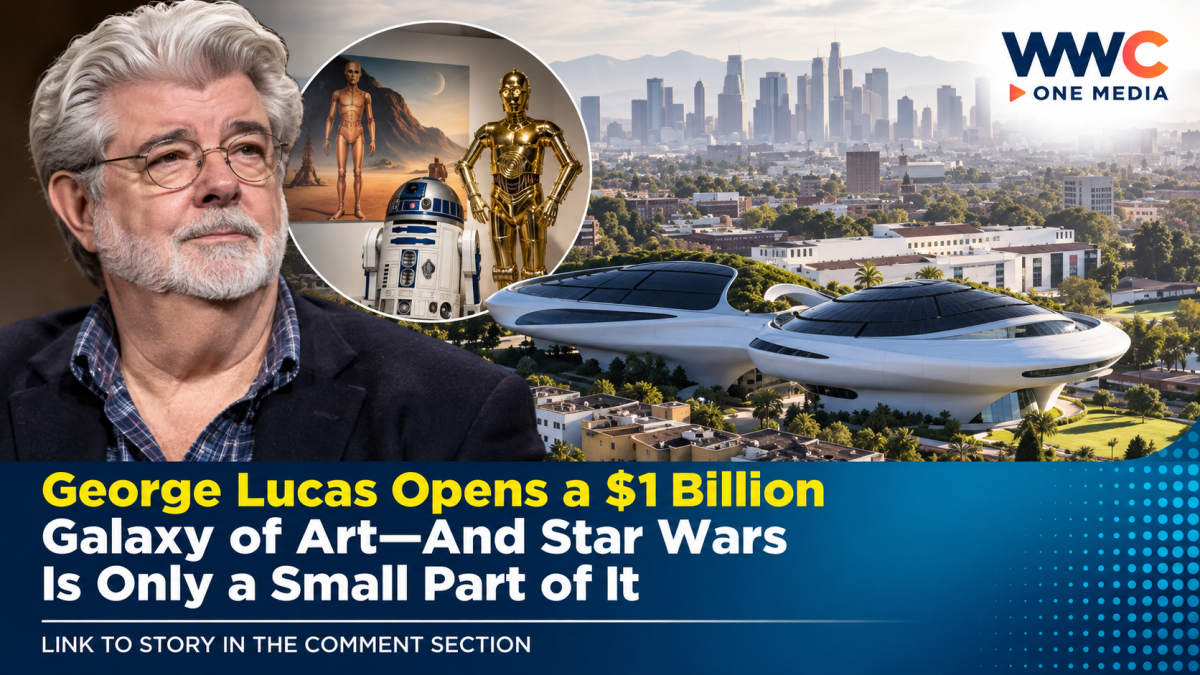
LOS ANGELES — George Lucas gave the world Star Wars, lightsabers, Darth Vader and one of the most famous galaxies in movie history.
But his latest creation is designed to take visitors far beyond a galaxy far, far away.
After years of planning, delays and changing locations, the Lucas Museum of Narrative Art is finally preparing to open its doors in Los Angeles — and despite the name behind it, this is not simply a museum filled with Star Wars memorabilia.
In fact, Star Wars occupies only a small fraction of the museum’s enormous gallery space.
Instead, the US$1 billion institution is built around a much bigger idea: celebrating the power of visual storytelling, from ancient art and classic paintings to comic books, movie props, manga and popular illustration.
George Lucas calls it a “temple to the people’s art.”
Star Wars Fans Will Still Find Plenty to Love
That does not mean Lucas is leaving Star Wars behind.
Visitors will be greeted by a bright yellow Naboo N-1 Starfighter displayed in the museum’s public research library.
The opening cinema exhibition, Star Wars in Motion, will feature vehicles, props, costumes and production artwork from the first six films in Lucas’ saga.
Among the highlights are production versions of:
- Luke Skywalker’s Landspeeder
- Speeder bikes from Return of the Jedi
- General Grievous’ Wheel Bike
- R2-D2
- C-3PO costumes and production materials
- Original Star Wars concept art and illustrations
The exhibition is designed to explore how movement, vehicles and visual design helped bring Lucas’ cinematic universe to life.
But museum officials have stressed that Star Wars represents only around 7 per cent of the museum’s 100,000 square feet of gallery space.
That means visitors expecting a giant Star Wars attraction may be surprised by what lies beyond the familiar characters and spacecraft.
From Darth Vader to Frida Kahlo
The Lucas Museum’s collection spans centuries of art and storytelling.
Its galleries include works and artists connected to:
- Frida Kahlo
- Diego Rivera
- Andy Warhol
- Norman Rockwell
- Maxfield Parrish
- N.C. Wyeth
- Frank Frazetta
- Jack Kirby
- Robert Crumb
- Charles White
- Robert Colescott
There are also comic strips, fantasy illustrations, manga, murals, children’s artwork, photography and cinema artifacts.
The goal is to challenge the traditional idea of what deserves to hang inside a major museum.
Lucas has spent decades collecting work by commercial artists and illustrators whose contributions, he believes, have often been overlooked by the traditional art world.
The museum gives popular illustration and comic art the same kind of space and attention traditionally associated with fine art.
For Lucas, a Norman Rockwell painting and a comic book illustration are not separated by value simply because one belongs to a more traditional category.
If an image tells a story, it belongs.
The Museum Is Built Around One Big Idea: Stories
The institution is called the Lucas Museum of Narrative Art for a reason.
The museum defines narrative art broadly as visual work that tells a story.
That story can come from:
- Ancient mythology
- Religious imagery
- Everyday family life
- Fantasy
- Politics
- Sports
- Social activism
- Comic books
- Movies
- Science fiction
Instead of organising everything strictly by artistic movement, time period or medium, many galleries bring different works together around shared themes.
One gallery explores sports.
Another focuses on civic activism.
Others examine childhood, fantasy, family and other experiences that connect people across generations.
The museum’s inaugural exhibitions trace storytelling across human history, from ancient and prehistoric imagery to Renaissance art, modern illustration, comics and cinema.
Lucas believes visual stories play a major role in shaping how societies understand themselves.
That idea sits at the heart of the entire museum.
A US$1 Billion Dream Nearly Two Decades in the Making
Getting the museum built was far from easy.
The project has taken approximately 17 years to reach this point.
Lucas initially explored plans for the museum in other cities, including San Francisco and Chicago, before the project eventually found its permanent home in Los Angeles.
The museum broke ground in Exposition Park in 2018.
Construction and development later faced further delays, including disruptions linked to the Covid-19 pandemic.
Now, the project is finally ready for the public.
The museum was founded by Lucas and his wife, businesswoman and investor Mellody Hobson, who also helped shape the institution’s collection and broader vision.
The museum will officially open to the public on Sept. 22, 2026.
The Building Looks Like Something Out of Science Fiction
Perhaps appropriately for the creator of Star Wars, the museum itself does not look like a traditional art institution.
The futuristic building was designed by Chinese architect Ma Yansong and his firm MAD Architects.
Its sweeping white form has been compared to:
- A spacecraft
- A floating cloud
- A tree canopy
The massive building covers approximately 300,000 square feet and sits within a major public landscape in Los Angeles’ Exposition Park.
Inside are more than 30 galleries, two theatres, a restaurant, public spaces and a free research library.
Outside, the campus includes newly created green space and gardens designed by landscape architect Mia Lehrer and Studio-MLA.
The futuristic architecture may look like something from another planet.
But Lucas says the purpose of the museum is deeply human.
It is about the stories people have told for thousands of years.
More Than 1,300 Works Will Fill the Opening Galleries
The museum’s inaugural exhibitions will feature more than 1,300 works and objects spread across its gallery spaces.
Visitors will move through stories that connect different eras and cultures.
Ancient mythology can sit alongside modern illustration.
Classic paintings can be placed in conversation with comics.
Movie props can share space with fantasy art.
That combination is one of the museum’s most unusual features.
Traditional museums often divide art according to period, nationality or medium.
The Lucas Museum is deliberately trying to blur those boundaries.
The question guiding the collection is simpler:
What story is this work telling?
The answer could come from a Renaissance painting, a comic panel, a film prop or a contemporary mural.
Why George Lucas Collected Comics Before He Collected Masterpieces
Lucas’ interest in narrative art began long before he became one of Hollywood’s most successful filmmakers.
According to the museum, Lucas began collecting original comic artwork while he was still in college.
One of his early purchases was an illustration connected to the comic strip character Alley Oop.
At the time, original comic art could be bought for relatively little money.
But as Lucas’ career exploded and blockbuster money followed, his collecting expanded.
He began acquiring works by commercial artists such as Norman Rockwell and Maxfield Parrish.
Many of those artists were once dismissed by parts of the traditional art establishment because their work was created for magazines, books and other commercial platforms.
Lucas saw something different.
He saw storytellers.
And decades later, those artists have become central to the museum he spent years building.
A Museum for Art the Traditional World Often Ignored
The Lucas Museum’s biggest mission may be to elevate forms of creativity that have historically received less recognition.
Comic artists.
Illustrators.
Paperback cover artists.
Fantasy painters.
Children’s book creators.
Movie concept designers.
Lucas believes these artists have shaped the public imagination just as powerfully as many of the names found in traditional museums.
For millions of people, their first encounter with powerful art did not happen inside a gallery.
It happened:
- On a comic book cover
- In a magazine
- Inside a children’s book
- On a movie screen
- On a poster
- In a newspaper illustration
The Lucas Museum wants to take those experiences seriously.
And that is why the museum mixes popular culture with traditional art instead of keeping them in separate worlds.
Lucas and Hobson Want the Museum to Be Part of Los Angeles
The museum is also intended to become more than a tourist attraction.
Its founders have positioned the institution as a long-term cultural space for Los Angeles and the surrounding community.
The campus includes public green space and gardens, while the research library will offer free access.
The location in Exposition Park places the museum near several major cultural and educational institutions.
Museum leaders say they hope the institution will become part of Los Angeles’ cultural landscape for generations.
That ambition matters at a time when the city is preparing for major global events, including the 2028 Olympic Games.
For Los Angeles, the Lucas Museum could become one of the city’s biggest new cultural attractions.
For Lucas, however, the project appears to be something even more personal.
It is the culmination of a lifetime spent telling — and collecting — stories.
This May Be George Lucas’ Biggest Story Yet
George Lucas changed cinema with Star Wars.
He helped transform blockbuster filmmaking.
He built Lucasfilm into one of the most important entertainment companies in the world.
But after selling Lucasfilm to Disney in 2012, his attention increasingly turned toward another passion.
Art.
Not necessarily the art traditionally displayed in the world’s most prestigious museums.
But art created by people whose work entered everyday life.
The illustrators who created unforgettable book covers.
The comic artists who built superheroes.
The concept artists who imagined distant worlds.
The filmmakers and designers who transformed ideas into physical objects.
The painters who captured ordinary life.
The artists whose work helped people dream.
That is the galaxy George Lucas is now presenting to Los Angeles.
And while visitors will absolutely find Star Wars, Darth Vader and familiar spacecraft inside, the museum’s message is much bigger than any one franchise.
The force behind the Lucas Museum is storytelling itself.
From ancient myths to comic books.
From Frida Kahlo to Norman Rockwell.
From fantasy paintings to Luke Skywalker’s Landspeeder.
From a galaxy far, far away to the stories people tell every day.
On Sept. 22, George Lucas’ newest world finally opens its doors.
WWC ONE MEDIA J.M.D


Leave a Reply