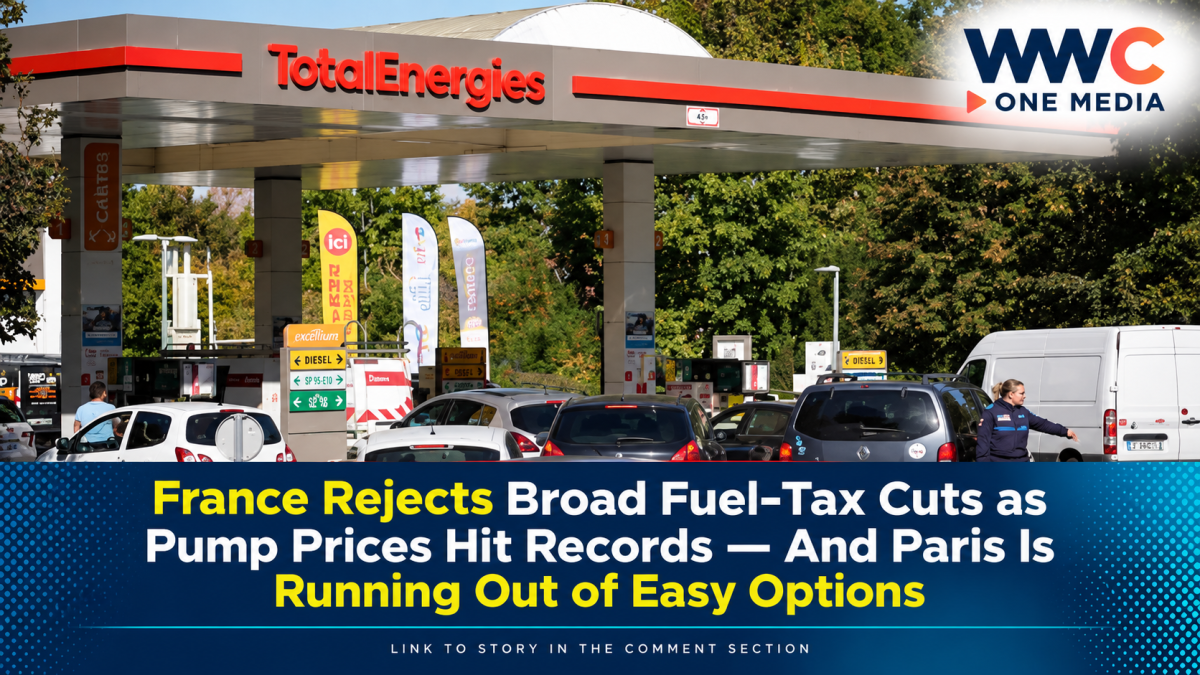
France is refusing to introduce a broad fuel-tax cut despite record pump prices, choosing instead to extend targeted support for the workers and industries hit hardest by the energy shock.
The decision comes as French motorists face some of the country’s highest-ever fuel prices. Diesel reached an average of about €2.39 per liter on September 18, while SP95-E10 gasoline climbed to around €2.17 per liter, according to figures cited by Le Monde from Agence France-Presse.
The surge is being driven largely by the wider Middle East energy crisis, including disruption around the Strait of Hormuz and pressure on global refining markets.
But Paris is resisting calls for a blanket tax reduction.
Instead, Prime Minister Sébastien Lecornu’s government is extending targeted assistance for sectors such as agriculture, fishing and construction, while maintaining support mechanisms for workers who depend heavily on their vehicles.
The strategy puts France on a different path from countries such as Germany, which has announced a €0.17-per-liter reduction in gasoline and diesel taxes.
And the political pressure on Paris is growing.
French Fuel Prices Are Breaking Records
The immediate problem is happening at the pump.
Diesel prices reached approximately €2.39 per liter on September 18, according to figures reported by Le Monde, while SP95-E10 gasoline reached roughly €2.17.
Those prices are feeding directly into household budgets and operating costs for businesses that rely heavily on road transport.
The consequences are already visible beyond ordinary motorists.
French fishermen blocked entrances to two ports and a fuel depot earlier in September to protest soaring fuel costs, according to Le Monde.
For businesses with large fuel bills, the increase can quickly translate into higher transportation, food and construction costs.
That creates a second problem for the government: an energy shock can eventually become a broader inflation problem.
Paris Is Choosing Targeted Relief Instead
Rather than reduce fuel taxes for everyone, the government has expanded assistance aimed at specific groups.
France’s official government portal says support for farmers, fishermen and construction companies was extended in September and October, while the government also opened or expanded assistance for “grands rouleurs” — workers who drive long distances to get to work.
The government has also announced that fuel support measures will continue through the end of 2026 for particularly affected sectors.
Reuters reported that the fishermen’s subsidy is being increased to 35 euro cents per liter, while farmers will continue receiving 15 cents per liter and eligible construction and public-works companies will receive 20 cents per liter for non-road diesel.
The approach is deliberately targeted.
Paris wants to provide relief without creating a huge new fiscal bill for every liter of fuel consumed nationwide.
Why France Is Rejecting A Blanket Tax Cut
The government’s argument is fundamentally about public finances.
A nationwide fuel-tax reduction would immediately reduce the amount of money flowing into the state budget at a time when France is already struggling with a large fiscal deficit.
Le Monde reported that a broad reduction in VAT on fuel could cost the French government billions of euros annually. A government estimate in 2024 put the potential revenue loss from reducing fuel VAT at approximately €10 billion per year.
There is another complication.
France cannot simply treat the current price shock as a normal domestic tax problem.
The underlying trigger is largely international.
Crude oil prices, refined-product prices and shipping costs are being affected by the Middle East conflict and disruption around the Strait of Hormuz.
Reducing French taxes would lower the amount consumers pay at the pump, but it would not solve the underlying shortage or restore disrupted global supply.
Paris Says A Price Cap Could Create Another Problem
Another proposal gaining attention is a temporary cap on fuel prices.
The French government has rejected that option as well.
According to Le Monde, officials at the Finance Ministry have argued that imposing a price ceiling during a period of constrained supply could encourage demand while discouraging supply, potentially worsening shortages.
The concern is not purely theoretical.
TotalEnergies has already been operating a voluntary price ceiling at some French stations, limiting gasoline to €1.99 per liter and diesel to €2.25.
The lower prices have attracted customers, but Le Monde reported that some TotalEnergies stations have subsequently experienced shortages of particular fuels.
That illustrates the dilemma facing policymakers.
A cheaper price can help consumers who manage to buy fuel.
But if demand rises faster than available supply, stations can run out.
France Already Tried A Fuel Subsidy
France has experience with broad fuel support.
During the 2022 energy crisis, the government introduced a nationwide pump rebate that was initially 18 euro cents per liter before being increased and subsequently reduced.
The French Court of Auditors estimated that the program cost approximately €7.6 billion over the year, according to Le Monde.
The current government is therefore reluctant to repeat a similarly expensive universal subsidy.
Instead, it is attempting to concentrate government money on those considered most exposed to the fuel shock.
That includes workers with long commutes and industries where fuel is a significant component of operating costs.
France Is Not Completely Closing The Door
Paris has not said that no additional assistance is possible.
At a September 16 government meeting, officials said the government remained prepared to adapt its measures if the international situation deteriorated further.
The government also emphasized that the current fuel-price crisis is being driven by geopolitical developments rather than by a purely French domestic problem.
That leaves open the possibility of additional targeted support.
But the government has so far resisted the politically simpler option of cutting taxes for every driver.
Germany Has Taken The Opposite Approach
France’s decision stands out because several European governments are taking different approaches to the same energy shock.
Germany announced a reduction in gasoline and diesel taxes of €0.17 per liter after Chancellor Friedrich Merz promised relief for consumers and businesses facing higher fuel prices.
Spain has also received EU approval to temporarily reduce fuel taxes below normal minimum levels as it responds to the energy crisis.
The divergence highlights a difficult choice for European governments.
They can absorb part of the energy shock through lower taxes or subsidies.
Or they can allow more of the increase to reach consumers while protecting public finances.
France is currently choosing the second approach, combined with targeted relief.
The Energy Shock Is Spreading Beyond The Pump
The problem is no longer limited to gasoline stations.
Higher oil prices are affecting airlines, shipping companies, manufacturers and transport operators around the world.
Reuters reported that American, United and Southwest Airlines have begun scaling back planned schedules as higher fuel costs threaten airline profitability.
Shipping costs are also rising.
Reuters reported that container rates from China to the US East Coast had climbed to around $10,948 per 40-foot container, more than four times their level at the start of the Iran war.
For France, that creates the possibility of a broader second-round effect.
Even if gasoline and diesel prices eventually stabilize, higher transportation costs can feed into the prices of food, manufactured goods and services.
Europe’s Governments Are Under Growing Pressure
The fuel crisis is becoming an increasingly political issue across Europe.
Reuters reported that EU finance ministers were preparing to discuss the possibility of an EU-wide windfall tax on energy companies benefiting from higher oil and gas prices.
That proposal reflects another side of the debate.
Governments are under pressure to help consumers, but they are also looking at energy companies whose revenues can rise when commodity prices surge.
The question is whether extraordinary profits should be taxed more heavily to help finance consumer support.
France has not chosen a broad fuel-tax cut, but the pressure for additional intervention is unlikely to disappear while pump prices remain elevated.
The Fiscal Problem Is Becoming Just As Important As The Fuel Problem
France’s dilemma ultimately comes down to a difficult trade-off.
Cut taxes and the government gives motorists immediate relief — but sacrifices revenue.
Subsidize fuel and the state absorbs part of the international price shock.
Cap prices and the government risks distorting demand during a period of constrained supply.
Do nothing and households and businesses absorb the full increase.
The targeted-support strategy attempts to split the difference.
It provides assistance to sectors most exposed to fuel prices without subsidizing every liter purchased by every driver.
The Green Transition Adds Another Layer
There is also a longer-term consideration.
French officials have argued that the country should use its relatively low-carbon electricity system to accelerate the shift toward electric transportation and heating rather than permanently subsidize fossil-fuel consumption.
France’s nuclear fleet supplies a large share of its electricity, giving the country a potentially significant advantage in electrifying transportation.
That argument becomes harder to sell, however, when households are facing an immediate jump in the cost of driving to work.
The government therefore faces two timelines at once.
In the short term, it has to contain the economic shock.
In the long term, it wants to reduce dependence on oil altogether.
The Bigger Test May Come If Oil Stays Above $100
The current strategy becomes more difficult if global oil prices remain elevated for an extended period.
A short-lived price spike can potentially be absorbed through targeted assistance.
A prolonged shock is much harder.
It can increase inflation, weaken household purchasing power, squeeze businesses and force governments to spend more on support programs.
At the same time, continued high prices could increase pressure for broader subsidies or tax cuts.
That is precisely what Paris is trying to avoid.
The government has already committed significant resources to targeted measures, while the 2027 budget process is approaching under intense fiscal scrutiny. Reuters reported that the government wants to extend assistance through the end of the year while preparing its budget and attempting to keep the deficit under control.
France Is Betting That Targeted Aid Can Hold The Line
For now, Paris is refusing the broadest and most expensive response.
Instead, France is extending sector-specific support, helping long-distance workers and maintaining assistance for industries such as fishing, farming and construction.
That approach protects government finances more than a universal tax cut would.
But it does not eliminate the underlying problem.
French drivers are still confronting record fuel prices.
Businesses are still paying more to move goods.
And the international energy crisis remains outside the French government’s direct control.
The real question is no longer whether France can make fuel cheaper with a tax cut. It is whether Paris can keep the political and economic pressure contained if the global oil shock refuses to fade.