
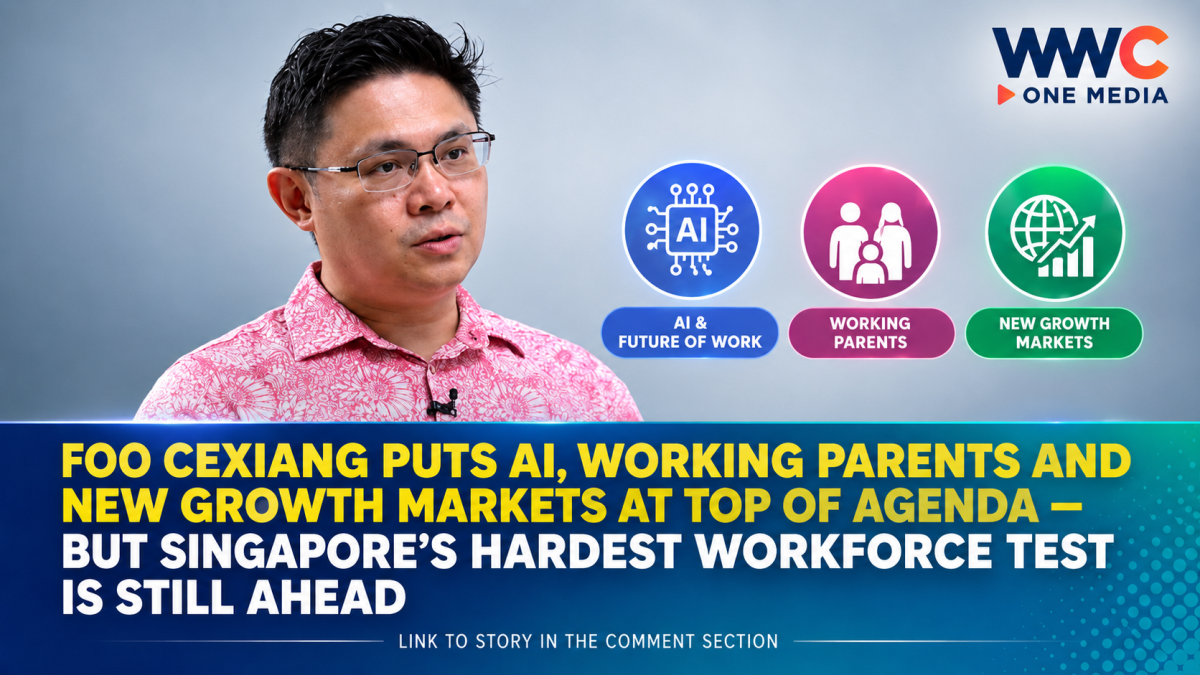
SINGAPORE — Artificial intelligence, the pressures facing working parents and Singapore’s search for its next generation of overseas growth markets are emerging as three major priorities for newly appointed Minister of State Foo Cexiang as he begins work at the Ministry of Manpower and Ministry of Trade and Industry.
Foo formally took up his appointments on September 1, marking a rapid rise for the first-term Tanjong Pagar GRC MP, who entered Parliament following the 2025 General Election. His appointment was announced by Prime Minister Lawrence Wong in July as part of the government’s continuing leadership renewal.
But behind the personnel change is a much bigger economic question: How does Singapore embrace technologies such as AI quickly enough to remain competitive without weakening the career pathways that allow workers to gain experience, skills and better wages?
That challenge appears likely to become one of the defining issues of Foo’s new portfolio.
AI is coming — but what happens to the worker?
In an interview with CNA conducted before he took office, Foo said companies should take advantage of AI’s substantial potential, while paying much closer attention to how the technology affects workers’ long-term development.
His focus is not simply whether companies deploy AI, but which tasks should be automated and which responsibilities employees still need to perform in order to learn, accumulate experience and progress in their careers. He said human-resource professionals, employers, unions and workers would need to be part of that discussion.
The issue has become considerably more urgent as AI adoption spreads across Singapore.
Fresh Ministry of Manpower data released in 2026 suggests the country has not yet experienced widespread AI-driven job destruction. MOM reported that among companies adopting AI, job redesign and the creation of AI-related positions were more common than reductions in employment. In a separate August parliamentary reply, the ministry said only 6 per cent of AI-adopting firms surveyed reported reducing headcount, while 19 per cent reported redesigning roles and 14 per cent had created AI-related jobs.
The numbers, however, also reveal how quickly the workplace could change.
AI adoption varies sharply according to company size. MOM said 27.2 per cent of firms with fewer than 200 employees had adopted AI in 2026, compared with 54.8 per cent of companies employing 200 to 500 people and 76.4 per cent of firms with more than 500 workers.
That creates a policy challenge that goes beyond preventing layoffs.
If AI performs more junior-level research, administration, writing, analysis or routine technical work, policymakers and employers will have to ensure younger employees can still acquire the knowledge traditionally gained by doing those tasks themselves.
That is effectively the dilemma Foo is highlighting: productivity cannot be the only measurement of successful AI adoption if automation inadvertently removes the training ground needed to produce tomorrow’s experienced workers and managers.
MOM has already formed a Tripartite Jobs Council with the National Trades Union Congress and Singapore National Employers Federation to address AI’s impact on businesses, jobs and workers, reflecting the government’s broader push for a coordinated transition rather than leaving individual companies to manage the disruption alone.
Singapore’s job market is changing, not disappearing
So far, official labour-market indicators do not point to an economy in which AI is eliminating employment on a broad scale.
MOM said job vacancies fell from 77,700 in December 2025 to 73,300 in March 2026, but entry-level professional, managerial, executive and technician openings actually edged higher, from 32,500 to 32,800 over the same period.
The underlying mix of jobs is nevertheless shifting.
Demand remains strong for technology specialists, engineers and workers equipped with skills such as software development, systems analysis and data analytics. MOM has said many jobs with significant exposure to AI will increasingly require employees to become comfortable using AI-enabled tools rather than simply compete against them.
That makes Foo’s stated focus on career development especially significant.
The policy question is increasingly becoming less about whether AI takes every job and more about whether Singaporeans can move quickly enough into the jobs AI creates or transforms.
Working parents are Foo’s second major test
Foo is also signalling greater attention to Singapore’s working parents, particularly the tension between family responsibilities and employers’ operational requirements.
The father of three told CNA that there is room to examine different kinds of workplace flexibility rather than treating flexible work as a single arrangement suitable for every company or occupation.
His comments come against a backdrop in which Singapore has already formalised the process for requesting flexible work arrangements.
The Tripartite Guidelines on Flexible Work Arrangement Requests have been in force since December 2024. They require employers to properly consider formal requests and generally respond within two months, although they do not guarantee that every request must be approved.
MOM has also acknowledged that outcome-based and flexible arrangements can benefit workers and businesses where the nature of the job permits them, while noting that such models are less practical for occupations requiring physical presence or shift work.
That distinction matters.
A software engineer, accountant or consultant may have considerably more flexibility over where and when work is performed than a healthcare worker, retail employee, technician or frontline service worker.
The difficult policy question therefore becomes: How can Singapore make workplaces more family-friendly without creating a system that disproportionately benefits office-based professionals while leaving other parents behind?
Mothership reported in July that Foo has three young daughters and had already been thinking about how to balance his expanding political responsibilities with family life. The publication said he had expressed interest in advocating for families while acknowledging the demands involved.
From Europe to Africa, Latin America and Central Asia
Foo’s other major portfolio will take him far beyond domestic employment policy.
At MTI, he has identified Europe as well as emerging markets in Africa, Latin America and Central Asia as areas where Singapore companies could find opportunities as global trade patterns change.
He pointed in particular to younger and expanding populations in several emerging markets as potential sources of economic growth over the next two or three decades.
This is not an isolated policy proposal.
Singapore’s trade authorities are already pursuing a wider diversification strategy. MTI said earlier this year that the country was expanding economic links with Latin America, South Asia, the Middle East and Africa as geopolitical tensions and economic nationalism make supply-chain resilience increasingly important.
At its 2026 Committee of Supply debate, MTI similarly identified diversification into emerging markets and new growth sectors as a central economic priority, alongside deeper regional integration and new digital and green-economy agreements.
Enterprise Singapore, meanwhile, said companies that pursued internationalisation projects expected those initiatives collectively to generate about S$5.7 billion in additional annual revenue, illustrating why overseas expansion has become more than a diplomatic objective.
His first day offered a clue about where Singapore is looking
There was also unusual symbolism surrounding Foo’s first day in office.
AsiaOne reported that he began September 1 while travelling back to Singapore after joining Senior Minister Lee Hsien Loong’s delegation to Kazakhstan and Uzbekistan.
The Prime Minister’s Office independently confirmed that Foo accompanied the delegation on Lee’s August 24-31 official visits, alongside government officials from the foreign affairs and trade ministries.
That trip closely matches Foo’s stated interest in Central Asia.
Singapore has been building ties with the region, and CNA reported ahead of the visit that Uzbekistan had become Singapore’s second-largest Central Asian services trading partner in 2024 and its third-largest goods trading partner in the region in 2025. Singapore and Uzbekistan were also expected to formalise plans for negotiations on a free-trade agreement.
In other words, the emerging-market strategy Foo is discussing is already moving from theory into economic diplomacy.
A former civil servant returns to government
Foo, 41, brings experience spanning both the public and private sectors.
The Straits Times reported that he spent more than a decade in the civil service and previously served as a director at the Ministry of Transport, where his responsibilities included private and future mobility. He later joined PSA Singapore as vice-president for port ecosystem development.
MTI’s official biography says his PSA work included developing the company’s supply-chain hub, strategies connected with the Johor-Singapore Special Economic Zone, and intermodal logistics initiatives designed to strengthen Singapore’s connectivity and competitiveness. His earlier government career included roles at JTC Corporation, MTI, the Ministry of Home Affairs, Ministry of Education and Ministry of Transport.
Prime Minister Wong said when announcing Foo’s promotion that the new officeholders were being brought into government to gain experience and help develop Singapore’s next generation of leaders.
His trade portfolio will also soon carry a slightly different name: MTI is scheduled to become the Ministry of Energy, Trade and Industry from October 1, reflecting the growing importance of energy to Singapore’s competitiveness and economic resilience.
The real test will be outcomes
Foo has described his intended role as one of connecting government, businesses, HR professionals, workers and other stakeholders so that policy produces tangible benefits — particularly better jobs for Singaporeans.
That may sound straightforward. In practice, all three areas he has selected involve difficult trade-offs.
Singapore wants companies to adopt AI aggressively without hollowing out careers.
It wants parents to have greater flexibility without making businesses less competitive or imposing arrangements unsuitable for frontline jobs.
And it wants companies to enter faster-growing markets without abandoning the established economies that remain crucial to Singapore’s trade network.
That is why Foo’s first months in office could matter far beyond the arrival of another new political office-holder.
The headlines will initially be about AI, flexible workplaces and overseas markets.
The bigger story will be whether those policies eventually translate into what Singapore workers care about most: secure careers, rising opportunities and a realistic path to building both a livelihood and a family.

Leave a Reply