
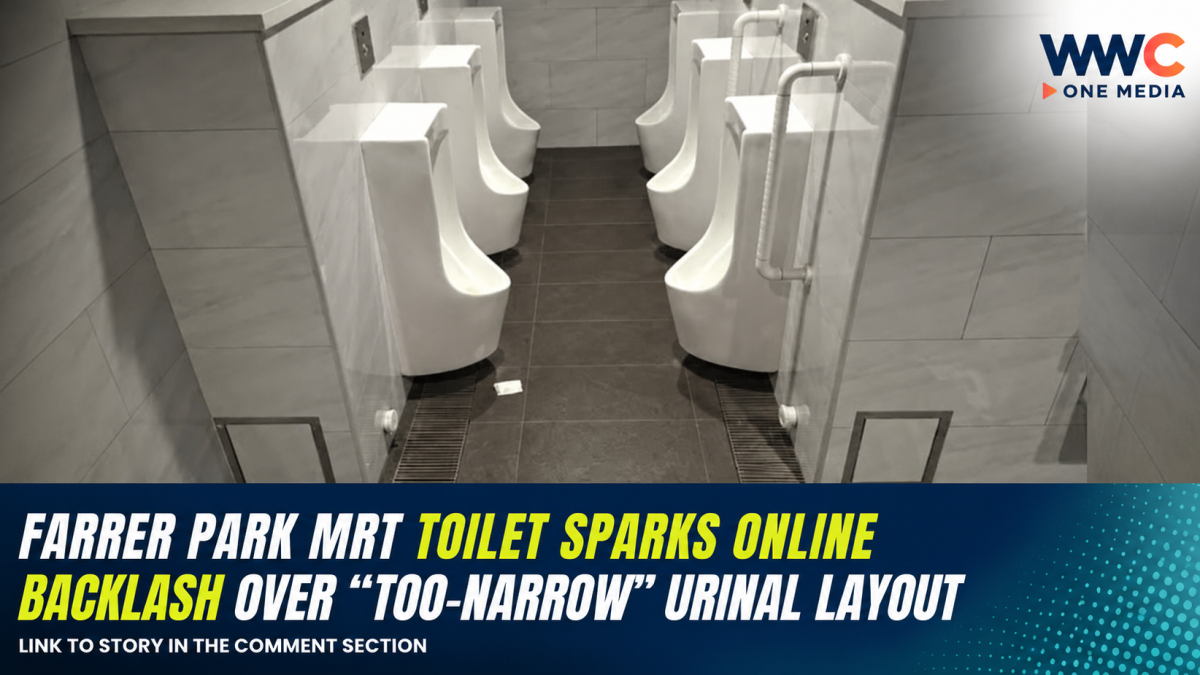
A public toilet at Singapore’s Farrer Park MRT station has become the center of an unexpected online debate after commuters questioned the unusually narrow space between two rows of facing urinals.
The issue gained wider attention after photos of the men’s toilet circulated online, prompting sanitation advocate and World Toilet Organization founder Jack Sim to visit the station himself to verify the layout.
The controversy has now reached the station operator: SBS Transit says it is reviewing possible improvements to the urinal arrangement.
Just 60cm between the two rows
According to Singapore media reports, the two rows of urinals are positioned directly opposite each other, leaving a passage of roughly 60cm between them.
A commuter who previously used the toilet told STOMP that the arrangement could make it difficult for people to reach the urinals farther inside when the units closest to the entrance are occupied.
The same commuter said two people using opposite-facing urinals could have very little space between them, particularly if either person was carrying a backpack or other belongings.
Lianhe Zaobao also reported that its journalist visited the toilet and measured approximately 60cm between the two rows. The report said there are four urinals on each side, creating the narrow central passage.
“Mr Toilet” checks it out for himself
The unusual design caught the attention of Jack Sim, founder of the World Toilet Organization and a well-known sanitation advocate.
After seeing the photographs online, Sim reportedly went to Farrer Park MRT station because he initially wondered whether the images had been digitally altered.
After seeing the toilet himself, he raised concerns about the practicality of the arrangement.
Sim pointed out that a person using one of the deeper urinals could potentially become unable to leave if the urinal closest to the entrance on the opposite side was occupied.
He also questioned how the design passed through the various stages of planning, construction and approval.
SBS Transit is now reviewing the layout
SBS Transit, which operates the North East Line and Farrer Park station, confirmed that it is aware of the issue.
The company said it is “reviewing possible improvements to the layout.”
However, any physical work would have to be carefully planned to reduce inconvenience to commuters, and the operator said the process could take some time.
The Land Transport Authority had also been approached for comment, according to AsiaOne.
Does the layout violate a building rule?
Not necessarily.
This is an important distinction.
Singapore’s Restroom Association recommends approximately 900mm of clearance in front of a urinal from a wall, fixture or door under its public-toilet design guidelines.
But those guidelines are recommendations. Reports have not established that the Farrer Park arrangement violates a mandatory building regulation.
That means the current controversy is primarily about usability, accessibility and practical design, rather than an established building-code violation.
The problem becomes bigger during peak hours
The layout may be manageable when only a few people are using the toilet.
But reports suggest the situation becomes considerably more difficult when the urinals near the entrance are occupied.
Someone trying to reach an empty urinal farther inside could find the narrow central passage blocked. Likewise, someone already using a deeper urinal could have difficulty exiting if other users are standing closer to the entrance.
Lianhe Zaobao spoke with regular users who said they had experienced having to wait outside because the passage became difficult to navigate when the outer urinals were occupied.
Why the story went viral
What makes the Farrer Park toilet story unusual is that it isn’t simply about a cramped restroom.
It raises a much broader question about how public infrastructure is designed and tested before it is opened to thousands of people.
A design can technically accommodate multiple fixtures while still creating an awkward or impractical experience for the people expected to use it.
That is precisely why Sim has called attention to the incident and argued that lessons from unusual designs should be used to improve future public infrastructure.
For now, commuters will have to wait to see whether SBS Transit ultimately changes the arrangement.
WWC ONE MEDIA J.M.D




Leave a Reply