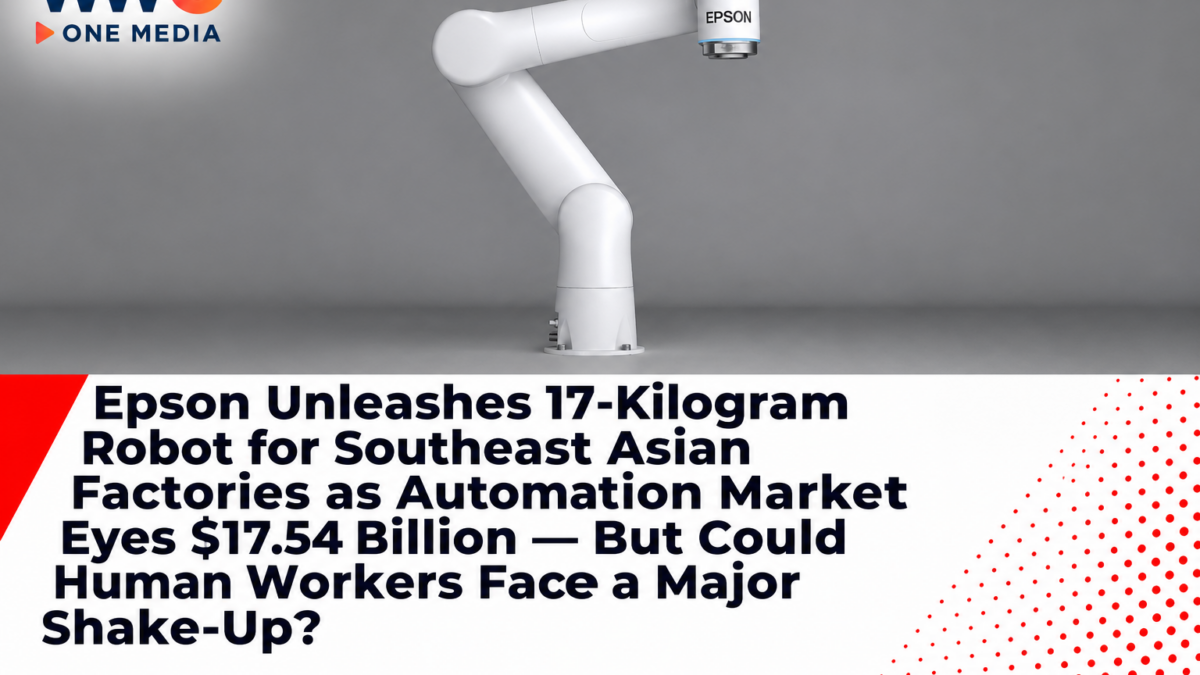
MANILA, Philippines — November 12, 2026 — Japanese technology giant Epson is accelerating its push into Southeast Asia’s rapidly expanding industrial automation market with the introduction of its first collaborative robot, a compact machine designed to work alongside employees in factories, laboratories and highly controlled manufacturing environments.
The new Epson AX6 Collaborative Robot, or cobot, weighs just 17 kilograms and combines intuitive programming, flexible installation and integrated safety functions.
Unlike conventional industrial robots that often operate inside fenced-off production areas, collaborative robots are engineered to support certain operations near human workers, subject to appropriate safety assessments.
The AX6 is being introduced across Southeast Asia at a time when manufacturers are under increasing pressure to improve productivity, address labor shortages and modernize production lines without rebuilding entire factories.
According to market estimates cited by Epson, Southeast Asia’s industrial automation and process control market could grow from US$10.06 billion in 2025 to US$17.54 billion by 2033.
That represents an estimated market expansion of about 74% over eight years.
For the Philippines, the development is particularly significant because Epson is also expanding industrial robot manufacturing at its Batangas facility.
But the arrival of increasingly accessible automation raises a bigger question.
Could collaborative robots strengthen Southeast Asia’s manufacturing competitiveness while creating new opportunities for workers—or could they accelerate the displacement of repetitive factory jobs?
Epson Introduces Its First Collaborative Robot in Southeast Asia
According to a November 12 report by InsiderPH, Epson’s new AX6 targets pharmaceutical, electronics, automotive and logistics operations.
The robot is designed for facilities where space, cleanliness and operational flexibility are major considerations.
Its compact carbon-body construction makes it easier to install in constrained production environments.
Epson describes the AX6 as the lightest collaborative robot in its class, although that comparison depends on the manufacturer’s specified product category.
The machine supports both alternating-current and direct-current power arrangements, allowing companies greater flexibility when integrating it into industrial systems.
It can also be incorporated into applications involving autonomous mobile robots and automated guided vehicles.
These are machines used to move materials and equipment through factories, warehouses and specialized production facilities.
The AX6’s introduction marks an expansion of Epson’s industrial robotics portfolio.
The company already manufactures conventional industrial robots, including SCARA and six-axis systems.
The AX6 adds a product specifically designed around collaborative operation and easier redeployment.
A Robot That Workers Can Teach by Hand
One of the AX6’s most important features is its hand-guided teaching system.
Instead of requiring every movement to be programmed through complex software instructions, operators can physically guide the robot to selected positions and establish points in a workflow.
The AX6 also supports block-based programming.
This interface is designed to make simpler automation tasks more accessible to users with limited robotics-programming experience.
For manufacturers with more advanced technical requirements, Epson provides compatibility with Python and the Robot Operating System, commonly known as ROS.
These development tools can support more sophisticated software integration.
The combination is significant because specialized programming expertise has historically been one of the barriers to adopting industrial robotics.
Smaller manufacturers may lack dedicated teams of robotics engineers.
Tools that simplify setup could make automation more practical for companies seeking to automate repetitive activities.
However, easier programming does not eliminate the need for training, maintenance, testing and professional safety assessments.
Epson Targets Pharmaceutical and Electronics Cleanrooms
Cleanroom compatibility is another major selling point.
Pharmaceutical and electronics facilities often need to control airborne particles and contamination.
The AX6 carries an ISO Class 5 cleanroom classification and IP54 protection against dust and splashing water.
The robot’s exterior incorporates smooth, easy-to-clean surfaces, with internal wiring and tubing intended to reduce areas where contaminants can accumulate.
These features make the machine relevant to specialized manufacturing environments.
Possible applications include repetitive material handling, carefully controlled positioning tasks and selected laboratory workflows.
However, an ISO cleanroom classification is not the same as certification for every pharmaceutical or medical procedure.
Manufacturers must still validate equipment for its intended application and comply with applicable quality and safety requirements.
Can the AX6 Work Safely Beside Human Employees?
Epson designed the AX6 with several collaborative safety functions.
These include Power and Force Limiting, Safe Operating Stop, Safe Limited Speed and Safe Limited Position.
The functions are intended to help manage risks when robots and human workers operate in shared or adjacent spaces.
Power and Force Limiting can restrict contact forces under specified conditions.
Safe Operating Stop allows the robot to enter a monitored stopped state when required.
Speed and position limits help control how the machine moves within defined operating boundaries.
These functions can make certain collaborative applications possible without traditional full-height safety fencing.
But the absence of a fence does not automatically make an industrial robot safe.
The required safeguards depend on its payload, speed, end effector, surrounding machinery and the possibility of human contact.
A factory using the AX6 must still conduct an application-specific risk assessment.
Southeast Asia’s Automation Market Could Reach $17.54 Billion
Epson’s regional launch comes amid growing interest in industrial automation.
SkyQuest Technology Consulting estimates that Southeast Asia’s industrial automation and process control market was worth approximately US$10.06 billion in 2025.
It projects the market could reach US$17.54 billion by 2033.
The forecast reflects expectations that manufacturers will continue investing in advanced machinery, control systems, robotics and digital production technologies.
But the projection is for the broader automation and process-control market, not collaborative robots alone.
It also does not represent Epson’s expected revenue.
The actual market size in 2033 will depend on business investment, economic conditions and technology adoption.
For manufacturers, the commercial case for robotics is influenced by several factors: labor availability, equipment prices, production volumes, maintenance costs and the potential gains in quality or efficiency.
Philippines Gains from Epson’s ₱40-Million Robotics Manufacturing Project
Epson’s Southeast Asian launch comes alongside a separate manufacturing investment in the Philippines.
In August 2026, the Philippine Economic Zone Authority announced that Epson Precision Philippines Inc. would invest more than ₱40 million to expand its operations at the Lima Technology Center–Special Economic Zone in Batangas.
The project will add industrial robot manufacturing to Epson’s existing registered activities.
According to PEZA, the planned production covers SCARA robots, six-axis robots and related components, subassemblies and spare parts.
The new manufacturing operation is scheduled to begin in March 2027 and is expected to create approximately 118 jobs.
The project reflects the Philippines’ potential role in the international robotics supply chain.
However, the Philippine manufacturing announcement is separate from the AX6 regional launch.
Epson has not established in the reporting reviewed that the AX6 itself will be manufactured at the Batangas facility.
That distinction is important because product distribution, industrial deployment and local manufacturing are separate activities.
Philippine Factories Face a Growing Automation Challenge
The Philippines has long been involved in electronics manufacturing, semiconductor assembly and other export-oriented industrial operations.
As international manufacturers adopt more sophisticated production technology, Philippine factories face pressure to keep pace.
The AX6 could be relevant to operations where repetitive handling, constrained production layouts or cleanroom requirements make conventional automation difficult.
But companies will need to determine whether the technology fits their production needs.
Installation costs, operator training, software integration, maintenance and worker safety all affect the investment decision.
The bigger competitive challenge is developing a workforce capable of operating and maintaining increasingly sophisticated manufacturing systems.
Automation can reduce the need for some repetitive tasks while increasing demand for technicians, engineers, programmers and quality-control specialists.
Whether employment rises or falls at a particular facility depends on how companies use the technology and whether additional production creates new jobs.
Singapore Is Also Investing in AI-Powered Factories
Epson’s launch reflects a larger regional shift toward advanced manufacturing.
Singapore has been expanding programs designed to help industrial companies adopt artificial intelligence and other technologies.
As WWC ONE MEDIA reported in its coverage of Singapore’s S$45-million AI manufacturing initiative, the city-state is investing in programs intended to accelerate factory modernization.
Singapore’s challenge is ensuring that smaller manufacturers can participate rather than leaving the benefits to large companies with extensive technology budgets.
Collaborative robots such as the AX6 address a related problem: making selected automation tasks easier to implement within existing facilities.
But software-driven AI systems and physical collaborative robots perform different functions.
The two technologies can complement one another without being interchangeable.
Taiwan Shows How AI Is Moving Into Industrial Production
Taiwan is also accelerating the adoption of advanced manufacturing systems.
As WWC ONE MEDIA examined in its report on Taiwan’s AI-powered textile factory technology, researchers are developing systems that combine machine data, predictive maintenance and artificial intelligence.
The goal is to help factory personnel identify potential problems and improve operational decisions.
Another WWC ONE MEDIA report on Taiwan’s AIDC partnership with Acer’s Altos highlighted efforts to connect fragmented production and management systems.
These examples illustrate how the next phase of industrial modernization may involve both intelligent software and more adaptable physical machinery.
For Southeast Asian manufacturers, the challenge is integrating these systems into productive workflows.
Toyota’s Robotics Strategy Reveals the Bigger Manufacturing Trend
Major automakers are also investing in robotics.
As WWC ONE MEDIA reported in its analysis of Toyota’s planned robotics modernization, the Japanese automaker is exploring upgrades across a manufacturing network involving hundreds of thousands of robots.
Toyota’s initiative is much larger and structurally different from Epson’s AX6 launch.
But both developments highlight the growing importance of automation in modern industry.
Some manufacturers will invest in large-scale production systems, while others may prefer flexible collaborative robots that can be redeployed between tasks.
The most suitable approach depends on production requirements and the return on investment.
Will Robots Replace Factory Workers?
The expansion of collaborative robotics raises legitimate questions about employment.
Robots are particularly suited to some repetitive, predictable and physically demanding tasks.
Automating these activities can allow companies to reassign workers to inspection, maintenance, technical support and more complex operations.
However, those benefits are not automatic.
If companies use automation primarily to reduce labor costs, some existing positions could be eliminated.
The effects will vary by industry, company and country.
Manufacturers and governments therefore face a shared challenge: preparing workers for new technologies while minimizing disruption.
Training in robotics operation, machine maintenance, programming and industrial safety may become increasingly valuable.
For the Philippines, partnerships among technology suppliers, employers, universities and technical training institutions could help strengthen workforce readiness.
How Much Does the Epson AX6 Cost?
Epson has confirmed that the AX6 is being introduced commercially in Southeast Asia, with configurations and availability varying by market.
However, the reviewed launch announcements do not establish a single verified public Philippine retail price.
Companies considering the robot should request official quotations covering the selected configuration, accessories and installation requirements.
The total cost of ownership is particularly important.
A robot’s purchase price is only one component of an automation investment.
Businesses may also need compatible grippers, safety equipment, software integration, staff training and ongoing maintenance.
Without those details, any claim that the AX6 will immediately deliver a specified percentage of savings would be speculative.
The Bottom Line: Epson’s AX6 Could Help Redefine Factory Automation
Epson’s first collaborative robot marks another step in Southeast Asia’s transition toward more advanced manufacturing.
The AX6 combines a compact 17-kilogram design with hand-guided teaching, simplified programming, cleanroom compatibility and collaborative safety functions.
Its launch comes as the regional automation market is forecast to grow significantly over the coming years.
The Philippines also has a potential opportunity to move further into robotics manufacturing through Epson’s separate Batangas investment.
But industrial transformation requires more than purchasing new machines.
Manufacturers must evaluate productivity, safety, workforce skills and long-term costs.
The AX6 could lower some barriers to automation, particularly in smaller or space-constrained facilities. Whether it delivers meaningful productivity gains will depend on how effectively businesses deploy the technology.
As Epson brings collaborative robots into Southeast Asian factories and the regional automation market moves toward a projected US$17.54 billion, could the Philippines become a major player in the next industrial revolution—or will businesses and workers struggle to keep pace with increasingly intelligent machines?