
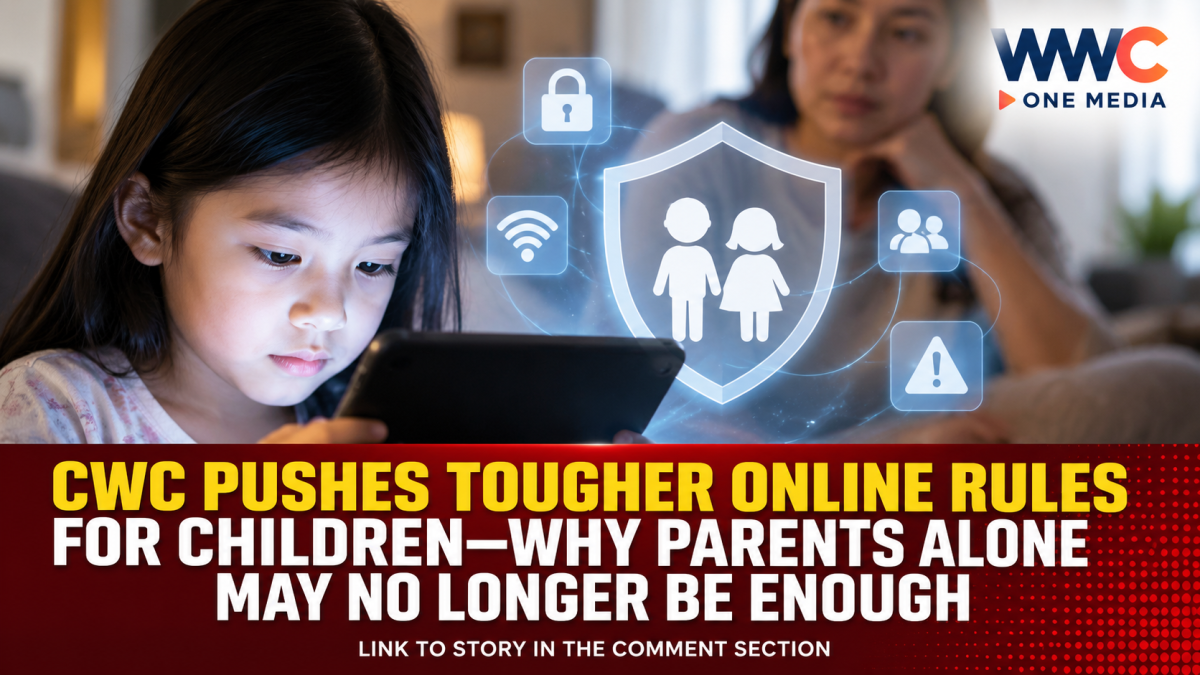
MANILA, Philippines — Protecting children in the digital age cannot rest on parents alone, according to the Council for the Welfare of Children (CWC), as calls grow for stronger government regulation and greater accountability from social media and gaming platforms.
The issue has gained renewed urgency as Filipino lawmakers and government agencies debate how far the state should go in regulating children’s access to social media and shielding minors from harmful online content.
The CWC has been advocating for a broader “safety by design” approach—one in which digital platforms themselves build age-appropriate safeguards into their systems instead of leaving parents to navigate complicated privacy, safety and content controls.
CWC Executive Director Undersecretary Angelo Tapales previously said child safety should not depend entirely on whether parents or children are technically skilled enough to find and activate a platform’s safety settings.
The agency has been working with technology companies on ways to make online environments safer for minors, including age-appropriate protections built directly into applications.
Parents still have a role—but platforms are being asked to do more
The CWC’s position does not remove parental responsibility.
Rather, officials have emphasized that parents and guardians also need to improve their digital literacy because children are increasingly exposed to social media, online games, messaging applications and other digital platforms.
But government officials and child advocates increasingly argue that parental supervision alone has limits.
Children can encounter harmful material quickly, while parents may not always understand how algorithms, recommendation systems, privacy settings, age controls and other platform features work.
That has fueled calls for a system in which technology companies share a greater responsibility for preventing foreseeable risks to minors.
The CWC has also warned against treating children’s online participation simply as a source of views, engagement or content.
In June, the agency reminded parents, guardians, content creators and media practitioners that children’s dignity, privacy and best interests must take precedence over online attention and engagement.
Congress is already considering tougher rules
The debate is no longer limited to recommendations.
Congress is considering several measures that would establish stronger protections for children online.
One major proposal is House Bill No. 9965, or the proposed Children’s Social Media Safety Act, filed by House Speaker Faustino “Bojie” Dy III and Majority Leader Ferdinand Alexander “Sandro” Marcos.
The proposal would prohibit children below 13 from creating or maintaining social media accounts.
For users aged 13 to below 18, the bill proposes verified parental or guardian consent and continuing supervision.
It would also require platforms to strengthen age-assurance systems, provide parental controls, apply stronger privacy settings to child accounts and restrict certain practices involving children’s personal and sensitive information.
The bill further seeks greater scrutiny of algorithms that recommend content to young users and would impose penalties of up to ₱50 million for certain violations. Repeated and serious violations could eventually lead to restrictions on a platform’s operation in the Philippines, subject to due process.
Importantly, HB 9965 remains a proposed measure and is not yet Philippine law.
Senate proposal would set 16 as minimum age
The Senate is pursuing a different threshold.
Senate Bill No. 2424, the proposed Child Online Safety and Protection Act, was endorsed by a Senate committee for consideration by the full chamber in August.
The proposal seeks to establish 16 as the minimum age for social media use and would require platforms to implement reasonable age-assurance measures designed to prevent children below 16 from creating or maintaining accounts.
The measure also seeks to ensure that age-assurance systems comply with the Data Privacy Act and that children’s personal information is not commercially exploited.
The proposed 16-year threshold has generated debate, with lawmakers and experts weighing children’s safety against their rights to information, communication and participation in the digital world.
Not everyone supports a blanket ban
The push for stronger safeguards does not mean there is consensus around completely removing children from social media.
Some lawmakers and advocacy groups have argued that regulation may be more practical than an outright ban.
Pasig Rep. Roman Romulo, who has been involved in congressional discussions on the issue, has questioned the feasibility of completely banning minors from social media, noting that enforcement inside homes would be difficult.
Consumer advocates have similarly warned that a blanket ban could push young users toward less visible or less-regulated online spaces, potentially making some risks harder to detect.
Instead, they have advocated stronger default safety settings, parental tools, reporting mechanisms, privacy protections and digital-literacy programs.
Pressure is also mounting on Big Tech
The push for regulation comes as Philippine authorities demand greater cooperation from major technology companies.
In August, Meta committed to closer cooperation with Philippine authorities over harmful content, online threats and investigations involving child safety.
According to the Philippine Daily Inquirer, the company agreed to establish stronger coordination mechanisms and provide relevant information to authorities when legally required, including in cases involving online child abuse and other serious threats.
The discussions also included mechanisms for addressing harmful AI-generated material and deepfakes.
The developments underscore a growing government position: platforms cannot simply rely on users to report dangerous material after harm has already occurred.
PNP also wants stronger oversight
The Philippine National Police Anti-Cybercrime Group has separately recommended creating a regulatory body that could oversee social media and gaming platforms.
PNP-ACG Director Maj. Gen. Wilson Asueta said the proposed body could monitor prohibited or violent content and direct platforms to take action when necessary.
The proposal illustrates how the discussion has expanded beyond parental controls to questions about platform accountability, enforcement and government oversight.
The bigger question: Who is responsible for a child’s online safety?
The Philippine debate is part of a much larger international shift.
Countries are increasingly examining whether social media companies should be legally required to protect minors through age verification or age assurance, safer default settings, restrictions on targeted advertising, parental controls and other safeguards.
Australia, for example, has moved toward restricting social media access for users under 16, while European governments have also been examining stronger child-safety measures.
For the Philippines, however, the challenge is finding a system that protects children without creating new privacy problems, unnecessarily restricting legitimate access to information, or simply pushing young users toward harder-to-monitor corners of the internet.
That is why the CWC’s call for stronger regulation is significant.
The emerging policy direction is not simply about telling parents to watch what their children do online.
It is about asking whether the platforms where children spend their time should carry a much larger share of the responsibility for keeping them safe.
And with multiple bills now moving through Congress, the debate could soon shift from whether children need greater online protection to exactly how far the government is prepared to go to enforce it.
For Filipino families, that may be the most important development to watch next.



Leave a Reply