
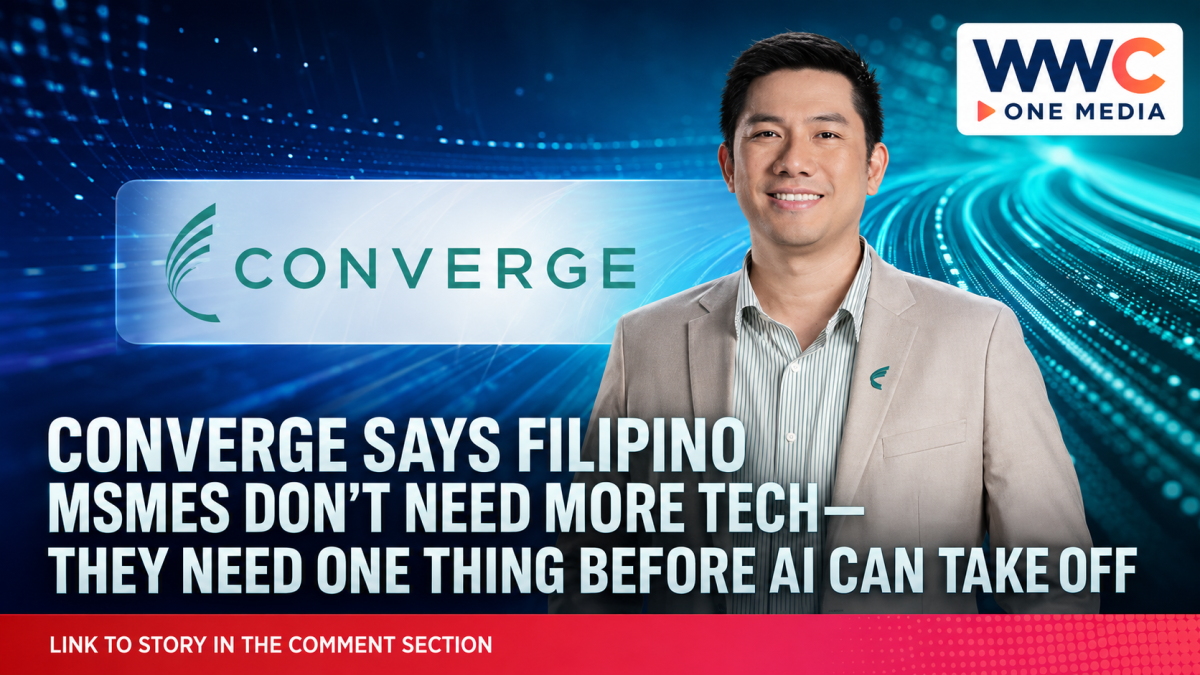
MANILA, Philippines — Artificial intelligence, cloud computing, digital payments and e-commerce tools are becoming easier for Filipino entrepreneurs to access. But Converge ICT Solutions Inc. says getting the technology into the hands of small businesses may actually be the easy part.
The bigger challenge is convincing entrepreneurs that these tools are simple enough, affordable enough—and useful enough—to trust with their businesses.
That emerging “trust gap” is becoming a crucial issue as Philippine micro, small and medium enterprises, or MSMEs, move deeper into the digital economy.
At the ASEAN Tech Summit Manila 2026, Converge SME Group head and senior vice president Dindo Marzan argued that simply giving entrepreneurs access to new technology will not automatically lead to adoption. Small-business owners need to understand exactly how a digital tool can make their daily operations easier or more profitable before they are likely to spend money on it.
For the neighborhood store owner, restaurant operator, online seller or small manufacturer, that means technology cannot remain an abstract promise involving AI, blockchain or the cloud.
It has to solve a problem today.
From Internet Access to Actual Business Results
For years, the Philippines’ digitalization push focused heavily on improving connectivity.
That problem has not disappeared. But increasingly, broadband is becoming only the foundation of a much larger digital ecosystem.
MSMEs now have access to online marketplaces, cashless payments, inventory systems, cybersecurity services, cloud applications, customer-management software and AI-powered productivity tools.
The challenge is making those technologies practical.
Converge’s argument is straightforward: an entrepreneur is unlikely to pay for another digital subscription simply because the technology sounds advanced. The business owner needs to see whether it can increase sales, reduce costs, save time or make customers easier to serve.
That shift is important because MSMEs dominate the Philippine business landscape. The Department of Trade and Industry has repeatedly estimated that roughly 99.5 percent of Philippine businesses are MSMEs, making their ability to adopt technology critical to the country’s broader competitiveness.
And the economy they are being asked to enter is already enormous.
BusinessMirror, citing Philippine Statistics Authority data, reported that the Philippine digital economy generated ₱2.74 trillion in gross value added in 2025, representing 9.8 percent of GDP. E-commerce accounted for more than 32 percent of that digital economy.
The opportunity is therefore no longer theoretical.
The question is whether smaller enterprises can participate fully in it.
Converge, DTI and TikTok Are Testing a Different Approach
Rather than expecting entrepreneurs to figure everything out themselves, Converge has increasingly partnered with government agencies and technology platforms to combine connectivity with training and hands-on assistance.
On August 25, the DTI, TikTok Shop and Converge SME Solutions signed an agreement in Cebu expanding the Unlad Lokal program, which was launched by DTI and TikTok Shop in 2025.
The arrangement combines three pieces that small businesses often need simultaneously: internet connectivity, digital skills and access to an online marketplace.
TikTok Shop is providing training on areas such as digital selling, while DTI is helping coordinate MSME participation and Converge is supplying business connectivity solutions.
That partnership followed another major step in August.
Converge and DTI formally launched joint MSME digital-transformation initiatives on August 11, building on an agreement the two organizations signed in November 2025. Those initiatives cover areas including connectivity, e-commerce, cloud technology, cybersecurity and artificial intelligence.
An AI & Scale-Up Center launched with DTI and private-sector partners is also intended to give Filipino businesses a more accessible environment in which to explore artificial intelligence and other technologies before attempting large-scale implementation.
The strategy addresses one of the biggest weaknesses in technology adoption: businesses are frequently sold sophisticated tools before they fully understand what they are supposed to do with them.
The ₱1,000 Question: Will the Technology Pay for Itself?
Price remains another major obstacle.
A digital tool that sounds inexpensive to a large corporation can become another recurring expense for a microenterprise operating on thin margins.
Converge therefore says digital services need to be priced realistically alongside an MSME’s basic connectivity bill, while trials and demonstrations can allow entrepreneurs to experience a product before committing financially.
That approach reflects a larger industry shift.
BusinessMirror reported in June that MSMEs increasingly want more than an internet connection. Businesses are looking for cloud-based productivity platforms, customer-management tools and other services that can become part of normal operations.
The distinction matters.
An entrepreneur who uses an e-wallet has technically adopted digital technology. But a company that manages inventory online, markets through e-commerce platforms, protects customer information, uses cloud-based accounting and deploys AI to automate repetitive work has moved much further along the digitalization curve.
That second stage is where technology companies increasingly see the next growth opportunity.
There Is Also a Business Reason Converge Wants MSMEs Online
Converge’s campaign is not just a digital-inclusion initiative. MSMEs are becoming increasingly important to the company’s own growth strategy.
Converge reported ₱22.4 billion in consolidated revenue during the first half of 2026, up 3.1 percent year-on-year.
But enterprise revenue expanded much faster, climbing 15.1 percent to ₱3.9 billion. Within that division, SME revenue increased 15.7 percent, while large corporate and enterprise revenue rose 14.8 percent.
That contrast is especially significant because Converge has been facing softer conditions in its much larger residential business.
BusinessMirror reported that the company lowered its full-year 2026 revenue-growth guidance to between 4 percent and 6 percent amid inflationary pressure on household spending. Management has consequently emphasized enterprise investment as a way to diversify growth.
In other words, helping small companies become more digitally sophisticated potentially benefits both sides.
MSMEs gain access to tools normally associated with larger companies.
Converge gains customers who may eventually purchase far more than an internet connection.
The Real Digital Divide May Be Changing
The Philippine digital divide was once largely defined by a straightforward question:
Can a business get online?
That question is increasingly being replaced by another:
Once it gets online, does the business know what to do next?
Affordable fiber can connect a sari-sari store to the internet. An e-wallet can allow it to accept digital payments. A social-media account can put its products in front of thousands of customers.
But connectivity alone cannot tell the owner which technology deserves their money, which platforms are trustworthy, how AI could improve their operation or whether another monthly software subscription will actually generate a return.
That is the gap Converge now wants to close.
And as AI, cloud services and digital commerce spread deeper into the Philippine economy, the companies that succeed with MSMEs may not necessarily be those offering the most sophisticated technology.
They may be the ones capable of answering the simplest question every small-business owner eventually asks:
“How exactly will this help my business tomorrow?”
WWC ONE MEDIA MJE




Leave a Reply