
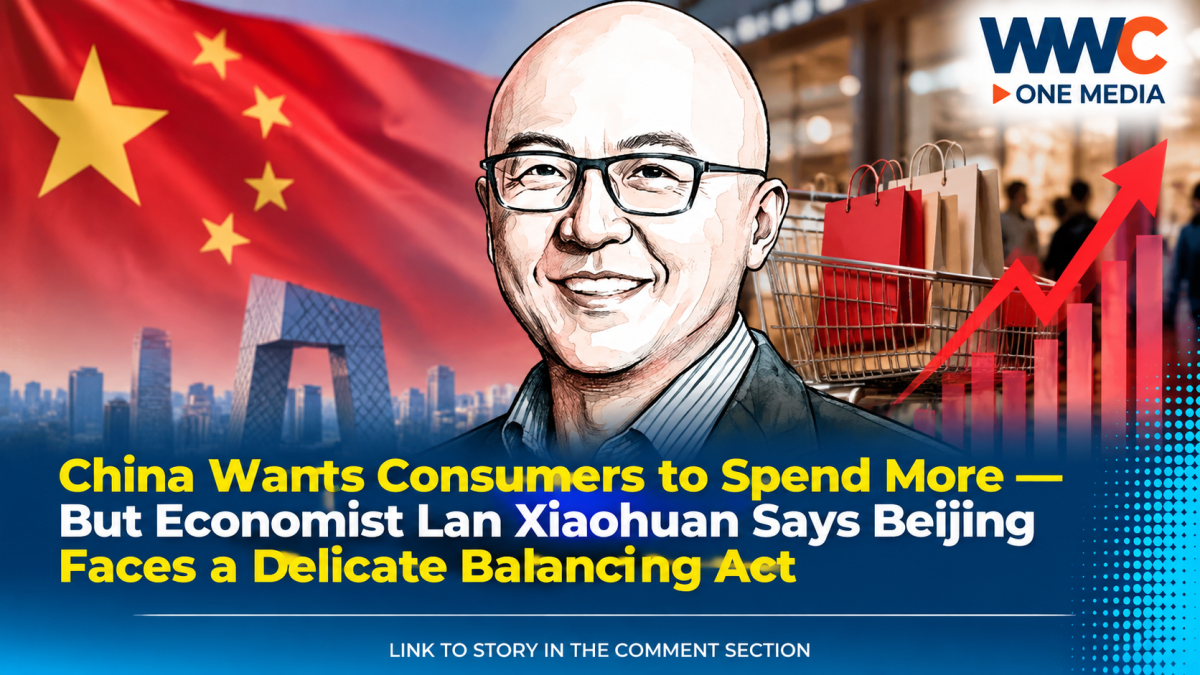
BEIJING — China has built one of the world’s most powerful manufacturing and export machines.
Its factories produce everything from electric vehicles and solar panels to smartphones, machinery and advanced technology.
But Beijing now faces a problem that could define the next phase of China’s economic future:
How do you convince hundreds of millions of consumers to spend more?
Economist and bestselling author Lan Xiaohuan says the answer is not as simple as handing out more subsidies or launching another short-term spending campaign.
China, he argues, needs a careful balancing act — one that strengthens household confidence and social security without undermining the industrial and technological development that has become central to the country’s economic strategy.
China’s economy has changed dramatically
Lan, a professor of economics at the China Europe International Business School and author of How China Works: An Introduction to China’s State-led Economic Development, said the changes facing China today are significant enough that he would not simply add a new chapter to his earlier book.
He would write an entirely new one.
At home, the biggest shifts include the decline of China’s once-dominant property sector and the rapid expansion of manufacturing and technology.
But Lan argued that some of the most consequential changes have come from outside China.
The Covid-19 pandemic.
The Russia-Ukraine war.
Global energy shocks.
Tensions involving Iran.
And changing political dynamics in the United States.
Together, these developments have reshaped the environment in which China must manage its economic transition.
China’s factories are strong. Consumer demand is the problem.
China’s economic imbalance has become increasingly clear.
Manufacturing output and exports have remained important pillars of growth.
But domestic consumption has struggled to keep pace.
Reuters-reported figures earlier this year highlighted the scale of the gap: China’s industrial output grew faster than retail sales in 2025, reinforcing concerns about an economy where supply remains stronger than domestic demand.
That creates a difficult situation.
Factories can continue producing.
Companies can continue investing.
Exports can help absorb some of the output.
But if households remain cautious about spending, China risks producing more goods than its domestic economy can comfortably absorb.
That can contribute to:
- Weak consumer demand
- Price pressure
- Excess industrial capacity
- Greater dependence on exports
- Trade tensions with other countries
And that is why boosting consumption has become one of Beijing’s most important economic priorities.
Why aren’t Chinese consumers spending more?
The answer goes deeper than consumer confidence.
One major issue is the tendency of households to save rather than spend.
Economists have long pointed to concerns involving:
- Healthcare costs
- Retirement security
- Education expenses
- Employment uncertainty
- Housing wealth
- Economic uncertainty
When families feel they may need significant savings to protect themselves against future risks, spending becomes less attractive.
That is where Lan’s argument about the social safety net becomes particularly important.
A stronger system of social protection could reduce the need for precautionary savings and give households more confidence to spend.
In simple terms:
People are more willing to spend when they feel safer about the future.
Lan’s argument: China needs balance, not just more spending
The challenge for Beijing is that China cannot simply redirect all of its resources toward consumption.
The country is also investing heavily in:
- Artificial intelligence
- Advanced manufacturing
- Semiconductors
- Robotics
- Green technology
- Strategic industries
- Technological self-reliance
Those investments have become even more important because of geopolitical competition, particularly between China and the United States.
China wants stronger consumers.
But it also wants stronger technology.
And both goals require significant resources.
That is the balancing act.
A greater share of economic resources directed toward households could help consumption.
But China also sees continued investment in industry and technology as essential to national economic security and long-term competitiveness.
The property crisis changed the equation
For years, China’s property sector was one of the country’s biggest economic engines.
Real estate supported construction.
Construction supported local government revenue.
Property ownership became a major source of household wealth.
But the sector’s decline has changed the entire economic landscape.
Lan identified the weakening property market as one of the most important domestic changes since he wrote How China Works.
The problem is not only about developers or housing sales.
A weaker property market can also affect:
- Household wealth
- Consumer confidence
- Local government finances
- Construction activity
- Business investment
That makes boosting consumption more difficult.
If families feel their biggest asset is losing value or no longer generating wealth, they may become even more cautious about spending.
Beijing is already trying to boost consumption
China has introduced a range of measures designed to encourage households to spend.
These have included:
- Consumer subsidies
- Trade-in programmes
- Interest support
- Consumer credit measures
- Support for services
- Policies aimed at increasing domestic demand
China’s government has also outlined plans for the 2026-2030 period that place greater emphasis on consumption and addressing the imbalance between supply and demand.
Officials have acknowledged that strong supply combined with weaker demand has become a major economic challenge.
Services, including healthcare, elderly care and leisure, are also increasingly being viewed as potential engines for future domestic demand.
But there is a major debate over whether short-term incentives can solve a deeper structural problem.
Subsidies may encourage spending — but can they change behaviour?
A household may buy a new appliance because of a trade-in subsidy.
A consumer may purchase an electric vehicle because of an incentive.
A family may spend more because borrowing costs have fallen.
These policies can generate immediate results.
But they may not permanently change consumer behaviour.
The larger challenge is whether households feel secure enough to increase spending over the long term.
That is why economists increasingly focus on structural reforms.
These could include stronger:
- Social security
- Healthcare support
- Pension systems
- Household income growth
- Employment security
The underlying goal is to reduce the pressure on families to save excessively for future emergencies.
That could potentially unlock more sustained consumption than temporary subsidies alone.
China’s record trade strength creates another problem
China’s export sector has been a major source of economic resilience.
But a strong export sector can also create geopolitical pressure.
When domestic consumption remains relatively weak, Chinese companies may look increasingly to overseas markets.
That can create concerns among trading partners about:
- Cheap imports
- Industrial overcapacity
- Manufacturing competition
- Trade deficits
- Government support for industry
Lan discussed the economic realities behind China’s record trade strength and the broader international pressures shaping China’s economy.
The challenge for Beijing is to maintain industrial competitiveness without becoming overly dependent on foreign markets to absorb domestic production.
The United States and geopolitics are changing China’s priorities
China’s economic decisions can no longer be separated from geopolitics.
The country is investing heavily in technological capabilities partly because of concerns about access to foreign technology and supply chains.
That means economic policy is increasingly tied to national security.
China wants to develop domestic capabilities in critical industries.
It wants stronger supply chains.
It wants technological independence.
And it wants to reduce vulnerabilities to external pressure.
But this creates tension.
Money directed toward strategic technology investments is money that could potentially be directed elsewhere.
That is why the debate over consumption is not simply about economics.
It is also about how China allocates national resources in an increasingly uncertain world.
Can China have both a tech boom and a consumer boom?
This may be one of the defining questions of China’s next five years.
Beijing wants to become a global leader in advanced technology.
At the same time, policymakers want household consumption to play a bigger role in the economy.
The two goals are not necessarily impossible to achieve together.
But they require careful coordination.
Too much emphasis on investment and manufacturing could leave consumer demand behind.
Too much focus on immediate consumption could potentially reduce resources available for strategic investment.
Lan’s broader message is therefore about balance.
China needs:
Strong industry — but also stronger households.
Advanced technology — but also greater consumer confidence.
Economic growth — but also better social protection.
The challenge will be determining how much support each side receives.
Why China’s social safety net may hold the key
One of the strongest arguments emerging from the debate is that social protection could be an economic policy as much as a welfare policy.
A stronger social safety net could potentially:
- Reduce precautionary saving
- Increase consumer confidence
- Encourage household spending
- Reduce financial anxiety
- Support long-term domestic demand
This is particularly important as China deals with demographic change and an ageing population.
Healthcare and retirement security are not only social issues.
They can directly affect how families make financial decisions.
If households believe they must personally absorb most future risks, they are more likely to save.
If they feel more protected, they may be more willing to spend.
That is the economic logic behind the push for stronger social security.
The next five years could determine China’s economic direction
China has already signalled that consumption will play a larger role in its next phase of development.
But policy announcements are easier than structural change.
The transition requires difficult choices.
Resources may need to move.
Local governments may need new priorities.
Household incomes may need to rise.
Social protection may need to expand.
And policymakers will have to decide how to support consumers without weakening strategic investments in technology and industry.
Reuters-reported policy plans show Beijing is increasingly focused on correcting the imbalance between strong supply and weaker demand.
But the scale of the challenge remains enormous.
Lan Xiaohuan’s warning: China needs a new framework
Perhaps the most significant part of Lan’s assessment is his suggestion that China’s economic changes are too significant to be treated as a minor update to the old model.
He said he would write an entirely new book rather than simply add another chapter to his previous work.
That reflects the scale of China’s transformation.
The property boom is no longer driving the economy in the same way.
Manufacturing and technology are rising.
Geopolitical pressures are intensifying.
And Beijing is searching for ways to turn hundreds of millions of cautious households into more confident consumers.
China’s next economic chapter will not simply be about producing more.
It may increasingly be about persuading people to buy more.
But that will require more than discounts and subsidies.
It may require a deeper change in how China’s economy distributes security, income and opportunity.
The factories are still producing.
The technology race is accelerating.
Exports remain powerful.
But China’s next great economic test may be much closer to home.
Can Beijing make Chinese households confident enough to spend?
And if it can, will China manage to do so without slowing the technological and industrial ambitions it believes are essential to its future?
That is the balancing act Lan Xiaohuan says China now faces.
WWC ONE MEDIA J.M.D




Leave a Reply