
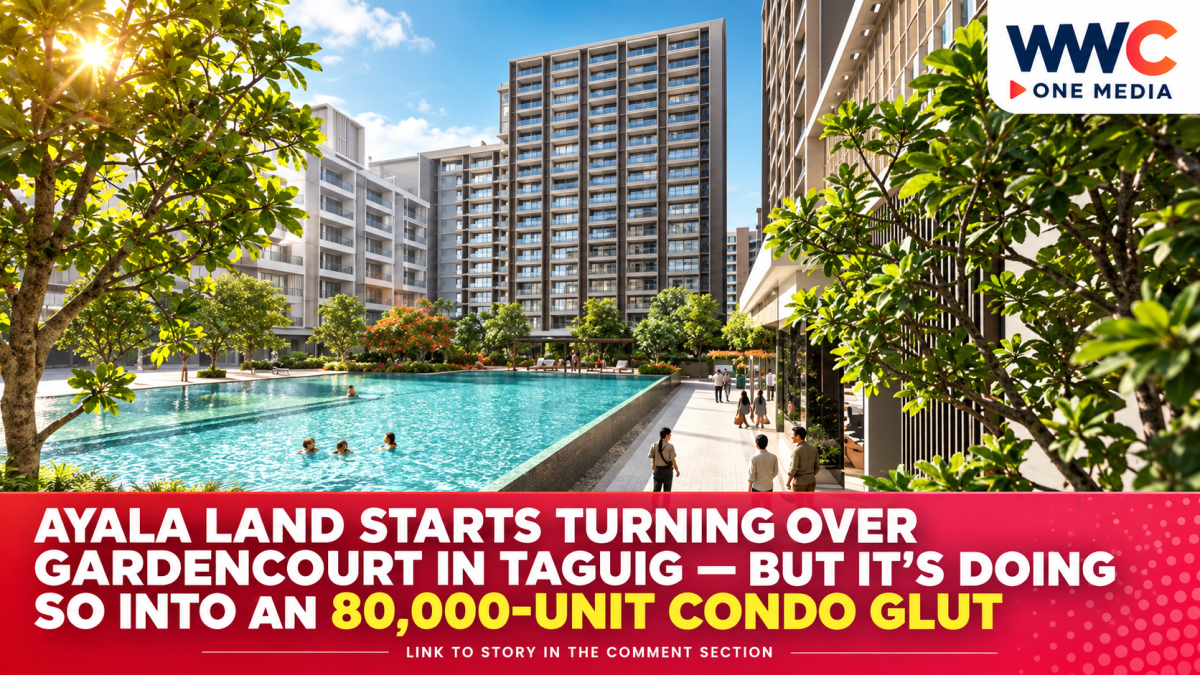
TAGUIG CITY, Philippines — Ayala Land Premier has begun handing over homes at Gardencourt Residences in Arca South, marking another major step in the buildout of Ayala Land’s 74-hectare Taguig estate at a time when the developer is racing to convert thousands of previously sold units into completed homes.
The first turnover covers Molave, the initial building in the 2.1-hectare Gardencourt development. Molave contains 134 units, and as of the second week of September, four buyers had formally accepted their residences while one homeowner had already moved in.
Gardencourt is Ayala Land Premier’s second residential project within Arca South, following Arbor Lanes, and is eventually planned to consist of five mid-rise residential buildings built around extensive landscaped open space.
But the significance of the turnover stretches beyond one luxury condominium project.
Ayala Land is trying to deliver roughly 13,000 residential units across 40 projects in 2026 after completing close to 6,000 units during the first half. That leaves around 7,000 scheduled deliveries for the second half if the company is to reach its full-year target.
Ayala Land is shifting from launching to delivering
The strategy reflects a wider change inside the country’s largest listed property developer.
Ayala Land entered 2026 with a large amount of previously launched inventory and a more cautious approach toward introducing new condominium projects as economic uncertainty and softer buyer sentiment weighed on property development.
Its first-half residential sales reservations reached ₱46.4 billion, down 22% year on year. Premium residential products—the segment that includes Ayala Land Premier—generated ₱31.5 billion, declining 8%, while the company’s core residential segment dropped 38% to ₱14.9 billion.
That makes the premium segment relatively more resilient inside Ayala Land’s portfolio, even as the wider residential market remains difficult.
President and CEO Anna Ma. Margarita Bautista-Dy said in August that the company had reduced residential inventory to roughly 15 months, near its pre-pandemic level, while prioritizing project completion, collections and deliveries.
Gardencourt therefore represents something Ayala Land currently needs as much as another property launch:
execution.
A sold condominium does not become a finished home until construction is completed, inspections are passed and buyers actually accept their units.
The turnover comes during a historic Metro Manila condo glut
The timing also makes Gardencourt an interesting test of the premium residential market.
Colliers Philippines estimates Metro Manila had around 80,000 unsold condominium units in the second quarter of 2026, including approximately 32,600 ready-for-occupancy units. Residential vacancy stood at 24.9% and is projected to peak at 25.6% by year-end before gradually improving from 2027.
Leechiu Property Consultants uses a different methodology but reached a similar conclusion about the market’s scale, reporting a record 82,900 units of unsold inventory across 616 actively selling condominium buildings during the second quarter.
Those figures should not be interpreted as 80,000 empty finished condos—the inventories include units at different stages of development and marketing—but they demonstrate how much supply developers still need to absorb.
The market has consequently become much more selective.
Colliers says economic and affordable housing has become the strongest driver of condominium demand, while many developers are clearing existing inventory before aggressively launching new towers.
Gardencourt sits at the opposite end of that market: a low-density, premium development whose strategy depends less on affordability and more on location, space, exclusivity and the broader transformation of Arca South.
Five buildings wrapped around one large garden
Ayala Land designed Gardencourt around a noticeably different concept from the high-density vertical developments found in many Metro Manila business districts.
The development will eventually comprise five buildings across about 2.1 hectares, with residences ranging from roughly 68 to 261 square meters and no more than 12 units on a floor.
At the center is a private landscaped courtyard covering about 5,000 square meters, containing lawns, pedestrian paths and shared amenities.
The East and West lawns alone provide about 1,035 square meters of open space, while residents also have access to jogging paths and a pool complex.
The development includes large windows, balconies and higher ceilings, while Molave has its own Sky Garden.
Singapore-based Habitus Design Group designed several of the communal areas, including the fitness center, Garden Pavilion, Garden Lobby and Sky Garden.
One small accuracy point is worth preserving: older promotional material has sometimes cited a 6,000-square-meter Gardencourt, while the latest turnover material describes the private central courtyard as 5,000 square meters. For a current news story, the latest company figure is the safer number.
Arca South itself is becoming a bigger part of the sales proposition
Gardencourt is being delivered into an estate that looks considerably different from when its first residential projects were originally sold.
Ayala Land opened Ayala Malls Arca South in February 2026, strengthening the retail component of the estate. The company’s 2025 annual report said the mall is intended to serve as a major commercial anchor as Arca South gains momentum.
In April, Ayala Land also opened a transport hub and the 26,000-square-meter Arca Main Street, a pedestrian-focused corridor connecting residential areas with Ayala Malls Arca South, Arca South Pitch and other destinations.
The estate already contains Healthway Cancer Care Hospital and Landers, while additional office and commercial developments are being built out. Gardencourt is within walking distance of several of those facilities.
Longer term, Arca South is also expected to benefit from the planned Taguig City Integrated Terminal Exchange, which is designed to link bus and public-utility transport with future rail connectivity. Previous Ayala Land disclosures said the five-hectare terminal is designed for as many as 160,000 passengers and 5,200 vehicles daily once fully developed.
Those transport projects are forward-looking, however, and should not be written as though all planned rail and expressway connections are already operating.
There is also 2.5 million liters of infrastructure buyers rarely see
One of Gardencourt’s less visible selling points sits underground.
Arca South includes a stormwater detention system capable of temporarily holding about 2,500 cubic meters—or 2.5 million liters—of excess rainwater before releasing it gradually into the drainage network.
That type of infrastructure is increasingly relevant in Metro Manila, where intense rainfall can overwhelm local drainage systems.
Ayala Land says it employs variations of the same approach in other estates, including an underground detention facility in Bonifacio Global City, a rain garden at Vertis North and temporary water storage at Cloverleaf.
The system does not make an estate immune from flooding, and it would be misleading to portray it as such.
Its purpose is to manage peak stormwater volume and reduce pressure on downstream drainage infrastructure.
Ayala Land needs deliveries as property-development earnings weaken
Gardencourt’s turnover also comes during a softer financial year for its parent.
Ayala Land reported ₱75 billion in first-half revenue, down 10%, while net income attributable to shareholders fell 19% to ₱11.5 billion. Property-development revenue declined 22% to ₱41 billion, with residential revenue down 15% to ₱35.3 billion.
The picture improved sequentially in the second quarter, with net income rising 13% from the first quarter to ₱6.1 billion.
The company has consequently stressed tighter inventory control and completion of commitments already made to buyers rather than maximizing the number of new launches.
In that environment, every completed tower matters.
Turning over a residential building reduces construction risk, allows buyers to occupy or lease their properties and moves the developer closer to completing a large backlog of commitments.
Gardencourt is small compared with Ayala Land’s 13,000-unit target
Molave contains only 134 residences.
Measured against Ayala Land’s planned 13,000 deliveries this year, it is a small part of the total.
But it represents a much broader question hanging over Philippine property developers in 2026.
The industry already has thousands of units for sale.
Buyers have become more selective.
Vacancies are elevated.
New launches have slowed.
And construction costs and economic uncertainty have made project execution increasingly important.
That changes what counts as good news for a developer.
During a property boom, announcing another tower may be the headline.
In today’s market, finishing the tower, handing over the keys and getting owners through the door may matter more.
Gardencourt has now begun that process.
Four buyers had accepted their homes by the second week of September.
One had already moved in.
For Ayala Land, the bigger test is repeating that process thousands more times before 2026 ends.




Leave a Reply