
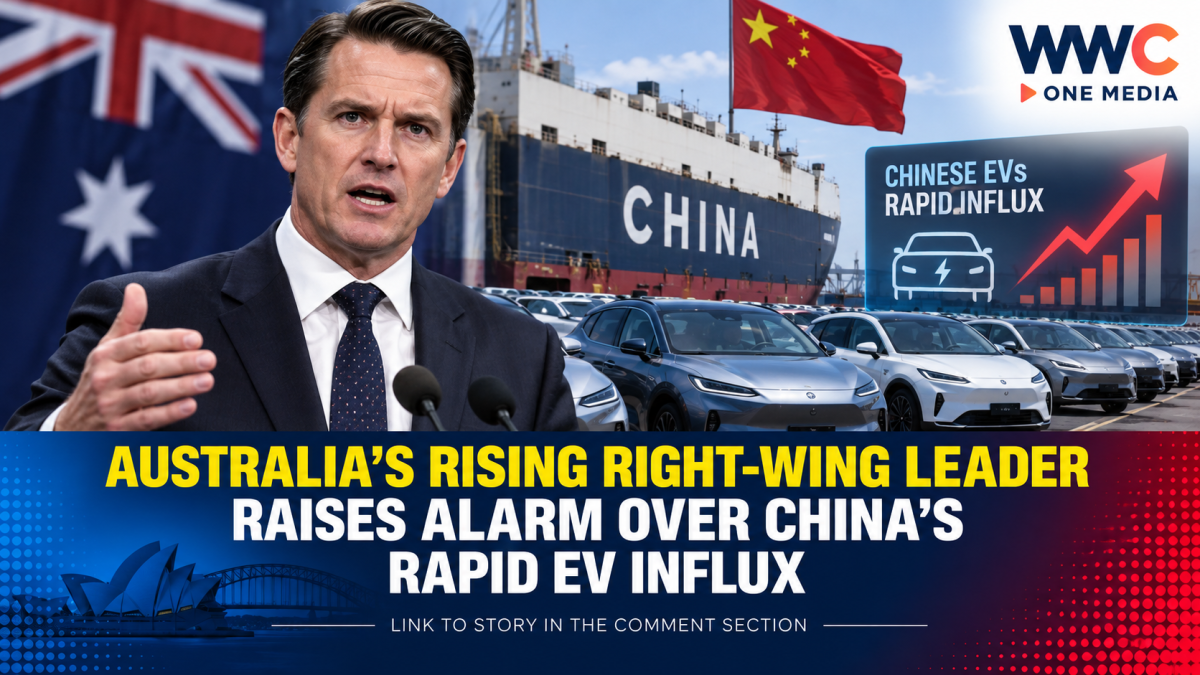
CANBERRA — Australia’s rapidly expanding market for Chinese electric vehicles is becoming a new political flashpoint, with One Nation leader Pauline Hanson warning about the growing presence of Chinese-made cars as the brands rapidly gain ground among Australian buyers.
Hanson and her party have previously argued that the growing number of Chinese EVs entering Australia raises economic and national-security concerns. One Nation has specifically called for greater scrutiny of Chinese-made electric vehicles and their potential implications for Australia’s automotive market.
But the political warnings come as Chinese manufacturers are becoming an increasingly important part of Australia’s rapidly expanding electric-vehicle market.
Chinese EV Brands Are Gaining Ground
The latest sales figures illustrate the scale of the shift.
In August 2026, battery-electric vehicle sales in Australia jumped 171% from a year earlier, according to figures reported by the Federal Chamber of Automotive Industries.
Chinese manufacturers were prominent among the country’s best-selling brands. BYD delivered 8,231 vehicles, compared with 4,877 in August 2025, while Geely recorded 4,504 sales — more than 10 times its sales a year earlier. Chinese brands including BYD, GWM, MG, Geely and Chery all ranked among Australia’s top 10 brands for the month.
That momentum is not confined to one month.
Australian reporting has documented the rapid expansion of Chinese EV brands such as BYD and GWM-owned Haval, as electric vehicles move further into the mainstream.
BYD’s Price Push Changes the Market
One of the clearest signs of the competition came this week when BYD launched its Atto 1 at a drive-away price of A$19,990, making it Australia’s cheapest new car.
The aggressive pricing puts pressure on traditional petrol-powered vehicles as well as established EV competitors.
The model’s relatively modest range and output show that its appeal is heavily tied to affordability, but the price nevertheless illustrates how Chinese manufacturers are changing the competitive landscape.
Why Hanson Is Raising the Alarm
Hanson’s concerns are part of a broader debate about Australia’s economic relationship with China.
China is Australia’s largest trading partner, while Chinese manufacturers have become increasingly important suppliers in the country’s automotive market.
One Nation has argued that the expansion of Chinese EVs could have implications for Australian manufacturing, economic dependence and national security. The party has previously described the influx as a potential market and security threat.
However, these are political claims and policy arguments, rather than findings that Chinese EVs currently constitute a confirmed national-security threat.
Australia Also Has a Stronger Reason to Embrace EVs
The growth of Chinese EVs is occurring alongside a broader Australian shift toward electric mobility.
EV sales have been rising sharply, with Australian buyers increasingly choosing battery-electric and hybrid vehicles.
The trend is part of a global transformation in the automobile industry, with Chinese manufacturers benefiting from enormous domestic production capacity, competitive pricing and increasingly sophisticated vehicle technology.
China itself is moving even faster. Reuters reported this month that EVs accounted for about 65% of China’s vehicle sales in July, with researchers at Sinopec projecting EV penetration could eventually reach 75%–80% by 2030.
The Security Question Remains Unresolved
One of the most controversial issues surrounding connected electric vehicles is data.
Modern cars can contain cameras, microphones, navigation systems, internet connections and large amounts of information about their users and surroundings.
That has led some governments and security officials to question how connected vehicles should be regulated when manufacturers are based in countries considered strategic competitors.
But concerns over potential data or cybersecurity risks should be distinguished from evidence of actual misuse.
Australia’s debate is therefore moving toward a difficult balancing act: encouraging affordable electric transport while examining questions surrounding data security, supply-chain dependence and the role of foreign manufacturers.
China Is Moving Beyond Cars
The debate also comes as China attempts to establish itself as a global leader in smart and autonomous vehicles.
China’s industry ministry recently announced a roadmap aimed at accelerating the development of smart electric vehicles and supporting the mass deployment of autonomous driving technology by 2030.
That means the competition is no longer simply about who can build the cheapest electric car.
It increasingly involves batteries, software, autonomous driving, connected services and artificial intelligence.
For Australia, that could make the question of Chinese EVs increasingly important as the country’s vehicle fleet becomes more digital.
A Political Battle Meets a Changing Car Market
Hanson’s warnings arrive at a moment when Australian consumers are voting with their wallets, with Chinese brands rapidly expanding their sales while EV adoption accelerates.
The central debate is therefore becoming more complicated than simply whether Chinese cars are popular.
It now involves price, consumer choice, Australian industry, national security, data protection and Australia’s relationship with China.
The market numbers show Chinese EV manufacturers are already making significant gains.
The bigger question is whether Australia will treat that transformation primarily as a consumer-driven automotive revolution—or as a strategic challenge requiring tighter scrutiny.




Leave a Reply