
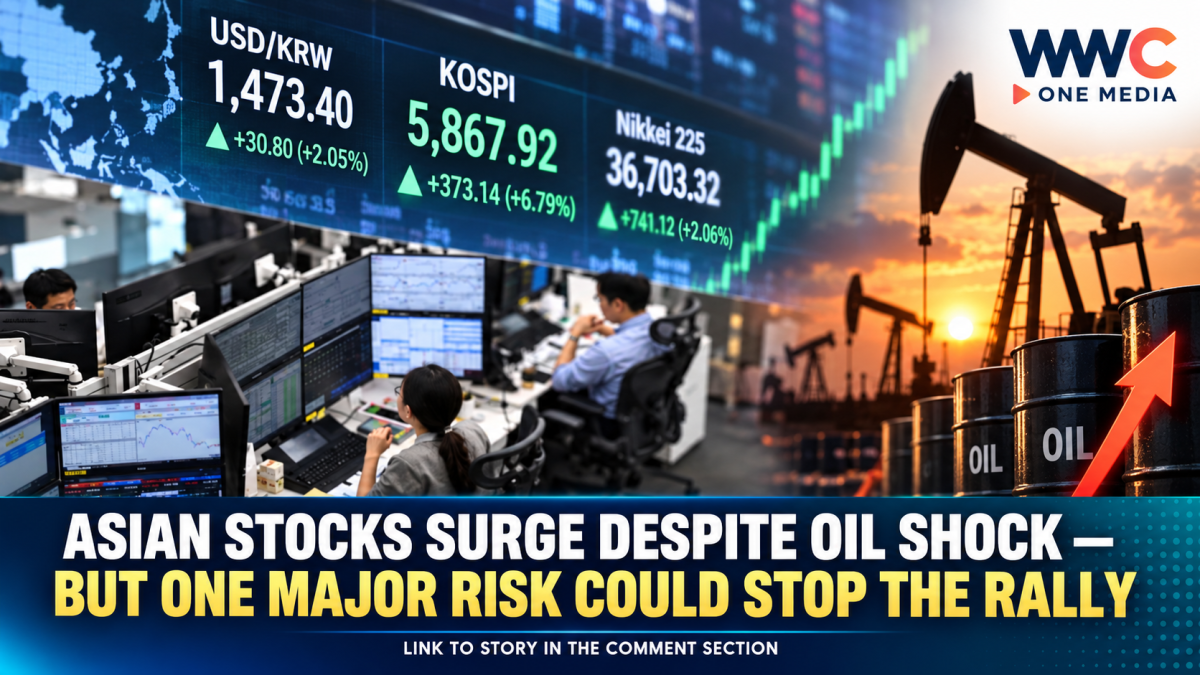
The rally highlighted a growing divide in global markets: investors remain optimistic about economic growth, but rising energy costs and expectations of tighter monetary policy are making traders increasingly cautious.
Japan and South Korea led the advance, while broader Asian markets also moved higher. However, the gains came as oil prices continued climbing, raising concerns that inflation could once again become the biggest threat to the global economy.
Strong U.S. Jobs Report Lifts Asian Markets
Investor confidence received a boost from the latest U.S. employment figures, which pointed to continued strength in the world’s largest economy.
The stronger-than-expected jobs data improved the outlook for global growth and encouraged investors to return to equities after recent market volatility.
Japan’s Nikkei climbed about 2%, while South Korea’s Kospi surged roughly 3%. MSCI’s broadest index of Asia-Pacific shares outside Japan also moved higher.
The market reaction showed that investors are still willing to buy stocks when economic data points to resilient growth.
But the optimism came with a major warning.
Oil Prices Rise as Middle East Tensions Fuel Supply Fears
Oil prices continued to move higher as investors monitored escalating tensions involving the United States and Iran.
Brent crude traded around US$96 per barrel, while U.S. West Texas Intermediate crude approached US$92, according to Reuters market reporting.
The rise in oil prices has renewed concerns about potential disruptions to global energy supplies and shipping routes, particularly around the Strait of Hormuz — one of the world’s most strategically important oil transit corridors.
Higher crude prices can quickly filter through the global economy by increasing transportation, manufacturing and consumer costs.
That creates a potentially difficult situation for central banks.
The Big Problem: Strong Growth Could Mean Higher Interest Rates
Normally, strong employment data would be welcomed by investors.
But markets are now facing a different problem.
A resilient U.S. economy, combined with rising oil prices, could make inflation more difficult to control. That could force central banks to keep interest rates elevated for longer — or even raise them further.
Reuters reported that markets have increased expectations for further monetary tightening, with investors closely watching upcoming inflation data and central bank decisions.
The European Central Bank is among the institutions expected to remain a major focus for investors this week.
Meanwhile, speculation surrounding potential policy moves by the Bank of Japan is also supporting the Japanese yen and adding another layer of uncertainty to currency and bond markets.
OPEC+ Keeps Oil Policy Unchanged
Oil traders are also digesting the latest decision from OPEC+.
The oil-producing alliance decided to keep its output policy unchanged for October as members continue discussions over future production quotas. The decision comes at a time when geopolitical disruptions and supply concerns have already placed significant pressure on global energy markets.
Analysts have warned that higher production targets do not always translate directly into additional physical supply, particularly when geopolitical disruptions affect exports and shipping.
That means the oil market could remain highly sensitive to developments in the Middle East.
Why Asian Investors Are Still Buying Stocks
Despite the growing risks, Asian investors appeared willing to focus on the positive economic outlook.
Strong U.S. employment growth suggests that consumer demand and business activity remain resilient, potentially supporting corporate earnings and international trade.
However, the rally could face pressure if oil prices continue rising.
Asian economies — particularly major oil-importing nations — can be vulnerable to sharp increases in energy costs. Higher oil prices can worsen inflation, increase import bills and put pressure on currencies.
Recent Reuters reporting has also highlighted how rising crude prices are becoming an increasingly important factor for emerging Asian markets, including India, where investors are closely monitoring the combined impact of oil prices, central bank intervention and U.S. monetary policy.
What Investors Are Watching Next
The next few days could determine whether Monday’s Asian market rally has staying power.
Investors are now closely watching:
- Upcoming U.S. inflation data
- Federal Reserve interest-rate expectations
- European Central Bank policy decisions
- Possible Bank of Japan action
- Further developments involving the U.S. and Iran
- Oil supply and shipping risks in the Middle East
- OPEC+ production developments
The key question facing markets is becoming increasingly clear:
Can global economic growth remain strong enough to support stocks without allowing inflation to return?
For now, Asian markets are betting on growth.
But with oil prices climbing and central banks facing renewed inflation pressure, investors may soon discover that the latest market rally comes with a much higher price.
Bottom Line
Asian shares bounced higher after strong U.S. jobs data reinforced confidence in global economic growth. But rising oil prices and geopolitical tensions are creating a new threat: inflation could accelerate again, forcing central banks to keep interest rates higher for longer.
The market is celebrating strong growth today — but investors may soon have to decide whether that same economic strength is becoming the next major risk.
WWC ONE MEDIA J.M.S




Leave a Reply