
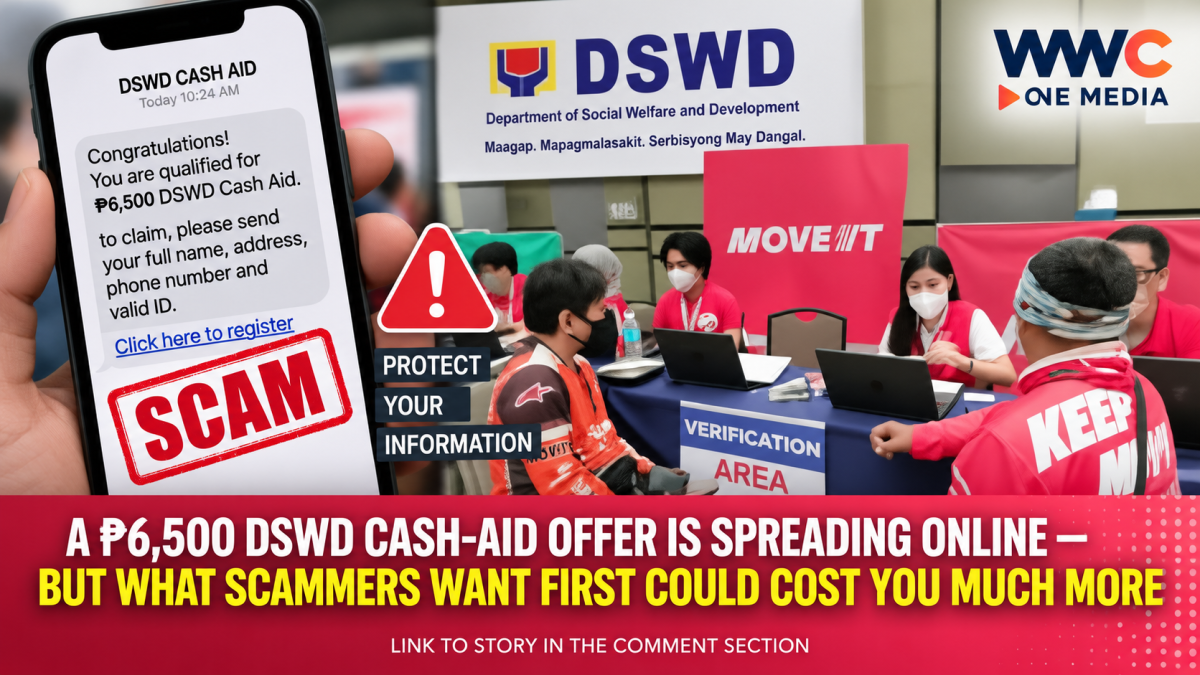
MANILA, Philippines — A message arrives promising ₱6,500 in government cash assistance.
All you supposedly have to do is provide your name, cellphone number, address or other personal details.
For Filipinos struggling with food prices, medical bills or everyday expenses, the offer can sound believable.
The Department of Social Welfare and Development says it isn’t.
The DSWD has renewed its warning against online scammers offering ₱6,500 in supposed financial assistance in exchange for personal information, stressing that collecting cellphone numbers, addresses and other personal details through unsolicited private messages is not part of the agency’s aid process.
And the danger may not end when somebody realizes the promised cash never arrives.
Because in earlier versions of the same scam, DSWD says fraudsters went further — sometimes trying to obtain access to victims’ GCash accounts and one-time passwords, potentially turning a fake government-aid offer into financial theft.
The ₱6,500 Offer Is Fake
DSWD spokesperson Assistant Secretary Irene Dumlao reiterated that the department does not ask people to provide their personal information through random private messages in exchange for financial assistance.
The latest warning traces to a DSWD advisory posted around August 31 and was reported by Radyo Pilipinas and Journal Online on September 1 before being highlighted again by Manila Bulletin on September 6.
The message from authorities is straightforward:
A stranger sending you an unsolicited message and promising DSWD money after you provide personal details is a major red flag.
Legitimate DSWD assistance involves official processes and assessment. Applicants for programs such as Assistance to Individuals in Crisis Situation (AICS) may be directed to DSWD Field Offices, SWAD offices or satellite offices, where social workers evaluate the person’s circumstances and supporting documents.
There is no legitimate process in which an unknown person simply messages someone online, promises them a fixed ₱6,500 payment and places them on an official beneficiary list after receiving their phone number.
And This Isn’t the First Time
The latest ₱6,500 warning is part of a pattern that has persisted throughout 2026.
Back in February, DSWD warned about scam messages promising ₱6,500 to ₱8,500 in supposed aid.
Those messages circulated primarily through text and Facebook Messenger and instructed recipients to provide their full names, phone numbers and home addresses to supposedly qualify for assistance.
DSWD said some scammers went even further.
In certain cases, targets were allegedly asked to grant access to their GCash accounts, creating an opportunity for criminals to steal money.
Then in April, another version surfaced promising ₱8,000 in DSWD assistance in return for a person’s contact number.
Again, the agency said the message was fake.
Just days later, DSWD warned of yet another scheme in which scammers demanded ₱1,000 upfront to supposedly release ₱5,000 in government cash relief.
DSWD’s response was unequivocal: the agency does not charge a fee in exchange for financial assistance.
Different amount.
Different message.
Same basic strategy.
Use government assistance as bait, then persuade the victim to surrender something valuable.
First They Want Your Number. Why?
A cellphone number may not look particularly dangerous by itself.
But scammers rarely have to stop there.
The National Privacy Commission describes phishing as a method in which criminals use messages, SMS and fraudulent websites to obtain information such as names, addresses, passwords, financial details and account credentials that can later be used for identity theft or fraud.
Even seemingly ordinary personal information can help a fraudster build a more convincing profile of a victim.
A name plus cellphone number can potentially be combined with information found elsewhere.
An address adds another identifier.
A birthday, ID photograph or account detail increases the value further.
Eventually, the scammer may have enough information to make the next message look far more believable than the first one.
That is why the ₱6,500 promise should not be viewed simply as a fake giveaway.
It can also function as a data-harvesting operation.
Then Comes the More Dangerous Question: Your OTP
One boundary should never be crossed.
Do not give anyone your OTP, MPIN or account password.
GCash specifically advises users never to share an OTP or MPIN and warns customers against clicking links delivered through suspicious SMS or email. If an unknown device attempts to register with an account and generates an OTP, GCash advises users to ignore the OTP, never disclose it and secure the account.
DSWD has issued essentially the same warning.
The department says it does not ask members of the public for one-time passwords in order to receive assistance.
That creates an easy rule for anyone receiving a supposed government-aid message:
The moment somebody asks for your OTP, stop.
Why ₱6,500 Sounds Believable
There is another reason this particular scam can be convincing.
The number does not sound completely invented.
The Philippine government has distributed aid in many different amounts over the years, including legitimate ₱6,500 assistance during the pandemic-era Social Amelioration Program in certain areas.
For example, DSWD records show poor families in parts of Bulacan received ₱6,500 each under the Social Amelioration Program during the COVID-19 emergency in 2020.
But that historical payment does not mean today’s unsolicited ₱6,500 messages are legitimate.
The context, eligibility rules and programs are entirely different.
The same number has also appeared in misinformation more recently.
VERA Files debunked viral claims earlier this year alleging that the government had approved a ₱6,500 monthly “universal pension” for senior citizens. The fact-check found those claims false and noted that some of the videos promoting them were AI-generated.
That illustrates a powerful scam technique:
Take something that sounds familiar and attach it to something that isn’t real.
Real DSWD Assistance Exists — But It Doesn’t Work Like This
The distinction is especially important because DSWD genuinely distributes billions of pesos in assistance.
Its AICS program supports people facing crises with medical, burial, food, transportation, educational and other forms of temporary assistance.
DSWD reported that more than 4.2 million clients received AICS services during the first six months of 2026, with over ₱27.9 billion in assistance facilitated nationwide.
That large legitimate assistance system gives criminals something valuable to impersonate.
But AICS is based on need and social-worker assessment.
The amount somebody receives can vary according to their circumstances and supporting documents; it is not an automatic fixed payment awarded because somebody replied to an unsolicited Facebook message.
DSWD has repeatedly told beneficiaries to deal with its official Field Offices, local social welfare offices, satellite facilities and verified online channels instead of unknown accounts or self-proclaimed intermediaries.
There Is No DSWD ‘Backer’ System Either
Another scam variation relies on political or personal connections.
In January, DSWD warned about individuals contacting people privately and claiming to have a “backer” inside the department who could guarantee or accelerate the release of aid.
Some demanded a percentage of the supposed assistance along with personal information.
DSWD said the claims were fraudulent and emphasized that it does not operate a backer system.
That creates another simple rule:
If somebody claims they can secretly place your name on a government-aid list because they know someone inside DSWD, that is not how legitimate assistance is supposed to work.
Scammers Are Also Exploiting Real Emergencies
Fraudsters do not always invent an entire government program.
Sometimes they hijack a genuine one.
During this year’s fuel-price crisis, DSWD warned about fake text messages claiming recipients were entitled to ₱3,000 in fuel assistance and directing them to an online link.
The legitimate government assistance at the time was different: eligible public utility vehicle drivers were receiving ₱5,000, while the fake messages used the situation to collect sensitive information.
DSWD Secretary Rex Gatchalian stressed that the department was not sending online application links for that cash assistance.
It is a useful example of how sophisticated social engineering works.
The best scams often contain one piece of real news surrounded by false instructions.
Fake Pages and AI Make the Problem Harder
Modern scams are also becoming easier to make convincing.
Fraudsters can copy government logos, photographs and visual branding within minutes.
DSWD separately warned earlier this year about AI-generated material spreading false claims involving the department, noting that realistic synthetic content can mislead viewers who do not verify the source.
That means bad grammar or an obviously fake logo is no longer a reliable way to identify fraud.
A post can look professionally designed.
A video can feature a convincing human face.
A page can copy DSWD’s colors and government seals.
A message can even know your name.
None of those things proves it came from the government.
The more reliable test is where the information originated and whether it can be independently confirmed through official DSWD channels.
If You Receive the ₱6,500 Message, Don’t Give It Anything
DSWD’s warnings and cybersecurity guidance point to several immediate precautions:
- Do not reply with personal details such as your full name, address, cellphone number, ID information or financial information.
- Never disclose your OTP, MPIN or password.
- Do not pay a registration, processing or release fee.
- Do not click suspicious links or submit information through forms sent by strangers.
- Verify the assistance directly with DSWD through its official website, verified social pages, Field Offices or satellite offices.
- Block and report the fraudulent account or number.
- If money or account access has already been compromised, contact the financial provider immediately and report the incident to law enforcement, while preserving screenshots and transaction records as evidence.
The National Privacy Commission likewise advises people to scrutinize unsolicited messages and avoid links that lead to forms requesting personal or financial data.
The Most Valuable Thing in the Scam May Not Be the ₱6,500
The promised money is what catches attention.
But the information being requested may be the real objective.
A scammer does not need to steal money during the first conversation.
The first message may simply establish contact.
The second collects information.
The third builds trust.
And by the time an OTP, payment or financial account is requested, the victim may already believe they are speaking with somebody connected to the government.
That is why DSWD keeps repeating essentially the same warning even as the amounts change from ₱5,000 to ₱6,500, ₱8,000 or ₱8,500.
The amount is the bait.
The request for your personal information is the warning sign.
And the easiest way to protect yourself remains the same:
Before giving anyone your data for government assistance, leave the private message and verify the offer directly with the government agency it claims to represent.
WWC ONE MEDIA M.J.E



Leave a Reply