
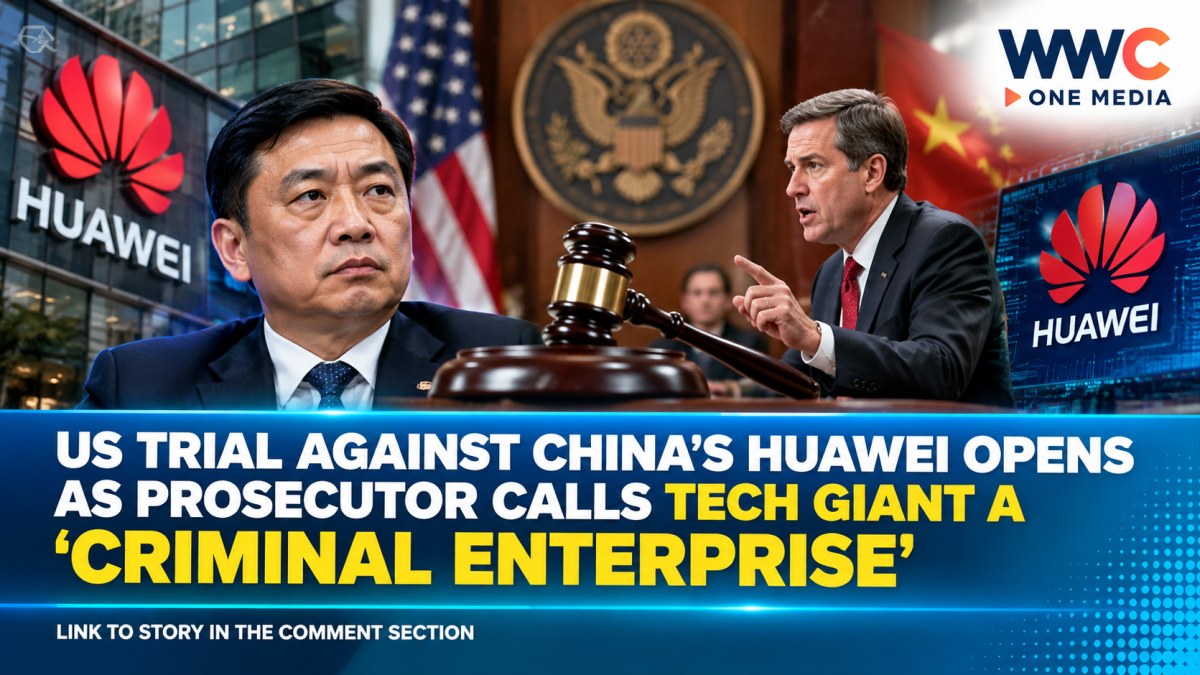
NEW YORK — A high-stakes U.S. criminal trial against Chinese technology giant Huawei has officially begun, with federal prosecutors accusing the company of operating as a “criminal enterprise” that spent two decades stealing American technology, deceiving financial institutions and violating U.S. sanctions.
Huawei has strongly denied the allegations, telling jurors that its global success was built on competition and innovation — not crime.
Prosecutor: ‘Theft, Lies, Cover-Up’
The trial opened in a federal court in Brooklyn on Wednesday, September 9, with U.S. Department of Justice trial attorney Taylor Stout delivering a blistering opening statement against one of China’s most important technology companies.
“Theft, lies, cover-up,” Stout told the jury, according to Reuters.
Prosecutors allege that Huawei spent about 20 years engaging in conduct designed to help it dominate the global telecommunications industry.
The U.S. government claims Huawei conspired to steal trade secrets from five American companies, including technology linked to Cisco Systems and a robotic phone-testing device developed by T-Mobile. Prosecutors said they intend to present evidence that employees were caught attempting to obtain American technology improperly.
Huawei Fires Back: ‘Competition, Not Conspiracy’
Huawei’s defence team presented a dramatically different picture of the company.
Defence lawyer Brian Heberlig told jurors the case was about “competition, not conspiracy” and “innovation, not theft.”
Huawei’s lawyers argued that prosecutors were taking isolated incidents involving individual employees and attempting to portray them as evidence of a company-wide criminal conspiracy.
The defence said Huawei’s management took action when it discovered employee misconduct and accused the government of selectively presenting evidence to support its broader case.
The Iran Sanctions Allegations
Another major part of the case involves Huawei’s business activities in Iran.
U.S. prosecutors allege that the company misrepresented the nature of its Iranian operations to financial institutions, allowing millions of dollars to move through the U.S. financial system while bypassing American sanctions.
Prosecutors have also accused Huawei of concealing aspects of its Iran-related business through Skycom, a company that operated in the country.
Huawei’s defence disputes the government’s interpretation of the transactions and argues that banks involved were aware of aspects of Huawei’s business in Iran.
Meng Wanzhou’s Case Returns to the Spotlight
The trial also brings renewed attention to Huawei’s chief financial officer, Meng Wanzhou, the daughter of the company’s founder.
Meng was detained in Canada in 2018 at the request of U.S. authorities as part of the original case involving allegations of bank fraud and sanctions violations.
She spent nearly three years fighting extradition before being allowed to return to China in 2021 under an agreement involving the United States.
The charges against Meng were later dismissed in 2022 under a deferred prosecution agreement. However, admissions made as part of that agreement are expected to be introduced as evidence during Huawei’s trial, according to Reuters.
A Case Nearly Eight Years in the Making
The criminal case against Huawei began with a 2018 indictment but later expanded into a far broader prosecution.
The company now faces allegations including racketeering, bank and wire fraud, sanctions-related offences and theft of trade secrets.
The racketeering accusation is particularly significant because prosecutors are seeking to convince jurors that the alleged acts were not isolated incidents but part of a broader pattern of activity carried out by an enterprise.
Why This Trial Matters Beyond the Courtroom
Huawei is one of China’s most prominent global technology companies and remains a major player in telecommunications, smartphones and artificial intelligence technology.
But the company has faced years of restrictions from Washington over national security concerns.
Its telecommunications equipment is heavily restricted in the United States, while U.S. suppliers face limits on exporting certain American goods and technologies to the company without government approval.
The trial now adds another layer of tension to the already complicated technology rivalry between the United States and China.
Trial Expected to Last Three Months
The case is expected to last around three months, meaning jurors could hear extensive testimony about Huawei’s internal operations, its relationships with international companies and its business activities in sanctioned countries.
For prosecutors, the challenge will be proving that the alleged misconduct represented a coordinated corporate strategy.
For Huawei, the challenge will be convincing jurors that the government’s case improperly turns individual incidents and business disputes into a sweeping criminal conspiracy.
The Bottom Line
One of China’s biggest technology companies is now fighting a major criminal case in a U.S. courtroom.
Federal prosecutors have accused Huawei of spending two decades engaging in “theft, lies [and] cover-up” to build its telecommunications empire.
Huawei says the government’s case tells a distorted story — insisting its success came from innovation, competition and legitimate business activity.
Now, after nearly eight years of legal battles, the question goes before a jury: Was Huawei’s global rise built on innovation — or on a criminal enterprise, as U.S. prosecutors allege?
The answer could have consequences far beyond Huawei, potentially becoming another defining chapter in the technology battle between Washington and Beijing.
:::




Leave a Reply