
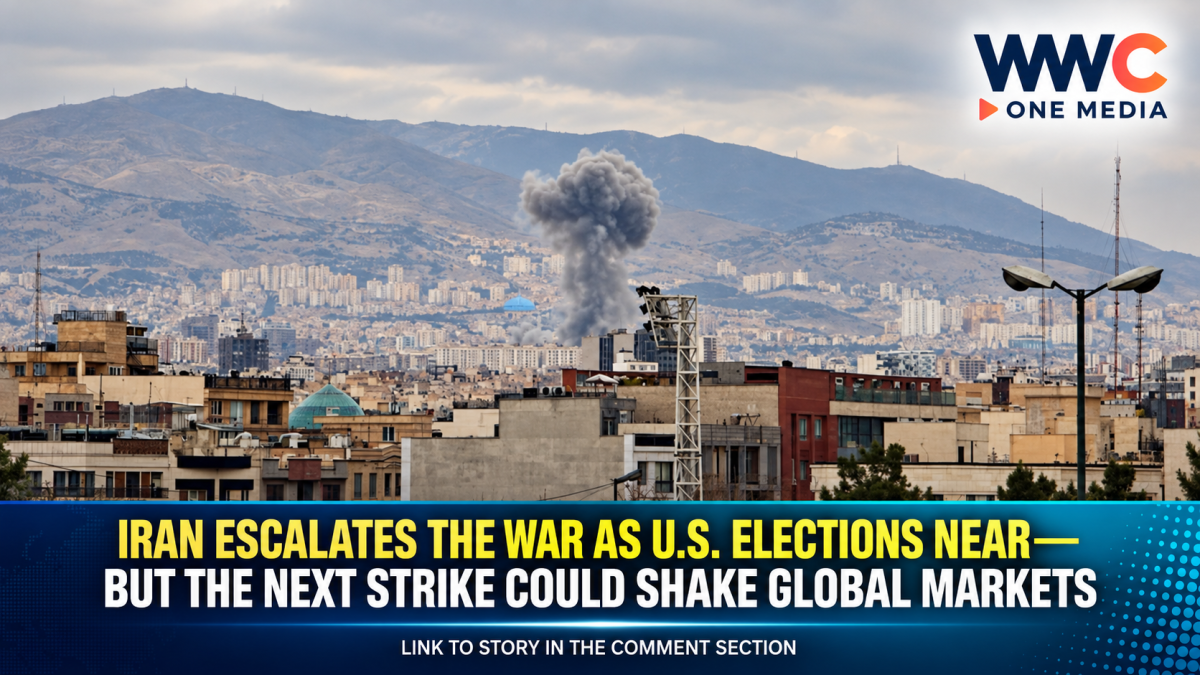
The conflict between Iran and the United States is entering a more dangerous phase, with fresh attacks on ships, threats against military targets and surging oil prices adding new pressure ahead of the November U.S. midterm elections.
What began as a military confrontation has increasingly become an economic and political crisis—one that could affect not only the Middle East, but consumers and businesses around the world.
Iran said it attacked 10 ships near the Strait of Hormuz after U.S. forces destroyed five Iranian oil tankers, marking what Reuters described as the biggest wave of attacks on shipping by both sides since the six-month-old war began. At least one seafarer was reported killed and another was missing.
The immediate consequence was felt in global markets.
Brent crude broke above $100 a barrel, raising fears of renewed inflation, higher fuel costs and broader disruptions to global trade.
But as the conflict escalates, another question is becoming increasingly difficult for Washington to ignore:
Is the war with Iran now becoming a major factor in the 2026 U.S. midterm elections?
The Strait of Hormuz Is Back at the Center of the Crisis
The latest escalation has placed the Strait of Hormuz firmly back at the center of the confrontation.
Before the current conflict, the strategic waterway handled roughly a fifth of global oil and gas shipments. Disruption there can quickly affect energy prices worldwide.
Iran has been attempting to use pressure on maritime traffic as leverage, while Washington has sought to limit Tehran’s economic options through military action, sanctions and pressure on Iranian shipping.
The result has been a dangerous cycle of retaliation.
Iran’s latest reported attacks followed the U.S. military’s destruction of five Iranian oil tankers. U.S. Central Command said the strikes came after Iran twice launched ballistic missiles toward an American warship, although the vessel was not hit.
Iran has also reportedly fired missiles toward a U.S. military base in Jordan, while tensions involving Iran-aligned forces and Saudi Arabia have added another layer of risk to the regional energy picture.
Iran Appears Willing to Raise the Stakes
The latest developments suggest Tehran may be trying to make the cost of continuing the conflict increasingly difficult for Washington and its regional partners.
The Wall Street Journal reported that Iran has recently taken more direct risks against U.S. naval forces, including missile launches toward American warships and an aircraft carrier. U.S. officials have reportedly grown increasingly concerned about Iran’s ability to threaten naval assets.
The strategy may not be to defeat the United States militarily.
Instead, analysts believe Iran could be trying to make the conflict more expensive, more unpredictable and more politically damaging—particularly as oil prices rise and the U.S. election approaches.
That calculation could make the coming weeks especially dangerous.
Trump Says the War Could End After the Election
President Donald Trump has linked the conflict’s trajectory to the upcoming U.S. midterm elections.
Trump said he believes the war could end “immediately after” the November vote, arguing that Iran is trying to influence the political outcome and will eventually be unable to withstand continued pressure. He also acknowledged that oil prices may remain elevated until after the election.
The remarks underline the increasingly political dimension of the conflict.
The midterm elections will determine control of Congress, and rising gasoline prices and broader cost-of-living pressures could become a significant challenge for Republicans.
At a Republican convention in Dallas, Trump defended the war while acknowledging its economic consequences. The Associated Press reported that the president made the conflict a central part of his political message as Republicans prepare for a difficult election environment.
Oil Above $100 Raises the Stakes for Everyone
The biggest immediate concern for consumers and businesses may be energy prices.
Brent crude rose above $100 per barrel, while fears of prolonged disruption around the Strait of Hormuz continued to support elevated oil prices.
Analysts warn that sustained conflict could increase transportation costs, pressure food prices and contribute to wider inflation because energy is embedded in virtually every part of the global economy—from shipping and aviation to manufacturing and agriculture.
The Financial Times reported that renewed attacks, stalled diplomatic efforts and threats to multiple Middle Eastern energy routes have intensified concerns about a deeper supply crunch.
For Asian economies heavily dependent on imported energy, prolonged disruption could be particularly significant.
Is This Becoming Another ‘Forever War’?
Perhaps the most troubling question is whether either side has a realistic path to ending the conflict quickly.
Reuters reported that critics and analysts increasingly see echoes of the long U.S. military campaigns that followed the September 11 attacks. The concern is not necessarily that the Iran conflict will look exactly like Iraq or Afghanistan, but that a campaign launched with limited objectives could gradually evolve into a prolonged confrontation without a clear political settlement.
The U.S. strategy has relied heavily on air and naval power, economic sanctions and pressure on Iran’s energy sector.
Iran, meanwhile, has demonstrated its ability to retaliate through missile strikes, maritime attacks and pressure on regional infrastructure.
That creates a dangerous imbalance.
Neither side may be strong enough to force a quick settlement—but both may be capable of keeping the conflict going.
A New Warning Over Iran’s Nuclear Sites
Adding to the tension, Trump on Thursday warned Iran against what he described as suspicious activity at Pickaxe Mountain, a fortified site near the heavily damaged Natanz uranium enrichment facility.
Trump said the U.S. could respond with force if Iran took provocative action at the site.
The location contains deeply buried tunnel complexes and has become an important point of concern for Washington as the broader conflict continues. Iran maintains that its nuclear program is peaceful and does not possess nuclear weapons.
Any attack involving another Iranian nuclear-related facility could dramatically increase the risk of further regional escalation.
The World Is Watching the Calendar
The conflict is now unfolding against a politically sensitive timeline.
The November U.S. midterm elections are approaching.
Oil has crossed $100.
Shipping in one of the world’s most important energy corridors remains under pressure.
And both Washington and Tehran appear unwilling to make major concessions.
Diplomatic channels and back-channel discussions have not completely disappeared, but hopes for an immediate breakthrough appear increasingly uncertain.
For the United States, the challenge is increasingly political as well as military.
For Iran, continued economic pressure is testing the country’s resilience.
For the rest of the world, the consequences may increasingly be measured at the fuel pump, in electricity bills and across global supply chains.
The Bigger Question Now
The latest attacks show that the conflict is no longer just about military strikes and retaliation.
It is about oil, shipping, inflation, regional power—and now, increasingly, politics.
With the U.S. midterm elections only weeks away, the pressure on Washington to contain the economic fallout is growing.
But if Iran believes escalating the conflict gives it greater leverage—and Washington believes continued pressure will eventually force Tehran to back down—the risk is that both sides could keep raising the stakes.
And with oil already above $100 a barrel, the next escalation may not just shake the Middle East—it could hit economies around the world.
The question is no longer whether the war can escalate. It already has. The real question is: who will blink first—and what happens if neither side does?



Leave a Reply