
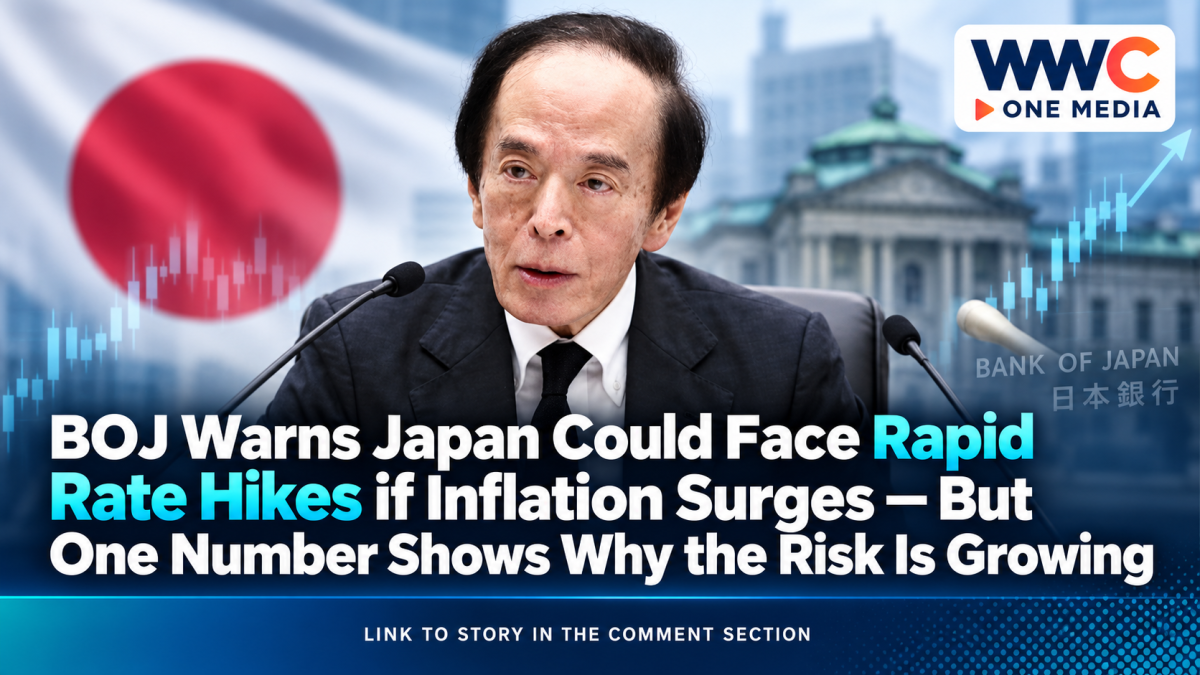
TOKYO — Japan spent decades fighting deflation with some of the world’s lowest interest rates. Now, a Bank of Japan policymaker is warning that the opposite problem could force the central bank to move faster than markets and borrowers have become accustomed to.
BOJ Policy Board member Kazuyuki Masu said Thursday that Japan could eventually be forced into rapid interest-rate increases if inflation accelerates, arguing that financial conditions remain relatively accommodative even after several rounds of monetary tightening.
The warning comes just days before the BOJ’s September 17-18 policy meeting, where economists overwhelmingly expect another increase in borrowing costs.
But Masu’s message went further than simply signaling another quarter-point move.
His concern is that if the BOJ waits too long while inflation pressures continue to build, the central bank could eventually find itself having to raise rates much more aggressively.
The number that explains Masu’s concern: 2%
Japan’s official inflation target is 2%, but Masu said the BOJ’s estimate of underlying inflation—designed to look through temporary factors such as volatile fresh-food prices, oil shocks and government subsidies—is already “very close” to that level.
That distinction matters.
Headline inflation can rise or fall because of temporary energy subsidies, rice prices or tax policies. Underlying inflation is intended to tell policymakers whether price increases are becoming embedded throughout the economy.
Masu argued that Japan has now fully transitioned away from its long period of deflation. That means the BOJ’s challenge is changing: instead of struggling to create inflation, policymakers increasingly need to prevent inflation from becoming excessive.
And evidence of broader cost pressures is beginning to appear.
Masu pointed to a recent 7% increase in Japan’s corporate goods price index, saying companies are now more willing than before to pass higher costs on to customers. Motor-freight transportation costs were also rising at close to 6% year over year in July, potentially spreading higher costs across everything from food distribution to retail goods.
Oil, food and the weak yen could create a dangerous combination
Japan is particularly vulnerable to international energy shocks because it imports much of the energy it consumes.
Masu said slightly more than 70% of Japan’s crude-oil imports had recently passed through the Strait of Hormuz. The continuing Iran conflict has therefore pushed up the cost of oil, chemicals and transportation, with knock-on effects potentially spreading across the Japanese economy.
Food presents another risk.
Even as the extraordinary rise in rice prices begins to ease, Masu warned that higher transportation expenses, packaging costs, shipping rates and imported fertilizer prices could trigger another round of increases in food prices.
Then there is the yen.
Masu stressed that currency policy belongs to the Japanese government rather than the BOJ. But he also acknowledged that yen depreciation is feeding into domestic prices more strongly than it did in the past, making exchange-rate movements increasingly relevant to the inflation outlook.
That is one reason Tokyo’s currency problems have become intertwined with monetary policy.
The BOJ rate is 1% — Masu thinks policy still looks loose
The Bank of Japan currently has its policy rate at 1.0%, following a June increase that took borrowing costs to their highest level in roughly three decades.
Yet Masu highlighted BOJ estimates suggesting Japan’s nominal neutral interest rate could lie somewhere between roughly 1.1% and 2.5%.
The neutral rate is the theoretical level that neither stimulates nor restricts economic activity.
Because the current 1% policy rate remains below that estimated range, Masu argued that Japan’s monetary conditions are still accommodative. He said he believes the BOJ should raise rates further so that policy moves solidly into the estimated neutral range.
This does not mean the BOJ has committed to rates as high as 2.5%. The bank itself emphasizes that the neutral-rate estimate is extremely uncertain and should be treated as a reference rather than a precise target.
But it does show why policymakers may believe Japan still has room to tighten.
September hike now overwhelmingly expected
The market is already preparing for the next move.
A Reuters poll conducted from September 1 to 8 found that 66 of 68 economists, or 97%, expect the BOJ to raise its policy rate by 25 basis points to 1.25% on September 18.
That is a dramatic shift from the previous Reuters survey, when only 57% expected a September increase.
More economists are also expecting the BOJ to keep tightening sooner than previously thought. About one-third of respondents forecast another increase to 1.50% in October or December, while 89% expected the rate to reach at least 1.50% by the end of March 2027.
Around 62% expected rates to reach at least 1.75% by the end of the second quarter of 2027.
That would represent an extraordinary transformation for a country that maintained zero or negative interest rates for years.
Japan’s economy is giving the BOJ room to move
Higher rates would be much harder to justify if Japan were sliding toward recession.
For now, however, recent economic data have strengthened the case for further tightening.
Japan’s economy expanded at an annualized 1.4% rate during the April-June quarter, revised upward from an initial 1.1% estimate.
Real, inflation-adjusted wages also rose 2.4% from a year earlier in July, the strongest increase since May 2021 and the seventh consecutive month of gains.
Those figures matter because the BOJ has spent years looking for a self-sustaining cycle in which higher wages support consumption, companies raise prices moderately and workers receive additional wage increases.
Masu said base-pay growth has recently been running at around 3%, arguing that if inflation settles close to 2% while wages continue increasing at approximately that pace, Japanese households could continue experiencing positive real-wage growth.
Why the BOJ does not want to wait too long
The logic behind gradual tightening is relatively simple: small increases now could reduce the risk of much bigger increases later.
BOJ Deputy Governor Ryozo Himino made a similar argument in August, saying timely rate increases could help Japan avoid a future acceleration in inflation and the need for abrupt tightening. The Japan Times, citing Bloomberg, reported that markets were already assigning a high probability to a September increase at the time.
Masu’s September warning reinforces that argument.
The BOJ has raised rates five times since March 2024, but Japan is still emerging from an extraordinary monetary experiment involving negative rates and massive central-bank asset purchases.
Moving too aggressively risks damaging consumption, investment and heavily indebted borrowers.
Moving too slowly creates the opposite danger: inflation could become entrenched, forcing the BOJ to slam on the brakes later.
That is the balancing act now facing Governor Kazuo Ueda and the rest of the Policy Board.
There is another global risk: the yen carry trade
What happens in Tokyo will not stay in Tokyo.
For years, extremely low Japanese interest rates encouraged investors to borrow cheaply in yen and invest the money in higher-yielding currencies, bonds, equities and other assets overseas—a strategy known as the yen carry trade.
Reuters reported that cross-border yen borrowing, one proxy for the scale of these trades, had surged to a record ¥360 trillion, roughly $2.35 trillion, by March 2026.
The yen has already rallied sharply as traders price in higher Japanese rates. Reuters reported that it recently climbed around 4.5% in a week, reaching its strongest level since February.
When the yen rises while Japanese rates increase, carry trades become less attractive.
Investors may then unwind their positions by buying back yen and selling other assets—a dynamic capable of amplifying volatility far beyond Japan.
Markets still remember August 2024, when a BOJ rate increase and a sudden strengthening of the yen helped trigger a violent carry-trade unwind and global market turbulence.
But “rapid hikes” are not yet the BOJ’s base case
This point is crucial.
Masu is one member of the BOJ Policy Board, and his warning describes what could happen if inflation accelerates. It is not an announcement that the bank has decided to begin raising rates aggressively.
Reuters analysis this week suggested that the more likely immediate strategy remains a 25-basis-point increase to 1.25%, rather than a surprise half-point move. BOJ officials appear keen to tighten gradually enough to keep inflation expectations anchored without creating another major financial-market shock.
The significance of Masu’s speech is therefore not that Japan is suddenly preparing emergency rate increases.
It is that a BOJ policymaker is openly warning that the option could become necessary.
Japan’s next rate hike may be the easy decision
With nearly every economist in Reuters’ latest survey expecting a September increase, a move to 1.25% may no longer be the most important question.
The much bigger issue is what happens afterward.
If oil and transportation costs ease, the yen stabilizes and underlying inflation remains around 2%, the BOJ could continue normalizing policy gradually.
But if higher energy prices, food costs, wage increases and currency weakness begin reinforcing one another, the central bank could find itself facing exactly the scenario Masu warned about: inflation rising while monetary conditions are still too loose.
And after decades in which investors became accustomed to Japan having virtually no interest rates at all, the real market shock may not be Japan raising rates once.
It could be discovering how quickly the BOJ is prepared to keep raising them.




Leave a Reply