
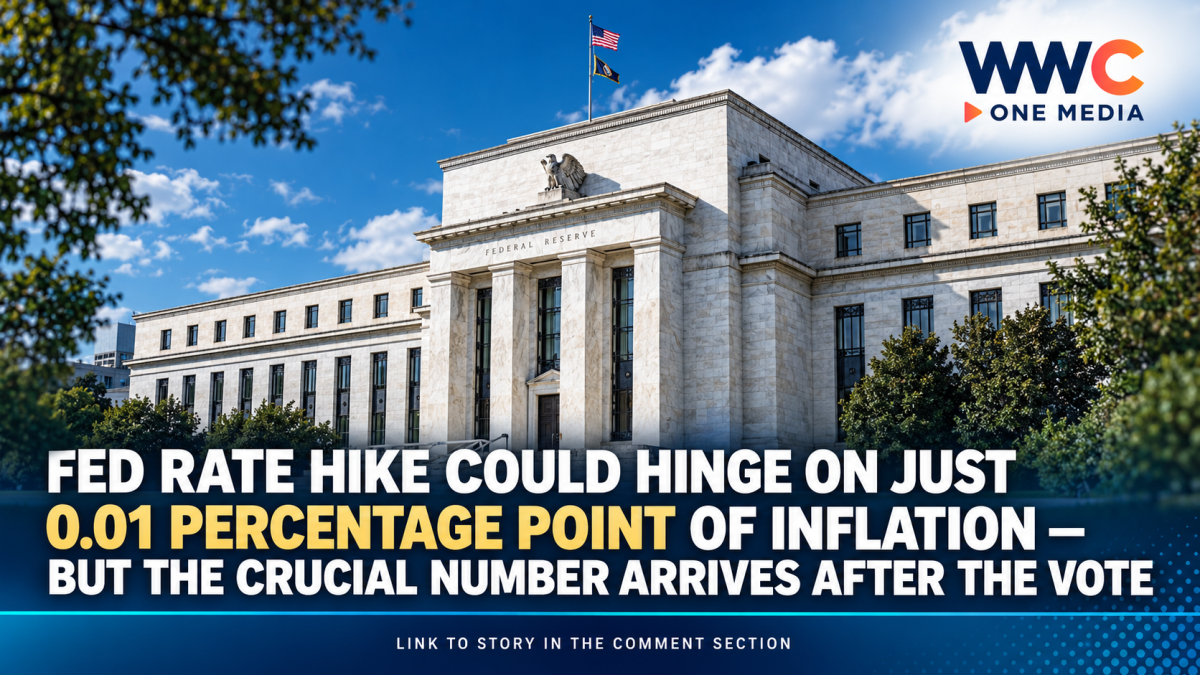
WASHINGTON — The Federal Reserve is heading toward one of its most finely balanced interest-rate decisions in years, with Wall Street economists arguing that a difference of only a few hundredths of a percentage point in underlying inflation could separate a rate hike from another hold.
The Federal Open Market Committee meets September 15-16, with its policy decision and press conference scheduled for September 16. The Fed’s benchmark federal funds rate is currently 3.50% to 3.75%.
What makes the September meeting unusually difficult is that policymakers will receive major inflation reports just days before voting—and the Fed’s preferred inflation gauge for August will not officially be published until September 30, two weeks after the decision.
That leaves markets trying to extract extraordinary meaning from extraordinarily small differences.
The difference between a hold and a hike may be 0.01%
CNBC’s Jeff Cox reported that Krishna Guha, head of economics and central bank policy at Evercore ISI, believes the rate decision could come down to the implied monthly reading for core Personal Consumption Expenditures inflation, the measure that strips out volatile food and energy prices.
Guha’s analysis suggested an implied core PCE increase of around 0.21% or 0.22% could favor keeping rates unchanged, while a reading closer to 0.23% or 0.24% could strengthen the argument for an increase. In other words, the policy debate could conceivably turn on as little as one or two hundredths of a percentage point.
That does not mean the Fed has an official 0.23% trigger. There is no publicly announced mathematical threshold requiring policymakers to hike at one number and hold at another. Instead, the figures illustrate just how close the economic and policy arguments have become.
The CPI number Wall Street is watching
Economists have been expecting August headline Consumer Price Index inflation to rise roughly 0.4% month over month, while core CPI is expected to increase about 0.2%.
Wall Street Journal reporting likewise found economists focused on the possibility that a seemingly minor difference—such as core inflation coming in at 0.1%, 0.2% or 0.3%—could materially change expectations for what the Fed does next.
MarketWatch reported a similar divide: a softer 0.1% core CPI reading could strengthen the argument for patience, while a hotter 0.3% increase could make a hike much harder for policymakers to avoid.
The Cleveland Fed’s inflation nowcast as of September 8 put August core CPI at 0.20% month over month and headline CPI at about 0.36%, illustrating how closely forecasts are clustered around the dividing line investors are watching.
But CPI is not actually the Fed’s preferred inflation gauge
This is where the September decision gets complicated.
The Federal Reserve formally targets inflation using the PCE price index, not the CPI. The latest official figures from the Bureau of Economic Analysis show that overall PCE inflation was 3.7% year over year in July, while core PCE inflation was 3.3%.
Both remained well above the Fed’s longer-run 2% inflation objective.
The problem is timing.
The August CPI and Producer Price Index reports arrive before the September Fed meeting and contain components economists can use to estimate what August PCE inflation will eventually show. But the official August PCE report is scheduled for September 30.
So Fed officials will effectively have to make their September decision using an informed estimate of their preferred inflation measure rather than the final published number.
That unusual timing explains why several hundredths of a percentage point are suddenly commanding so much attention.
Strong jobs data changed the calculation
Only weeks ago, the argument for another rate increase appeared weaker.
Then the August employment report showed the U.S. economy adding 162,000 jobs, with unemployment holding at 4.1%. The stronger labor-market numbers convinced several major forecasters that the economy might be capable of absorbing tighter monetary policy.
UBS, for example, shifted its outlook after the jobs report and began forecasting 25-basis-point increases in September and December, according to Reuters.
A resilient labor market matters because it reduces one of the risks traditionally associated with raising rates: pushing an already weakening economy into a sharper slowdown.
But it also creates a problem for the Fed. If jobs remain solid while inflation remains significantly above target, policymakers have less reason to tolerate persistent price pressures.
Oil above $100 adds a new inflation threat
The decision has become even harder because energy prices have surged.
Reuters reported Brent crude above $100 a barrel on September 9 amid escalating Middle East tensions, pushing Treasury yields higher and reviving fears that expensive energy could feed another round of inflation.
Energy prices can have an unusually broad impact. Higher crude prices affect gasoline and transport directly but can also raise shipping, manufacturing and distribution costs throughout the economy.
The Fed typically tries not to overreact to temporary oil shocks. But a sustained increase can become more troubling if businesses begin passing those costs to consumers or workers demand higher wages to compensate for rising living expenses.
That is one reason headline inflation could look considerably hotter than core inflation in August.
Fed officials themselves are divided
Fed Governor Christopher Waller has indicated that continued moderation in inflation would strengthen the case for keeping rates steady, while a stronger-than-expected inflation report could justify tightening.
Associated Press reported that Waller’s comments helped underscore how dependent the September decision has become on the final inflation readings.
Other policymakers have sounded more concerned about persistent inflation. Cleveland Fed President Beth Hammack has been among officials advocating a tougher stance, while Waller, Michael Barr and New York Fed President John Williams have emphasized the importance of incoming data.
Chair Kevin Warsh therefore faces a potentially difficult job building agreement inside an increasingly divided committee.
Markets say hike. Economists still lean hold.
Perhaps the most striking part of the story is the disagreement between markets and professional forecasters.
Financial markets recently put the probability of a September rate increase at around 60%, following the stronger jobs report and renewed inflation fears. Reuters reported similar market pricing after oil prices climbed sharply.
Yet a Reuters poll published September 9 found that a majority of economists still expect the Federal Reserve to hold rates at 3.50%-3.75% in September and through the remainder of 2026.
The confidence behind that call, however, has weakened considerably, with more economists now expecting at least one rate increase before the year ends.
That divergence means Thursday’s producer inflation report and Friday’s consumer inflation report could cause an unusually sharp repricing across bonds, stocks, currencies and commodities.
Why one decimal can move trillions of dollars
A quarter-point Fed increase may sound small, but its influence extends across the global financial system.
The federal funds rate helps determine the cost of money throughout the economy. Changes can filter into Treasury yields, mortgages, corporate borrowing, credit cards, auto loans and bank financing. They can also affect the dollar and global capital flows.
For investors, the immediate question is whether inflation is cooling quickly enough for the Fed to stay patient.
For consumers and businesses, the bigger question is whether borrowing costs remain elevated—or move higher again.
And for the Federal Reserve, the September meeting presents a particularly uncomfortable choice: tighten policy and risk doing too much, or hold rates and risk allowing inflation to remain above target for even longer.
The extraordinary part is how little may separate those two outcomes.
If economists such as Evercore’s Guha are right, 0.01 percentage point buried inside an inflation estimate could help determine the direction of U.S. interest rates—and potentially move markets around the world.




Leave a Reply