
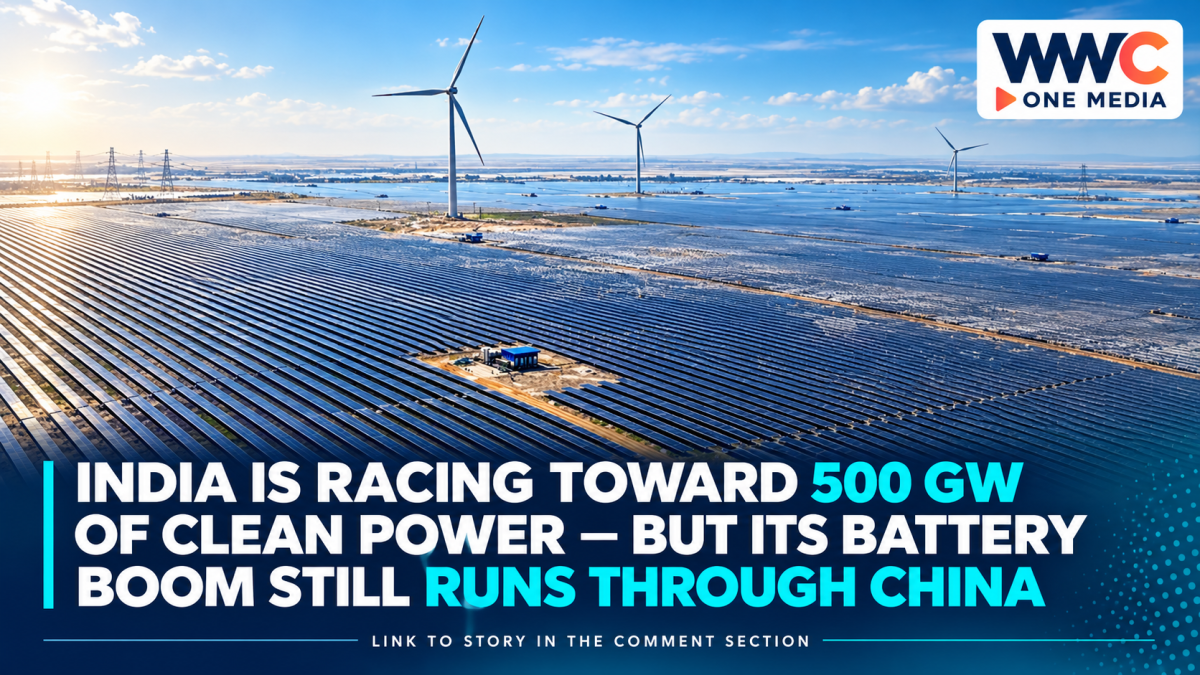
NEW DELHI — India is building solar farms, wind projects and battery installations at a pace that could reshape one of the world’s biggest power markets.
But buried inside that green-energy boom is an uncomfortable strategic problem.
The more India builds renewable power, electric vehicles and grid-scale storage, the more batteries it needs—and much of the technology, processed materials and components behind those batteries still trace back to China.
That leaves New Delhi facing an energy-security paradox: India is trying to reduce its dependence on imported fossil fuels, yet its clean-energy transition risks replacing one form of overseas dependence with another.
The International Energy Agency estimates that China accounts for roughly 80% of global lithium-ion battery supply-chain production capacity, with concentration even greater in some upstream components, including anode materials.
For India, that concentration is no longer an abstract geopolitical concern.
It is becoming an industrial bottleneck.
India has already crossed a huge clean-energy milestone
India’s renewable transformation is substantial.
As of July 31, 2026, the country had surpassed 300 gigawatts of non-fossil-fuel electricity capacity, according to India’s Ministry of New and Renewable Energy.
Solar accounted for about 164.6 GW, wind for 58.1 GW and hydro for 57.2 GW. Non-fossil sources represented more than 54% of India’s roughly 552 GW of installed generating capacity.
India’s longer-term goal is 500 GW of non-fossil electricity capacity by 2030.
It had already achieved another headline target early: non-fossil sources passed 50% of installed capacity in June 2025, more than five years ahead of the country’s original Paris Agreement-linked milestone.
Yet installing solar panels is only part of the problem.
Solar power disappears after sunset. Wind output fluctuates. To make those renewable sources capable of delivering electricity when consumers actually need it, India needs enormous amounts of energy storage.
That is where batteries become strategic.
India’s battery market is about to explode
Reuters reported in July that India had around 260 GWh of battery-storage projects at various stages of development.
Operational battery storage jumped from just 0.78 GWh at the end of 2025 to 8.7 GWh by mid-2026, according to the India Energy Storage Alliance. The organization expected capacity to approach 10 GWh by the end of this year.
The government is preparing to push storage even harder.
Draft regulations unveiled in September would require new government-backed solar and wind projects to incorporate battery storage from July 2027, further increasing demand for cells and energy-storage systems.
But India currently does not manufacture enough battery cells to satisfy that emerging demand.
And that is where Beijing enters the equation.
More than 80% of India’s lithium-ion battery imports came from China
A 2026 study by Koan Advisory Group and the Institute of Chinese Studies found that Chinese suppliers accounted for 83.6% of India’s lithium-ion battery imports in fiscal 2025-26.
The value of those imports from China had more than doubled from 2021-22 to reach about $3.9 billion in FY2025-26, according to the study.
India’s own government has acknowledged the broader vulnerability.
The Ministry of Heavy Industries said in March that India’s current requirement for critical minerals such as lithium is met through imports and warned that China’s export controls covering certain lithium-ion batteries, cathode materials, artificial-graphite anodes and related manufacturing technology could tighten global supply conditions.
The ministry specifically said the restrictions create potential supply-chain risks for Indian companies dependent on Chinese midstream processing.
That means India’s challenge goes considerably deeper than importing finished batteries.
Even a battery carrying a “Made in India” label can still depend on Chinese equipment, materials, designs or processing technology farther upstream.
Reliance is trying to break that equation
Few companies illustrate India’s ambition—or the difficulty of achieving it—better than Reliance Industries.
Mukesh Ambani’s conglomerate is building a massive green-energy manufacturing complex in Jamnagar, Gujarat, as part of its effort to move beyond its traditional oil and petrochemicals businesses.
Battery production is one of the project’s central pillars.
And Reliance’s latest disclosures are considerably more ambitious than its earlier plans.
At its 2026 shareholder presentation, Reliance said the first phase of its combined battery energy storage system and cell gigafactory will have 40 GWh of annual capacity and is scheduled to be commissioned in 2026.
The company now intends eventually to increase annual capacity to 120 GWh.
Reliance said all equipment for the first phase had reached the site.
During its July results presentation, company executives again said battery manufacturing was progressing and that the 40-GWh facility would be commissioned this year.
If Reliance successfully reaches the proposed 120-GWh scale, it would become one of the world’s biggest lithium-iron-phosphate battery manufacturers.
But getting there has not been straightforward.
Earlier reports exposed how difficult cutting China out can be
In January, Bloomberg reported that Reliance had encountered problems securing battery-cell technology from Chinese producer Xiamen Hithium Energy Storage Technology as Beijing tightened restrictions on overseas technology transfers.
The report said talks over licensing technology stalled and suggested Reliance had shifted its near-term emphasis toward battery-pack and energy-storage-system assembly.
Reliance disputed the central premise.
The company told Reuters there had been “no change” in its battery strategy and insisted that cell manufacturing, battery-pack production and containerized energy-storage systems all remained part of its plan. Reuters said at the time that it could not independently verify Bloomberg’s account.
That distinction remains important today.
It would therefore be inaccurate to publish a new story saying Reliance has abandoned battery-cell manufacturing.
It has not, according to its latest disclosures.
In June and July, Reliance went further, saying construction and equipment installation were advancing and reaffirming plans to commission the initial 40-GWh cell and BESS facility during 2026.
The larger question is how much of the eventual supply chain India can genuinely localize.
CATL talks showed the supply-chain reality
Reliance was also reported in May to be discussing purchases of battery-energy-storage-system components from CATL, China’s battery giant, as well as other global suppliers.
Those discussions were described as potentially giving Reliance another source of components for the Jamnagar operation.
There is nothing unusual about an Indian manufacturer sourcing components internationally.
The strategic concern is concentration.
When one country dominates cell manufacturing, cathodes, anodes, processing equipment and technical know-how simultaneously, normal commercial sourcing can become a vulnerability if export policy changes or geopolitical tensions interrupt supply.
China demonstrated precisely that risk when it introduced tighter controls over exports involving some battery materials and manufacturing technology.
Even India admits local cell production is still tiny
New Delhi has attempted to close the manufacturing gap through its Production Linked Incentive program for Advanced Chemistry Cell battery storage.
The program carries an outlay of ₹18,100 crore and is designed to establish 50 GWh of advanced-cell manufacturing capacity in India.
As of March 2026, however, only 1 GWh of installed capacity was recorded among the program’s beneficiaries, despite 40 GWh having been awarded to participating companies.
The government itself acknowledged in February that domestic battery demand was still being met largely through imports.
Outside the PLI program, at least 10 manufacturers had announced roughly 178 GWh of additional cell capacity over the following five years—but announced factories are not the same thing as commissioned, commercially competitive plants.
That gap between announced capacity and operating capacity is central to India’s problem.
Wood Mackenzie says true self-sufficiency could be years away
Research firm Wood Mackenzie reached an even more sobering conclusion in August.
It estimated that India’s domestic battery manufacturing currently represents less than 1% of the roughly 260-GWh storage-demand pipeline emerging from competitive tenders.
Although more than 226 GWh of cell-manufacturing projects have been announced through 2035, Wood Mackenzie said execution delays, financing challenges and dependence on Chinese and Korean technology could leave India 10 to 15 years away from a globally competitive, self-sufficient battery-cell industry.
That does not mean India’s localization drive will fail.
It means building a battery industry involves much more than constructing factories.
India also needs competitive cathode and anode production, refining, chemical processing, machinery, intellectual property, skilled workers, recycling capacity and reliable access to lithium and other critical minerals.
China spent decades building precisely that ecosystem.
Batteries could become the new oil
The strategic stakes become clearer when viewed through India’s traditional energy vulnerability.
India has long depended heavily on imported crude oil.
Electrifying vehicles and expanding renewables can reduce that exposure. But replacing petrol-powered cars with EVs and coal-heavy grids with solar-plus-storage does not automatically create energy independence if the batteries underpinning both systems depend overwhelmingly on foreign supply chains.
In other words, the commodity changes—but the geopolitical problem can remain.
India’s government appears aware of that danger.
It launched the National Critical Mineral Mission in 2025 to strengthen domestic exploration, mining, processing and recycling and has pursued overseas lithium resources, including projects in Argentina.
The country is also investing in battery recycling and incentivizing domestic production of active materials and other battery components.
But China’s head start is enormous.
Beijing controls far more than battery factories
China’s competitive advantage extends throughout much of the clean-energy manufacturing chain.
The IEA estimates China holds around 80% of lithium-ion battery supply-chain production capacity, approximately 85% of solar manufacturing capacity, and extraordinarily high shares in certain upstream processes—including around 97% of battery anode-material capacity.
That scale produces another challenge for emerging competitors: cost.
Chinese producers have enormous manufacturing volumes, mature supplier networks and highly integrated production chains.
Indian companies therefore face a difficult choice.
They can import comparatively inexpensive Chinese cells and components and deploy renewable storage more rapidly—or spend more time and potentially more money building domestic alternatives.
Energy security pushes toward localization.
Immediate affordability pushes toward imports.
India needs both.
China itself is now dealing with battery overcapacity
Ironically, China’s dominance has grown so rapidly that Beijing is beginning to confront problems of its own.
Chinese authorities recently temporarily suspended approvals for new energy-storage battery manufacturing projects, according to Chinese financial media cited by Reuters, amid concern over excess production capacity.
Chinese solar companies including JinkoSolar, JA Solar, LONGi and Trina have meanwhile been moving deeper into batteries as solar-panel margins weaken, increasing competition in an already crowded sector.
For Indian developers, Chinese overcapacity can mean cheaper equipment.
For Indian manufacturers attempting to establish their own factories, those same low-cost imports can make domestic investment much harder to justify.
It is a classic industrial-policy trap.
India cannot simply stop buying Chinese batteries
A rapid break with Chinese supply chains could also slow India’s renewable deployment.
Battery storage is becoming increasingly necessary because India’s grid is already struggling to absorb all the renewable power being generated.
Reuters reported that India curtailed about 8.13 TWh of solar generation during the quarter through June 2026, equivalent to roughly 14% of solar output during the period, citing government and grid data.
More storage would allow excess daytime solar electricity to be captured and released later instead of wasted.
That makes batteries both the solution and the vulnerability.
India needs them quickly.
China can supply them quickly.
But India does not want to remain permanently dependent on China for them.
Reliance’s 40-GWh factory could become an important test
This is why Reliance’s Jamnagar project has significance far beyond one company’s earnings.
The conglomerate says it plans not only to manufacture batteries, but to integrate them with massive solar production and renewable-generation projects.
Its Kutch renewable-energy project is designed to combine solar generation with storage and eventually produce more than 40 billion units of green electricity annually, according to Reliance.
The company is preparing for peak deployment rates of 55 MW of solar modules and 150 MWh of battery containers per day.
If Reliance can manufacture competitive battery cells at scale while progressively localizing materials and technology, it could demonstrate that India can build more of the clean-energy value chain domestically.
If it remains heavily dependent on imported inputs and foreign technical know-how, it will illustrate how difficult escaping China’s ecosystem really is.
The real race is not India versus China
India’s battery challenge should not be reduced to a simplistic contest in which every Chinese import represents failure.
Global manufacturing supply chains are interconnected, and China currently offers technologies and economies of scale that would be extremely difficult for any country to duplicate overnight.
The more realistic goal is to reduce single-country concentration risk while developing Indian capability in the parts of the battery chain where domestic production can become competitive.
That may involve Chinese suppliers in the near term, partnerships with Japan and South Korea, overseas mineral investments, Indian recycling operations and progressively deeper domestic manufacturing.
But the direction is clear.
India has already proved that it can build renewable-power capacity at extraordinary speed.
The next stage is harder.
It must learn how to store that electricity without swapping dependence on imported oil for dependence on imported batteries.
Because India’s clean-energy revolution will not ultimately be judged only by the number of solar panels it installs.
The bigger test is who controls the technology sitting behind them when the sun goes down.




Leave a Reply