
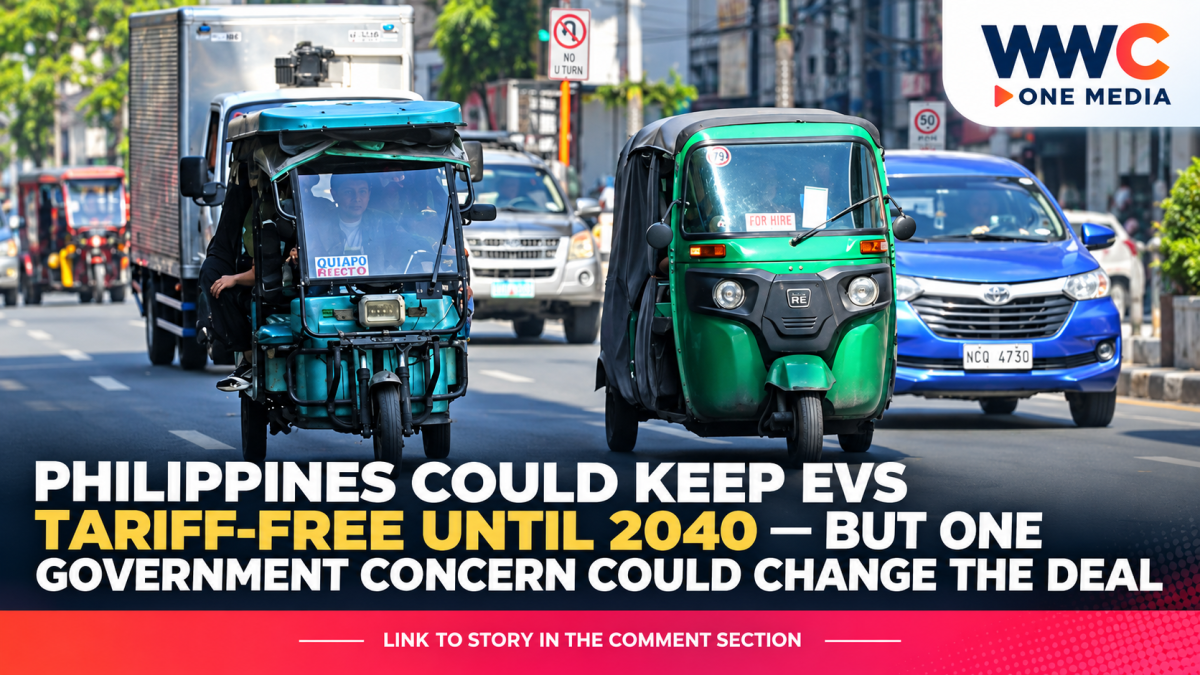
MANILA, Philippines — The Philippines’ rapidly growing electric-vehicle market could be approaching a major policy crossroads, as the government considers calls to keep imported EVs tariff-free long after the current incentive expires in 2028.
The Electric Vehicle Association of the Philippines (EVAP) is pushing for the zero-tariff treatment of electric vehicles to remain in place until 2040, arguing that a longer incentive period could keep EV prices competitive, attract investment and help the country meet its long-term electrification targets.
But the government has yet to make that commitment.
Trade and Industry Secretary Cristina Roque said the proposal may be considered, but stressed that the final position would have to be discussed by the broader government economic team.
Roque also pointed to another major consideration: the Philippines wants not only to import more electric vehicles but also to develop a stronger domestic EV manufacturing industry capable of creating jobs and generating investment.
That sets up a critical balancing act for policymakers — keeping electric vehicles affordable while ensuring generous import incentives do not undermine efforts to build cars, batteries, components and other parts of the EV supply chain locally.
Zero EV Tariffs Currently End in 2028
The Philippines currently imposes zero import duty on covered electric vehicles until 2028.
The policy traces back to Executive Order No. 12, issued by President Ferdinand Marcos Jr. in January 2023, which temporarily reduced tariffs on certain electric vehicles and components as part of the government’s attempt to accelerate EV adoption and reduce dependence on fossil fuels.
The government widened the policy in 2024.
Under Executive Order No. 62, the zero-duty treatment was maintained until 2028 and expanded to cover additional categories, including battery electric vehicles, hybrids, plug-in hybrids and certain EV-related products.
Before the tariff reductions, duties on some imported electric vehicles ranged from 5% to 30%, meaning the policy can materially affect the landed cost of vehicles sold to Filipino buyers.
President Marcos reaffirmed the incentive during his July 2026 State of the Nation Address, saying the government had removed tariffs on EVs until 2028 as part of its clean-energy strategy. He also reiterated the ambition of having half of vehicles in the country powered by electricity by 2040.
EV Industry Wants the Deadline Moved to 2040
EVAP believes 2028 may be too soon to pull back government support.
EVAP Vice President Carla Buencamino has argued that incentives should ideally remain in place until 2040, matching the country’s long-term EV adoption horizon.
Industry officials are also urging policymakers to think beyond vehicle imports. They say incentives and reforms are needed across the entire EV ecosystem, including charging stations, electricity supply, vehicle servicing, batteries and other supporting infrastructure.
EVAP President Willy Tee Ten has similarly backed continued zero tariffs across EV categories, although he acknowledged that the government must also consider its revenue requirements.
The argument comes down to predictability.
Automakers, charging-network operators and investors typically make decisions years in advance. A clear incentive framework extending toward 2040 could give companies more certainty when deciding whether to import vehicles, establish dealerships, install charging infrastructure or invest in Philippine assembly and manufacturing.
Philippine EV Sales Are Surging
The industry is making its case at a time when electrified-vehicle demand is growing dramatically.
Data from the Chamber of Automotive Manufacturers of the Philippines and Truck Manufacturers Association showed sales of battery EVs, hybrids and plug-in hybrids reached 38,286 units from January through July 2026.
That was up 136.4% from 16,195 units during the same period in 2025.
Hybrids remained the largest segment with 20,716 units, while battery electric vehicles reached 10,476 units and plug-in hybrids climbed to 7,094 units.
Perhaps even more striking, electrified vehicles accounted for about 29.5% of vehicle sales in July alone, according to CAMPI-TMA data.
The surge came even as the broader Philippine automotive market struggled. Total CAMPI-TMA vehicle sales from January through July fell to 241,725 units, around 10% below the comparable period a year earlier.
That divergence suggests Filipino consumers are increasingly looking toward electrified powertrains even while overall demand for new vehicles remains under pressure.
Senate Push Could Change the EV Incentive Landscape
The tariff debate is also moving through Congress.
Senate President Win Gatchalian filed Senate Bill No. 2270 in June seeking to amend Republic Act No. 11697, or the Electric Vehicle Industry Development Act.
The proposal would extend the validity of fiscal and non-fiscal EV incentives from eight years to 12 years and establish zero-percent import duties for EVs and related equipment and infrastructure.
It also proposes additional benefits for EV owners, including waived or discounted parking fees, toll-free access through designated EV expressway lanes and a “Buy Now, Register Later” system for newly purchased electric vehicles.
The measure demonstrates that the debate has moved beyond whether the Philippines should encourage EV adoption. The bigger question is how long government support should last — and what kind of EV industry the country ultimately wants to build.
The Bigger Question: Import More EVs or Build Them Here?
Extending zero tariffs through 2040 could help keep imported EVs affordable and potentially accelerate consumer adoption.
But keeping imports duty-free for another decade or more could also complicate Manila’s effort to convince manufacturers to assemble vehicles, batteries and components inside the Philippines.
That concern is becoming increasingly important as the Philippines competes against established automotive manufacturing centers such as Thailand and Indonesia for electric-vehicle investment.
Recent industry analysis has warned that the country still needs deeper supplier networks, stronger infrastructure and a more predictable incentive framework to secure major EV manufacturing commitments.
For the Marcos administration, therefore, the looming decision is bigger than a tariff rate.
It is a choice about how the Philippines wants its electric-vehicle transition to unfold.
Keeping zero tariffs could help put more affordable EVs on Philippine roads faster. Scaling them back, however, could eventually become part of a strategy to encourage automakers to manufacture more vehicles locally.
With the existing incentive scheduled to expire in 2028 and EV sales now expanding at triple-digit rates, the government still has time to decide.
But for automakers, investors and Filipino consumers deciding whether to make the switch to electric, what happens after 2028 could determine just how fast the country’s EV revolution moves.




Leave a Reply