
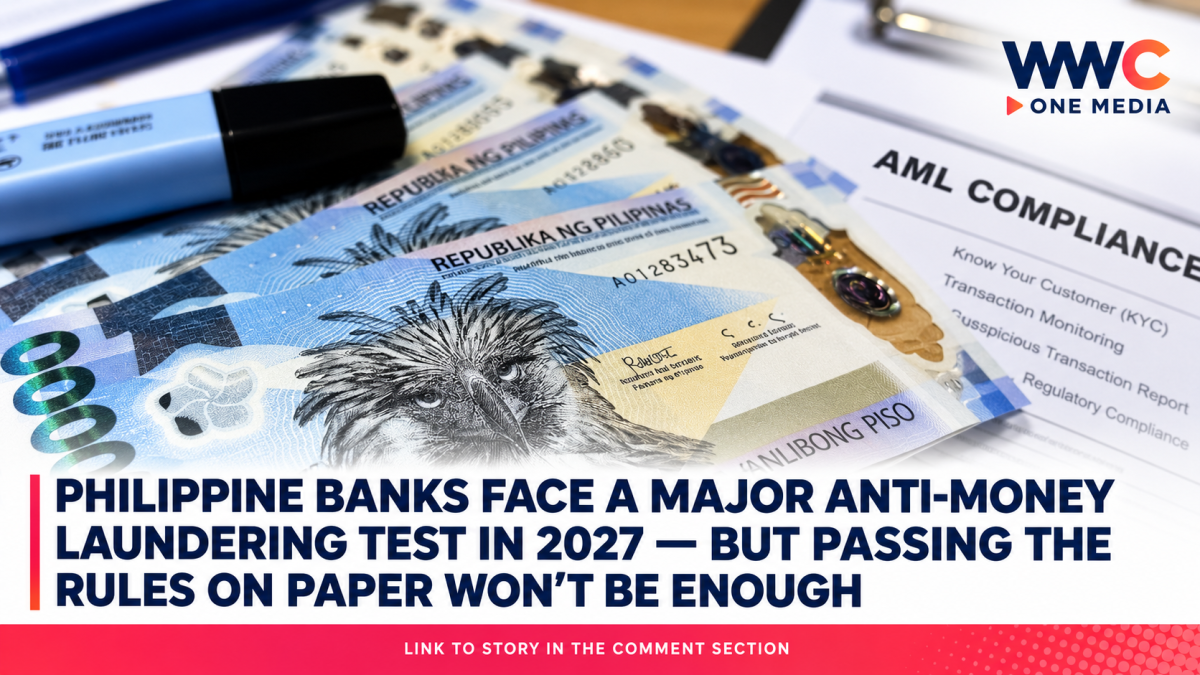
MANILA, Philippines — Philippine banks and other financial institutions are being told to prepare for a major international test of the country’s defenses against dirty money, terrorism financing and proliferation financing, with the Bangko Sentral ng Pilipinas calling for industry-wide cooperation ahead of the Philippines’ next mutual evaluation in 2027.
The BSP has urged all BSP-supervised financial institutions, or BSFIs, to provide “full cooperation and active participation” in evaluation-related activities and data-gathering exercises until the country’s Mutual Evaluation Report is eventually adopted.
The message is significant because the coming assessment will look far beyond whether Philippine banks simply have anti-money laundering rules written into their manuals.
Evaluators will want evidence that those safeguards actually work.
What the 2027 evaluation will examine
The Philippines is preparing for its fourth mutual evaluation, which will assess its anti-money laundering, counter-terrorism financing and counter-proliferation financing—or AML/CTPF—framework.
The assessment has two major dimensions.
The first is technical compliance, which determines whether the country has the necessary laws, regulations and legal mechanisms required under the FATF’s 40 Recommendations.
The second—and increasingly important—area is effectiveness: whether regulators, banks, investigators and other institutions can demonstrate that those measures are producing meaningful results in the real world.
Evaluators will examine effectiveness across 11 Immediate Outcomes, covering areas ranging from risk understanding and financial-sector supervision to financial intelligence, money-laundering investigations, asset confiscation, terrorism financing and international cooperation.
That distinction could become crucial for Philippine banks.
The BSP said information supplied by supervised financial institutions and other credible sources will be important in demonstrating whether the central bank’s supervisory system—and the preventive controls implemented by individual institutions—are genuinely effective.
Banks and other BSFIs could also be asked to provide strategic information demonstrating the Philippines’ continuing compliance with global anti-money laundering standards.
Philippines faces another test after escaping FATF grey list
The review comes only a few years after the Philippines achieved one of its biggest financial-regulatory milestones.
The FATF officially removed the Philippines from its list of jurisdictions under increased monitoring—the so-called grey list—on February 21, 2025.
The country had been placed on the list in June 2021 because of strategic weaknesses in its system for combating money laundering and terrorism financing.
To secure its removal, the Philippines had to demonstrate progress in several areas, including risk-based supervision, regulation of casino junkets and money-transfer services, access to beneficial ownership information, use of financial intelligence, money-laundering investigations and prosecutions, terrorism-financing enforcement and targeted financial sanctions.
The 2027 evaluation therefore presents a different challenge.
Instead of merely proving that previously identified deficiencies have been corrected, Philippine authorities and financial institutions must demonstrate that reforms have become part of a sustainable and effective financial-crime prevention system.
AMLC Executive Director Ronel Buenaventura has already indicated that preparation for the evaluation will focus heavily on turning regulatory reforms into measurable results and directing enforcement resources toward the country’s highest financial-crime risks.
Government mobilizes ahead of the assessment
Preparations now extend well beyond the banking system.
President Ferdinand Marcos Jr. issued Administrative Order No. 46 on July 30, 2026, creating a Philippine working group tasked with coordinating preparations for the APG’s global mutual evaluation program.
The order emphasizes inter-agency cooperation as the country prepares for the 2027 assessment following its successful exit from the FATF grey list.
The government has also been working on an updated national anti-money laundering strategy covering 2026 to 2030, informed by the country’s latest National Risk Assessment and a technical compliance gap analysis against FATF standards.
The Third National Risk Assessment covers financial-crime risks during 2021 to 2024 and includes, for the first time, a dedicated assessment of proliferation-financing risks.
Bigger issues remain beyond banks
International institutions have also warned that the Philippines cannot treat its 2025 grey-list exit as the end of the reform process.
The International Monetary Fund said continued improvements to the country’s AML/CFT framework should remain a priority ahead of the 2027 mutual evaluation.
Among areas highlighted by the IMF are possible reforms to bank secrecy laws to strengthen BSP supervisory powers, improvements in terrorism-financing investigations and prosecutions, greater capacity to investigate cases involving crypto assets and continued development of the national AML/CFT strategy.
That means the next evaluation will test not only banks’ compliance departments but the wider ecosystem connecting regulators, law enforcement agencies, prosecutors, financial intelligence authorities and private institutions.
When will the Philippines actually be evaluated?
According to the current FATF schedule for APG members, the Philippines has a possible on-site evaluation period in November 2027.
The resulting report could then come before the relevant plenary for discussion in July 2028.
Those dates remain described as possible periods rather than immutable deadlines, but they give Philippine banks and regulators a clear preparation window.
For the financial sector, the message from the BSP is increasingly clear: maintaining the Philippines’ improved international standing will require more than compliance documents and written policies.
When international evaluators arrive, Philippine institutions will need to show evidence that suspicious transactions are being detected, risks are being managed, financial intelligence is being used and regulatory safeguards are producing results.
After spending years getting off the FATF grey list, the bigger challenge may now be proving that the reforms that got the Philippines out can keep it from going back.
.



Leave a Reply