
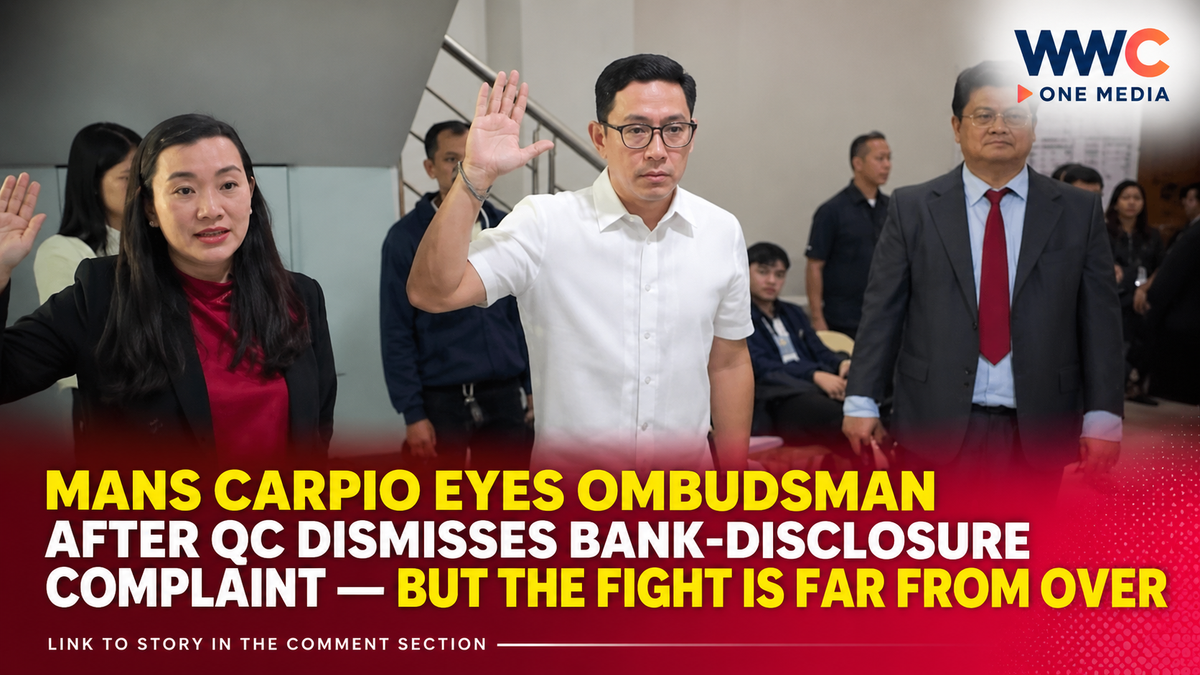
The legal battle over the disclosure of the financial records of Vice President Sara Duterte and her husband, lawyer Manases “Mans” Carpio, is far from over.
Carpio’s camp said Wednesday that it is considering refiling his complaint before the Office of the Ombudsman after the Quezon City Prosecutor’s Office recommended its dismissal on jurisdictional grounds.
Carpio’s lawyer, Peter Paul Danao, said the September 7 resolution did not rule on the substance of their allegations. Instead, the complaint was recommended for dismissal without prejudice because the prosecutor’s office found that the questioned acts were committed by public officials in relation to their official duties.
Carpio camp: The case was not rejected on the merits
Danao said Carpio has yet to receive and fully review the official copy of the resolution.
The lawyer emphasized that the dismissal does not constitute a final ruling that the alleged violations of the Bank Secrecy Law, Data Privacy Act and Anti-Money Laundering Act did not occur.
According to Danao, the resolution instead points toward the Ombudsman as the appropriate forum, given the finding that the respondents allegedly acted in relation to their public offices.
The camp therefore says it is considering all available legal remedies, including challenging the resolution or filing the complaint anew with the Ombudsman.
What started the legal fight?
The dispute traces back to the House impeachment proceedings against Vice President Sara Duterte.
In April, the Anti-Money Laundering Council disclosed before the House Committee on Justice that transactions totaling about P6.7 billion had been recorded under the names of Duterte and Carpio and classified as covered and suspicious transactions.
The AMLC said its submissions included Covered Transaction Reports, Suspicious Transaction Reports and Financial Intelligence Reports covering periods from 2006 to 2025.
Carpio subsequently accused government officials and lawmakers of violating laws protecting financial and personal information.
His camp argued that AMLC information was confidential and should not have been disclosed during the House proceedings.
The complaint named officials including AMLC Executive Director Ronel Buenaventura and BSP Governor Eli Remolona Jr., as well as several members of the House justice committee and impeachment prosecution panel. Supplemental complaints later expanded the list of respondents.
QC prosecutor’s ruling
The Quezon City Prosecutor’s Office took a different view.
A 23-page resolution reportedly found that the issuance of subpoenas, manifestations made during the impeachment proceedings and compliance with the subpoena were acts performed by public officers in connection with their official functions.
The resolution said there was nothing inherently immoral about complying with a subpoena issued by a competent legislative body.
It also reportedly found that the complaint failed to establish a prima facie violation of the Bank Secrecy Law, particularly because the respondents were alleged to have acted pursuant to a lawful order. The Data Privacy Act allegations were likewise assessed in the context of the lawful purpose of the impeachment proceedings.
That distinction is crucial: the QC prosecutor’s dismissal was not a declaration that every issue surrounding the financial records had been finally settled.
Lawmakers welcome the dismissal
Several lawmakers who were respondents in Carpio’s complaint welcomed the development.
Bicol Saro Rep. Terry Ridon, one of the impeachment prosecutors, said the dismissal clears an obstacle as the prosecution prepares to present evidence concerning allegations of unexplained wealth.
Manila 3rd District Rep. Joel Chua also said he expected the complaint to be dismissed, arguing that the case had been used to pressure or intimidate people involved in the impeachment proceedings.
House prosecutor Leila de Lima went further, describing the complaint as a “harassment suit” intended to intimidate lawmakers carrying out their duties.
Carpio’s camp, however, maintains that the dismissal was without prejudice and based on jurisdiction—not a determination that its allegations lacked merit.
The bank records remain central to the impeachment case
The dispute is particularly significant because the financial records remain relevant to the impeachment proceedings against Duterte.
The Senate impeachment court previously authorized subpoenas for Duterte’s and Carpio’s peso-denominated bank accounts, tax records and relevant AMLC records. It also ordered safeguards for sensitive AMLC information, including in-camera review in certain circumstances.
By late July, the Senate impeachment court had formally received financial and tax records from several banks, including BDO, PSBank, Metrobank, Security Bank, LandBank and BPI. The court said access to the documents would be tightly controlled and that AMLC materials would undergo additional review.
The prosecution has said the records are relevant to Article 2 of the impeachment case, which includes allegations concerning unexplained wealth.
The bigger legal question
At the heart of the dispute is a difficult legal clash between financial confidentiality and constitutional accountability.
Carpio’s camp argues that confidential financial information obtained by AMLC cannot simply be disclosed.
Lawmakers, meanwhile, have argued that the impeachment process and lawful congressional subpoenas provide a constitutional and statutory basis for examining information relevant to the allegations against a public official.
Earlier, the House justice committee maintained that what AMLC provided was information concerning covered and suspicious transactions, rather than a direct disclosure of ordinary bank-account records by the banks themselves.
The Senate impeachment court later took an additional step by determining that its constitutional subpoena authority could require relevant AMLC and financial records, while still protecting confidential information through procedural safeguards.
So the latest development does not end the controversy.
It may simply move the fight to another legal arena.
If Carpio ultimately brings the complaint before the Ombudsman, the next question will be whether that office agrees with his camp that the disclosure and handling of the financial information warrant a full investigation—or whether the respondents’ actions were legally protected because they were carried out as part of official impeachment-related duties.
That decision could add another major legal battle to an already explosive impeachment case.




Leave a Reply