
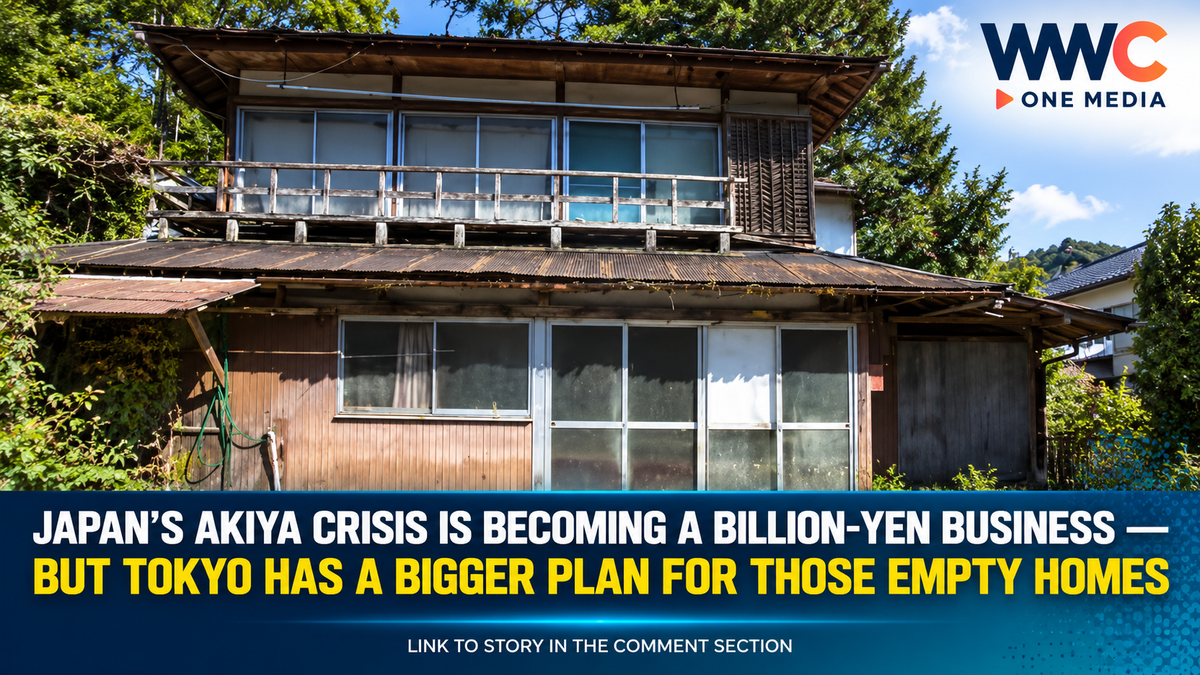
Japan is sitting on a housing problem unlike almost anywhere else.
The country had about 9 million vacant dwellings in 2023, the highest number ever recorded, with a vacancy rate of 13.8%. The official Statistics Bureau said both figures were records.
But buried inside that enormous number is an even more difficult problem: homes that are not being rented, sold or used as second homes.
The Land Ministry’s data show approximately 3.85 million such vacant homes in 2023, while The Japan Times reported the figure at about 3.86 million.
These properties can become increasingly difficult and expensive to maintain as owners age, move away or inherit houses they have little reason to occupy.
Now Tokyo wants businesses to help change that.
Government-backed loans could unlock the market
Under the proposed program, the Japan Housing Finance Agency would provide low-interest financing to businesses renovating vacant homes for rental use.
The policy is being included in the government’s fiscal 2027 budget request, with the goal of encouraging businesses to provide rental housing for families with children as well as low- and moderate-income households.
The financing is aimed at one of the biggest obstacles facing the industry.
Vacant homes can have relatively low collateral value, making banks reluctant to finance their acquisition and renovation. That means a property that could become useful housing may remain untouched simply because a private developer cannot secure sufficient funding to get the project started.
The proposed system would use investment returns from government funds provided to the JHF to support low-interest lending for renovation projects. Local governments would also be involved, potentially giving priority to projects aligned with local housing and community-development plans.
Why rental housing is the key
Japan already has companies that purchase vacant homes, renovate them and resell them.
But converting akiya into rental housing remains far less common.
Jiji Press, as reported by Nippon.com, said rental-focused projects remain largely limited to a small number of businesses because financing is difficult before renovations are completed.
The government’s intervention therefore targets a specific gap:
It isn’t simply trying to get rid of empty houses. It wants to turn them into functioning homes.
That distinction could have major consequences for communities facing both housing shortages and population decline.
The numbers show why Tokyo is worried
Japan’s vacant-home problem has been growing for decades.
The number of vacant dwellings increased from roughly 6.59 million in 2003 to about 9 million in 2023, according to government statistics. The vacancy rate rose from 12.2% to 13.8% during the same period.
And the problem may become significantly larger.
Nomura Research Institute projects Japan’s vacancy rate could reach around 25% by 2043. It also expects the number of detached vacant homes with deterioration or damage to more than double from 2023 levels to about 1.65 million by 2043.
That means the akiya problem isn’t simply about unused real estate.
It is increasingly a question of housing policy, neighborhood safety, property maintenance and Japan’s demographic future.
Akiya could also become social infrastructure
Businesses are already experimenting with different ways of giving abandoned homes a second life.
One Japanese company, Akiya Inc., recently launched services aimed at converting vacant houses into properties for elder-care and welfare facilities, illustrating how the business model is expanding beyond conventional housing. The company said it had worked on more than 100 vacant-home redevelopment projects since its main business launch in 2025.
That points to a potentially much broader market.
Instead of simply asking:
“How can Japan dispose of its empty houses?”
the emerging question is:
“What can Japan turn those houses into?”
Affordable rentals, worker housing, elder-care facilities and community services could all become potential uses, depending on location, building condition and local regulations.
But not every akiya is a hidden bargain
The growing international fascination with Japanese abandoned homes has sometimes created the impression that akiya are essentially free houses.
That is misleading.
Some municipal programs do list properties at extremely low prices, including occasional zero-yen listings, but acquiring an inexpensive house does not eliminate renovation, taxes, maintenance, legal and other costs.
The condition and location of an akiya can also make redevelopment economically difficult.
This is precisely why government-backed financing could matter: the challenge is often not finding an empty house, but making the numbers work after buying and renovating it.
Japan’s bigger problem is population decline
The vacant-home crisis is ultimately tied to a deeper demographic shift.
As Japan’s population ages and the number of households changes, demand for some types of homes is weakening while existing housing stock continues to age.
NRI estimates that Japan’s housing starts will fall from about 800,000 units in fiscal 2023 to 580,000 by fiscal 2040.
At the same time, the country’s existing housing stock will continue to age.
That creates a paradox:
Japan could have millions of empty homes while still needing affordable housing in the places where people actually want to live.
The government’s new financing plan is an attempt to bridge that gap.
The real test comes next
Tokyo’s plan could create a new business ecosystem around Japan’s akiya stock — but financing alone will not solve the problem.
Developers still have to determine whether an individual property can be safely renovated, whether there is enough local rental demand and whether the economics justify the investment.
Local governments will also have to coordinate housing policy, infrastructure and community needs.
Still, the direction is becoming clear.
Japan is moving away from treating vacant homes purely as a liability and toward treating at least some of them as potential housing assets.
With roughly 9 million vacant dwellings already recorded, and the possibility of an even higher vacancy rate in the decades ahead, the question may no longer be whether Japan has too many empty houses.
The bigger question is who will figure out how to make them useful again — and whether there is enough money to do it.




Leave a Reply