
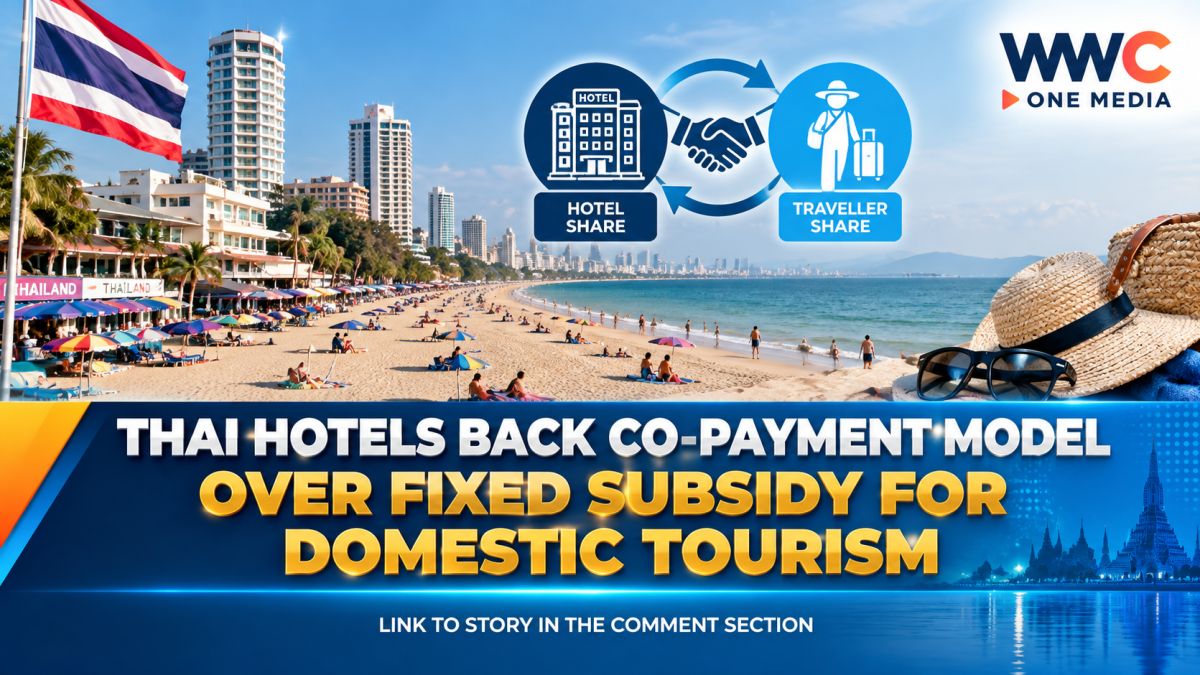
BANGKOK — Thai hotel operators are urging the government to retain a co-payment model for its planned domestic tourism stimulus programme rather than replace it with a fixed subsidy for accommodation.
The debate centres on the proposed Thai Tiew Thai Plus campaign, which is intended to encourage more Thais to travel domestically and support hotels and tourism businesses.
Hotel operators say a co-payment arrangement, in which the government covers part of eligible travel expenses, would be more effective than providing travellers with a fixed subsidy amount.
Hotels prefer travellers to share the cost
Under the proposed co-payment model, the government would pay part of a traveller’s accommodation costs while the traveller covers the remaining amount.
Earlier proposals outlined a 50:50 arrangement, with government support capped at a specified amount for each entitlement.
The proposed programme would also include benefits for tourism-related spending beyond accommodation, such as restaurants, attractions and other eligible services.
Hotel operators believe the structure gives travellers an incentive to spend more while ensuring they also contribute to the cost of their trips.
A fixed subsidy, by comparison, could limit how the benefit is used and reduce flexibility for travellers and businesses.
Domestic tourism scheme aimed at boosting spending
The proposed Thai Tiew Thai Plus programme has been designed to stimulate domestic tourism, particularly during quieter periods for the industry.
The government has discussed a budget of 1.75 billion baht for the programme, with projections that it could generate more than 32 billion baht in economic activity.
Under earlier proposals, 500,000 entitlements would be made available on a first-come, first-served basis, with each person eligible for up to five benefits.
The programme is intended to spread tourism spending across all 77 provinces while supporting smaller businesses and local communities.
Why hotels favour co-payment
Hotel operators argue that a co-payment system can encourage travellers to make additional spending decisions because the government contribution is linked to actual expenses.
For example, when the state covers part of a hotel bill, travellers may be more willing to:
- Stay longer
- Choose additional tourism services
- Spend at restaurants
- Visit attractions
- Travel outside their home province
The model is designed to create a multiplier effect by encouraging private spending alongside government support.
Hotel businesses say this is particularly important for tourism operators that depend on visitors spending money across several services during a trip.
Focus on smaller tourism businesses
The Thai Hotels Association has also pushed for clear rules on which businesses can participate in the scheme.
The government has indicated that the campaign should focus on helping smaller operators and ensuring that tourism spending reaches local businesses and communities.
Industry representatives have called for transparent criteria for participating hotels and have argued that all properties joining the programme should be legally registered.
The issue is important because the final design of the programme could determine whether the benefits are concentrated among larger hotel groups or spread more widely across smaller businesses.
Timing remains important for the industry
Hotel operators have also raised concerns about when the new tourism stimulus should begin.
The Thai Hotels Association previously urged the government to launch the programme earlier so that it could support the industry during the low season.
Operators warned that launching too close to the traditional high season could reduce the programme’s effectiveness, as demand and room rates normally increase during that period.
For hotels, the timing of the subsidy is almost as important as its structure.
A well-timed programme could help fill rooms during quieter months.
A late launch could mean government support arrives when demand is already recovering.
Scheme still subject to government decisions
The proposed programme has gone through several rounds of discussions involving the Tourism and Sports Ministry, Finance Ministry and tourism industry representatives.
While earlier proposals outlined a nationwide co-payment model, the final structure and conditions remain subject to government approval.
Details that have been discussed include:
- A co-payment arrangement for accommodation
- A cap on government support
- Benefits for eligible tourism spending
- Support across all 77 provinces
- A focus on smaller tourism businesses
- A limited number of entitlements
The final programme could still change before implementation.
The bottom line
Thai hotel operators want the government to stick with a co-payment model rather than move to a fixed accommodation subsidy as it prepares its next domestic tourism stimulus programme.
The industry believes sharing costs between the government and travellers would encourage more spending and provide greater flexibility for domestic tourists.
With hotels also pushing for an effective launch date and clear rules for participating businesses, the government now faces key decisions over how the next tourism subsidy programme will be structured.
For hotel operators, the message is clear: a co-payment model is seen as the better way to turn government support into broader tourism spending.
WWC ONE MEDIA J.M.D



Leave a Reply