
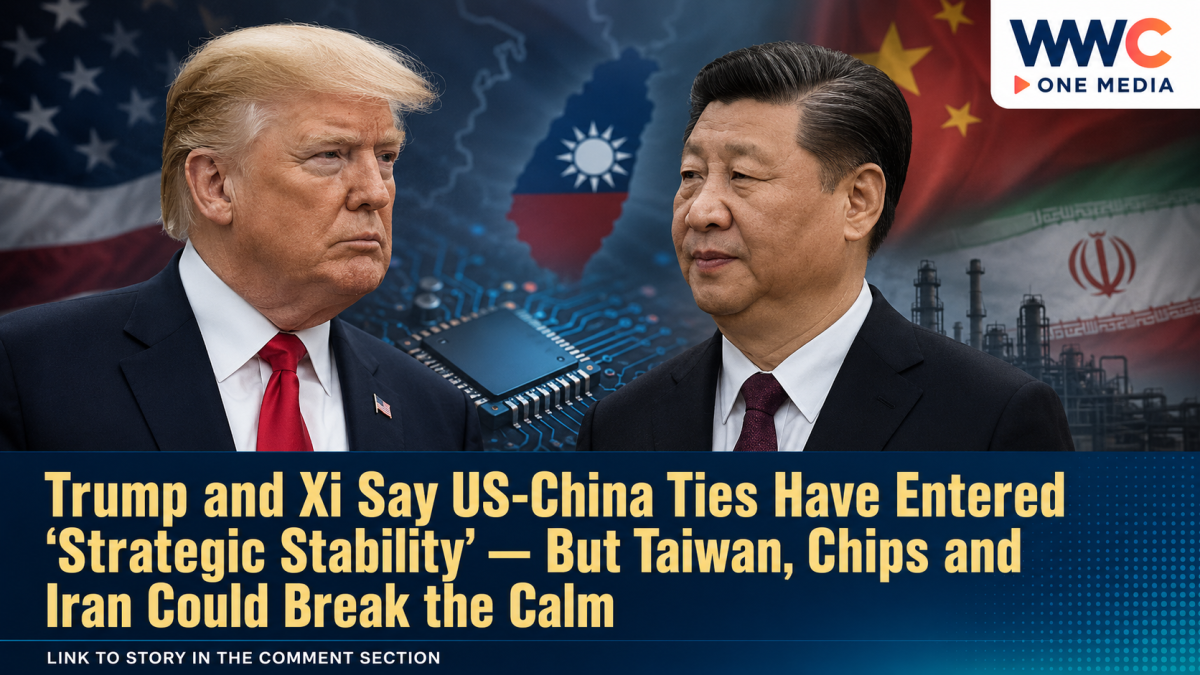
WASHINGTON/BEIJING — Three months after Donald Trump and Xi Jinping emerged from their closely watched Beijing meetings promising a more stable relationship between the world’s two biggest powers, the temperature between Washington and Beijing appears to have fallen.
But beneath the smiles, state dinners and diplomatic language, the United States and China are still competing fiercely over trade, artificial intelligence, advanced semiconductors, Taiwan, rare earth minerals and global influence.
That raises a question likely to dominate the next Trump-Xi meeting: Is the new era of “strategic stability” becoming a genuine détente — or is it simply giving both superpowers time to prepare for the next confrontation?
THE TRUMP-XI RESET
Trump travelled to China in May for the first visit by a sitting US president since 2017, meeting Xi during a highly choreographed state visit that included talks in Beijing and a private meeting at Zhongnanhai.
The two leaders agreed on what officials described as a “constructive relationship of strategic stability.”
The White House said the relationship would be based on “fairness and reciprocity,” while Beijing described the concept as a framework under which cooperation would remain possible, competition would be kept within limits and disagreements would be managed without allowing them to spiral into conflict.
There were commercial agreements as well.
China committed to purchasing 200 Boeing aircraft, although Reuters reported that the initial commitment had not yet become a fully finalized aircraft order. China also agreed to increase purchases of US agricultural products to at least $17 billion annually through 2028.
Yet Reuters’ assessment of the May summit was notably cautious: the trip delivered considerable pageantry but relatively few breakthroughs on the most difficult strategic disputes.
That distinction matters.
Trump and Xi may have found a formula for preventing the relationship from collapsing. They have not solved the problems driving the rivalry.
THE REAL TEST IS HAPPENING NOW
Since the Beijing summit, Washington and Beijing have repeatedly demonstrated how limited their new understanding may be.
Taiwan remains perhaps the most dangerous flashpoint.
On August 22, a US Navy P-8A Poseidon aircraft flew through the Taiwan Strait in international airspace. The US military described the transit as demonstrating Washington’s commitment to a free and open Indo-Pacific, while China’s military tracked the aircraft and objected to the operation.
Beijing considers Taiwan part of China and has repeatedly warned Washington against actions it believes encourage Taiwanese independence.
China’s Foreign Ministry has gone even further, describing Taiwan as the most important issue in the bilateral relationship and warning that mishandling it could put the entire US-China relationship at risk.
That makes Taiwan the clearest test of whether “strategic stability” can survive a genuine crisis.
THE TRADE WAR IS QUIETER — NOT OVER
Economic relations tell a similar story.
Although Washington and Beijing have avoided returning to the most extreme stages of their trade confrontation, tensions over Chinese industrial capacity, tariffs and market access remain unresolved.
The Trump administration is considering another tariff targeting Chinese goods over concerns that heavily subsidised Chinese production is flooding global markets with inexpensive manufactured products.
AP reported that officials were discussing a 7.5 per cent tariff, while Reuters separately reported the proposal but noted that it had not independently verified the original report.
Even agreements already made remain contentious.
US Treasury Secretary Scott Bessent said American officials had pressed Beijing over whether China was fully delivering on commitments involving agricultural purchases and rare-earth supplies.
Reuters reported in July that Washington believed some Chinese commitments had only been partially fulfilled.
Rare earths are particularly important because China dominates significant parts of the global processing and supply chain for minerals essential to electric vehicles, electronics and defence equipment.
The United States and its allies are now investing aggressively in alternative suppliers, including Australia’s Lynas Rare Earths, precisely because policymakers remain uncomfortable with that dependence.
In other words, even while Trump and Xi talk about stability, both countries are actively reducing vulnerabilities to the other.
AI CHIPS MAY BE EVEN HARDER TO NEGOTIATE
Technology competition is even less likely to disappear.
Advanced artificial intelligence chips have become one of Washington’s most powerful strategic tools against Beijing.
The US continues to restrict China’s access to cutting-edge semiconductors, while China is accelerating development of domestic alternatives.
Reuters reported this week that Chinese memory-chip producer CXMT has begun mass-producing advanced LPDDR6 memory, another sign of Beijing’s push to narrow its technology gap with foreign suppliers.
At the same time, Washington itself remains divided over how much advanced technology American companies should be permitted to sell to China.
Republican lawmakers have pressured the Trump administration to prevent advanced US semiconductor technology from reaching sanctioned Chinese companies, arguing that looser controls could strengthen Beijing’s technological and military capabilities.
That creates an unusual contradiction.
Trump may want a more predictable economic relationship with Xi while US lawmakers, security officials and technology strategists continue treating China as America’s most important long-term competitor.
THEN THERE IS IRAN
The Iran conflict has created another test.
China remains an important economic partner for Tehran and a major buyer of Iranian oil. Washington, meanwhile, has intensified efforts to financially isolate Iran.
The Trump administration recently sanctioned dozens of Iran-linked entities, including companies operating in mainland China and Hong Kong.
But the measures stopped short of some of the most aggressive options Washington could deploy against major Chinese institutions.
AP reported that the approaching Trump-Xi summit complicates Washington’s strategy because the administration has an incentive to avoid triggering a major confrontation with Beijing while simultaneously increasing pressure on Tehran.
China has warned Washington against expanding secondary sanctions against Chinese companies, while continuing to reject unilateral US sanctions on Iran.
It is a revealing example of what the new relationship may actually mean.
The two powers can strongly disagree — perhaps even support opposing sides of a major geopolitical dispute — while trying to prevent that disagreement from destroying the wider relationship.
XI’S US VISIT COULD BE THE BIGGEST TEST YET
The White House announced after the May summit that Trump would welcome Xi to Washington during the fall.
AP reported this week that officials have been discussing a summit tentatively planned for September 24, although the final date has not been publicly confirmed.
That meeting could therefore become much more than another diplomatic photo opportunity.
Trump and Xi will arrive with unresolved disputes over trade, Iran, advanced technology and Taiwan still hanging over the relationship.
And the situation is particularly delicate because America’s own allies are watching.
Reuters reported that governments including Japan and Taiwan have grown increasingly concerned about the predictability of US security policy in Asia, especially as Trump simultaneously seeks improved relations with Beijing and pursues a more transactional approach toward several American partners.
That means every Trump-Xi agreement will be scrutinised not only in Washington and Beijing, but across the Indo-Pacific.
STABILITY — OR A PAUSE BEFORE THE NEXT SHOWDOWN?
The most important development since May may therefore be what has not happened.
There has been no dramatic collapse in US-China relations.
Trump and Xi are still talking.
Trade continues.
Diplomatic channels remain open.
And both governments increasingly appear interested in preventing individual disputes from escalating into an uncontrollable confrontation.
That is meaningful progress between two nuclear-armed superpowers whose economies remain deeply connected.
But stability should not be confused with reconciliation.
Washington is rebuilding critical supply chains, restricting Chinese access to strategic technologies and strengthening its ability to compete economically and militarily.
Beijing is simultaneously pursuing technological self-reliance, expanding domestic semiconductor production, strengthening its military capabilities and reducing vulnerabilities to Western pressure.
CNA commentator Han Fook Kwang framed the dilemma starkly: the current calm could become the foundation of a more durable relationship — or simply provide both countries with breathing space to become stronger before competing even harder.
That may be the real meaning of “strategic stability.”
The United States and China are not becoming allies.
They may simply be learning how to remain rivals without allowing every confrontation to become a crisis.
And when Trump and Xi meet again, the world may discover whether that arrangement is strong enough to survive the issues neither leader has been able to solve.
Leave a Reply