
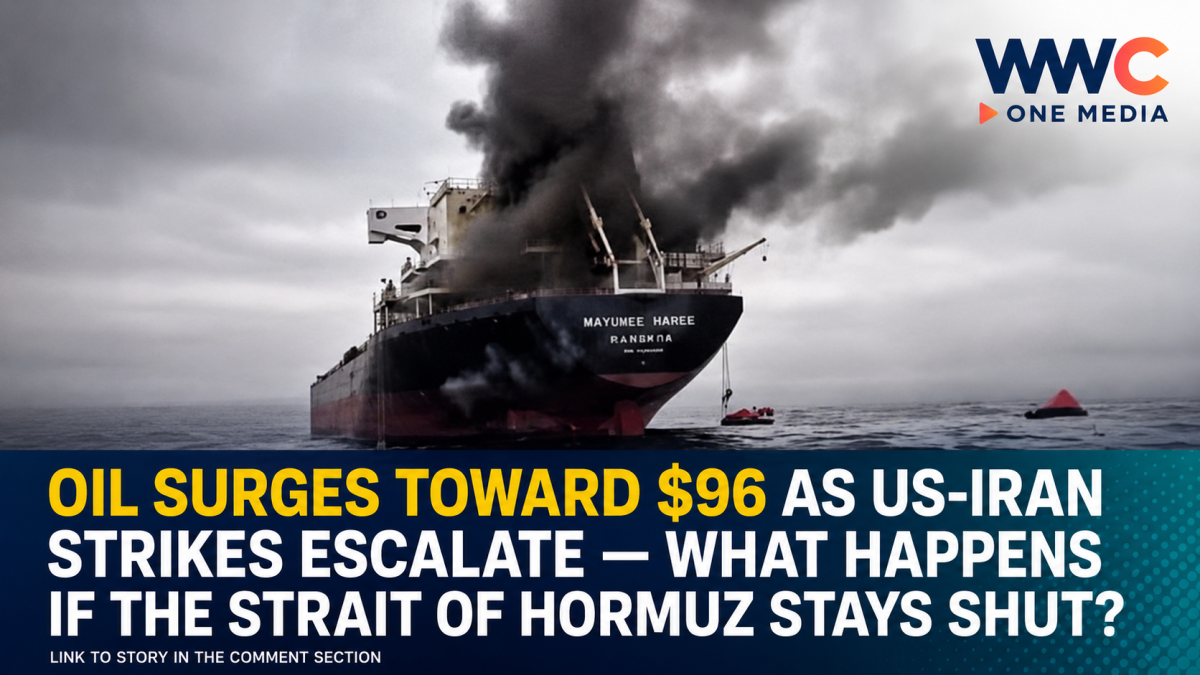
Oil prices climbed nearly 1% in early Asian trading on Wednesday as renewed US-Iran military strikes intensified concerns about disruptions to crude supplies and shipping through the Strait of Hormuz.
Brent crude futures rose 87 cents, or 0.92%, to $95.52 a barrel, while US West Texas Intermediate (WTI) crude gained 80 cents, or 0.89%, to $91.02, according to Reuters data cited by Channel NewsAsia.
The latest gains came after both benchmarks surged by more than $4 a barrel on Tuesday, with Brent recording its biggest one-day increase since July 24 and WTI its largest gain since July 23.
The sharp move in oil markets reflects growing fears that renewed military confrontation between Washington and Tehran could further restrict energy flows from the Middle East.
Fresh strikes revive supply fears
The United States said it launched a series of airstrikes against targets in Iran overnight, prompting retaliatory attacks by Tehran.
US Central Command said the strikes followed what it described as recent attempted attacks by Iran’s Islamic Revolutionary Guard Corps against commercial shipping in the Strait of Hormuz and against US military personnel in the region.
Iran subsequently launched missile and drone attacks targeting US-linked positions in the region. Jordan said its air defenses intercepted most of the ballistic missiles that entered its airspace, while US officials said no American casualties had been reported at the time of Reuters’ report.
The escalation has once again placed the Strait of Hormuz at the center of global energy concerns.
The waterway is one of the world’s most important oil transit routes, with roughly one-fifth of global oil consumption passing through it under normal conditions.
Tanker attacks add another layer of risk
The latest military escalation follows attacks involving two oil tankers near the Strait of Hormuz on Monday.
Reuters reported that the Saudi-flagged tanker Sidr and the Liberian-flagged Senegal Prosperity were struck by unidentified projectiles while carrying Saudi crude out of the region. No crew casualties were reported.
Each vessel had reportedly loaded about 2 million barrels of Saudi crude, highlighting the potential scale of disruption if attacks on commercial shipping continue.
The incidents have forced traders and shipping operators to reassess routes and supply risks, adding another source of uncertainty to an already volatile oil market.
US inventories also provide support for crude prices
Geopolitical tensions are not the only factor supporting oil.
US crude inventories fell by 2.6 million barrels during the week ended August 28, according to market sources citing American Petroleum Institute data. Distillate inventories, including diesel and heating oil, also declined by 265,000 barrels.
The inventory decline adds another bullish factor for oil traders as markets assess whether physical supply is becoming tighter.
Why the Strait of Hormuz matters so much
Any prolonged disruption in the Strait of Hormuz could have consequences far beyond the Middle East.
The waterway connects the Persian Gulf with the Gulf of Oman and the Arabian Sea and is a crucial export route for oil-producing countries including Saudi Arabia, Iraq, Kuwait, Qatar and the United Arab Emirates.
Even if alternative supply routes exist, replacing the volumes that normally move through the strait would be difficult and expensive.
That is why every new attack involving commercial vessels or threats to the waterway can trigger an immediate reaction in oil markets.
Markets now face a bigger question
Oil prices had already been climbing after fighting between the United States and Iran resumed following a period of relative calm.
On Tuesday, Brent settled at $94.65 a barrel, up 4.6%, while WTI settled at $90.22, up 5.2%.
The latest overnight gains suggest traders are increasingly focused on whether the renewed confrontation remains limited or develops into a longer disruption to regional energy supplies.
For consumers, the concern is straightforward: a sustained rise in crude prices can eventually put upward pressure on fuel and transportation costs, although the timing and size of any pass-through vary by country and market.
For investors, the bigger risk is the possibility that military escalation, tanker attacks and restrictions around the Strait of Hormuz reinforce one another.
For now, the oil market is watching one question above all others: how long can the region’s vital energy shipping routes remain disrupted before the supply shock becomes much larger?
WWC ONE MEDIA MJE




Leave a Reply