
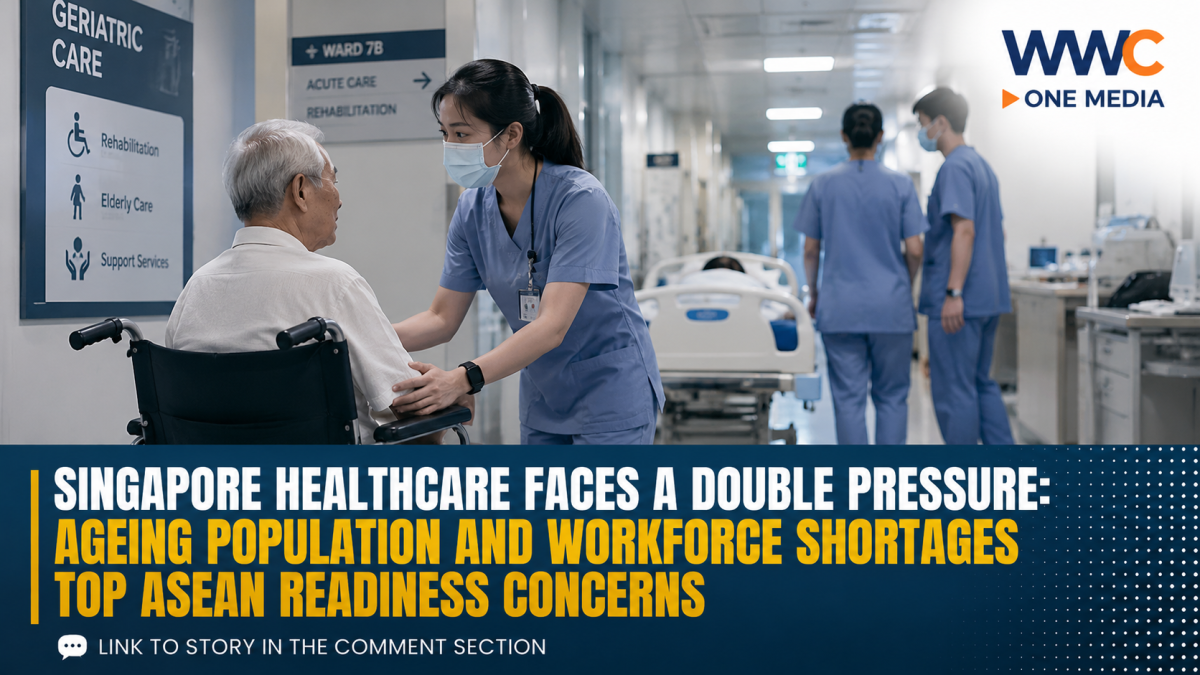
SINGAPORE — Singapore’s healthcare system is entering a critical period as rapid population ageing and workforce shortages emerge as the two biggest future pressures on healthcare readiness, according to the newly reported ASEAN Care Readiness Index 2026.
The index found that 48% of Singapore respondents identified ageing populations as a major future pressure, while another 48% pointed to workforce shortages. The findings highlight a difficult balancing act for the city-state: caring for a rapidly ageing population while ensuring there are enough skilled workers to deliver that care.
But the report also points to another transformation taking place at the same time — healthcare is becoming increasingly digital, and artificial intelligence is moving from an emerging technology to a core investment priority.
Singapore’s ageing population is accelerating
The timing of the findings is significant.
Singapore is expected to reach “super-aged” status in 2026, meaning at least 21% of its citizens are aged 65 and above. By 2030, the Ministry of Health expects one in four Singapore citizens to be aged 65 or older.
Health Minister Ong Ye Kung said in May that more than 21% of Singapore’s citizens were already aged 65 and above, while a large cohort currently aged 60 to 64 will cross that threshold over the next five years.
He warned that the ageing trend will increase demand for healthcare and care services, particularly as more seniors move into ages where illness and support needs become more common.
That means the pressure is not simply about treating more patients in hospitals. Singapore is also preparing for greater demand for community care, home-based services, rehabilitation and long-term support.
The workforce challenge is just as important
The ASEAN index’s 48% figure comes with an important qualification: it reflects the perceptions of healthcare and MedTech decision-makers, rather than an independent measurement showing that Singapore currently has an absolute shortage of healthcare workers.
In fact, Singapore’s Ministry of Health says its current healthcare workforce is broadly adequate for present population demand, with low overall vacancy rates in public hospitals. However, MOH projects the healthcare workforce will need to expand by about 20%, from 129,000 workers in 2024 to around 156,000 by 2030.
The ministry has also said that securing enough manpower remains a major priority as healthcare demand rises.
Its strategy includes expanding local training pathways and intakes, improving job attractiveness and pay, and recruiting qualified foreign healthcare workers in areas where shortages remain.
Nurses remain a key part of the equation
Singapore’s official manpower statistics illustrate the scale of the healthcare workforce.
The number of doctors increased from 16,753 in 2023 to 17,582 in 2024, while nurses and midwives increased from 46,344 to 50,389 over the same period.
But increasing headcount is only part of the challenge.
MOH has been working on retention, skills development and redesigning healthcare roles. In 2026, the ministry said nurse attrition had fallen back to around 7%, close to pre-pandemic levels, but emphasized that attracting and retaining healthcare professionals remains important.
The government is also shifting toward more flexible, competency-based training and work-study models so healthcare workers can develop new skills without spending excessive time away from patient care.
AI could become the next major battleground
Ageing and manpower are not the only issues highlighted by the ASEAN index.
Across the six markets surveyed, digital transformation and AI were the most frequently cited future pressure, at 54%.
Even more strikingly, 44% of respondents identified digital health and AI as their biggest capability gap, compared with 17% for MedTech innovation.
Investment priorities are moving in the same direction.
About 60% of respondents said digital health, AI, data and interoperability should receive priority investment, making it the top investment area across every market surveyed, including Singapore.
But technology itself may not be the hardest part.
The index found that technology implementation capability was the most commonly cited barrier to readiness, at 54%, followed by workforce capacity and skills at 46%.
In other words, buying technology may be easier than finding the people and capabilities needed to use it effectively.
Singapore is trying to move care beyond hospitals
The response to ageing is also pushing Singapore toward a more community-based healthcare model.
Under Age Well SG, the government aims to help seniors remain active, socially connected and cared for within their communities. MOH says the strategy is designed around ageing well rather than relying exclusively on institutional or hospital-based care.
Singapore’s community-care planning is becoming increasingly important because the number of older residents requiring support is expected to rise substantially.
A Singapore government policy analysis published in July estimated that almost one million Singaporeans could be aged 65 and above by 2030, increasing the need for ageing-in-place and community-based services.
The wider ASEAN picture
Singapore’s challenges are part of a much larger regional transformation.
The ASEAN Care Readiness Index found that digital transformation and AI dominated as future pressures in Indonesia, Vietnam and Malaysia, while Thailand’s biggest concern was increasing demand for rehabilitation and long-term care.
In the Philippines, rising healthcare demand topped the list, while technology implementation and funding were major barriers.
The regional findings point toward a common problem: ASEAN healthcare systems are simultaneously dealing with ageing populations, changing care needs, workforce constraints and rapid technological change.
The bigger question for Singapore
Singapore’s healthcare challenge may ultimately be less about choosing between people or technology and more about making the two work together.
An ageing population creates more demand for care. More demand requires more healthcare professionals. But with labour markets tightening, technology, automation, AI and new models of community care could become increasingly important in helping healthcare workers handle that demand.
The ASEAN index itself describes a region where many healthcare leaders feel prepared for the coming three to five years, even while almost all identify developments that could test that readiness.
For Singapore, the coming years could therefore determine whether its healthcare system can successfully manage three transformations at once: an older population, a changing workforce and an increasingly AI-driven healthcare environment.
Accuracy & Context
The 48% figures are survey findings, reflecting what respondents identified as future pressures; they should not be interpreted as proof that Singapore currently has a nationwide healthcare-worker shortage. Singapore’s MOH says the existing workforce is broadly adequate for current demand but expects substantial workforce growth will be needed by 2030.
WWC ONE MEDIA J.M.D



Leave a Reply