
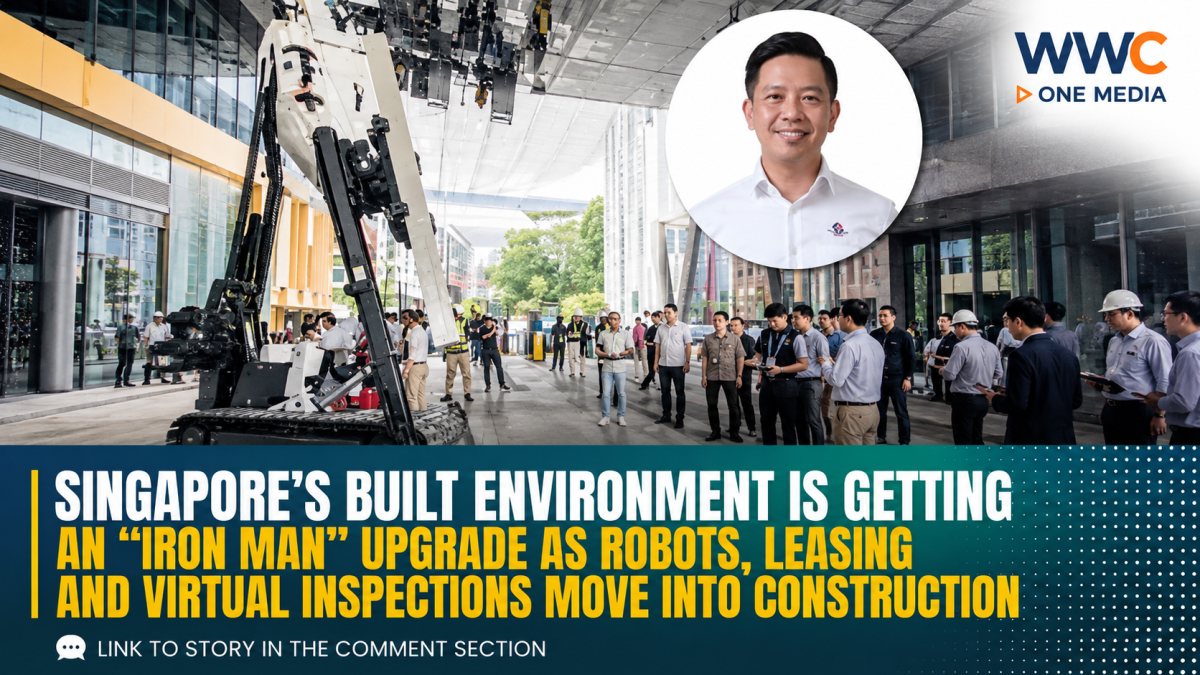
SINGAPORE — Singapore’s construction industry is accelerating toward a more automated future, with robotics, equipment leasing, smart machinery and virtual inspections being positioned as key tools to tackle manpower constraints and improve productivity.
The push comes as the Government expands support for construction technology and encourages firms to move beyond traditional, labour-intensive methods. At the heart of the strategy is a simple idea: companies should not always have to buy expensive robots outright to benefit from them.
Instead, an equipment-leasing model is being developed to make advanced construction technology more accessible, particularly for firms that cannot justify a large upfront investment.
An “Iron Man” moment for Singapore construction
The comparison to an “Iron Man upgrade” captures the direction of the transformation: workers are increasingly being supported by machines that can perform repetitive, physically demanding or hazardous tasks.
Singapore’s Building and Construction Authority (BCA) says there are now more than 20 ready-to-deploy robotics and automation solutions available across structural, architectural and mechanical, electrical and plumbing trades.
These include technologies for tasks such as:
- Drilling and anchoring
- Material transportation
- Concrete finishing
- Tiling
- Rebar tying
- Welding
- Floor grinding
- Demolition
- Cleaning
- Site inspection
The objective is not simply to replace workers. Singapore’s agencies are increasingly framing robotics as a way to reduce reliance on manual labour, improve productivity and remove people from dangerous work environments.
Why leasing robots could be a game changer
One of the biggest obstacles to construction automation is cost.
Buying specialised equipment can require substantial capital, while some contractors may only need a particular robot or automated system for selected projects.
That is why Singapore has been exploring an equipment-leasing model.
National Development Minister Chee Hong Tat previously explained that companies that do not use such technologies frequently may struggle to justify purchasing them outright. Under the proposed model, equipment could instead be purchased and leased to companies when needed, allowing the same technology to be shared across a wider pool of firms.
The approach could be particularly important for smaller contractors, which may otherwise face a difficult choice between investing heavily in technology or continuing to rely on labour-intensive processes.
Government is lowering the barriers to experimentation
The leasing push is part of a broader package of measures announced at Construction Technology @ Punggol Digital District (ConTech@PDD) in July.
BCA said it will waive space-rental fees for technology sandboxes at the Built Environment Innovation Hub (BEIH) for two years from July 2026, initially supporting teams testing productivity-enhancing technologies such as robotics and automation.
The BEIH has hosted more than 170 technology demonstrations and testbeds since 2023, with about 60 involving robotics and automation, according to BCA and JTC.
JTC is also establishing a sandbox in Jurong Innovation District for large-scale autonomous construction technologies and heavy construction equipment systems.
Robots could get a clearer path from testing to actual projects
Another major change is the Government’s new Innovative Procurement Partnership (IPP) approach.
JTC is using IPPs to make it easier for proven technologies to move from pilot projects into real-world deployment.
The first IPPs include technologies such as construction inspection robots, remote-controlled tower cranes, computer-vision systems for worksite productivity and robotics designed to automate inspections of covered drains.
Successful pilots can potentially be used across other JTC projects without having to go through an entirely new tender process.
That could help solve one of the biggest problems facing construction technology companies: proving that a product works in the real world and then finding a pathway to scale it.
The construction site is also becoming virtual
Robots aren’t the only technology changing how Singapore builds.
BCA is expanding virtual inspection, using 360-degree imaging and LiDAR to create digital representations or “digital twins” of construction sites.
These virtual environments allow project teams and inspectors to examine sites remotely, review measurements and track issues without necessarily having to physically travel through the entire site.
The results could be significant.
BCA says projects using virtual inspections have achieved productivity savings of up to 60% in inspection processes, while more than 70 projects have completed virtual inspections with support from industry partners.
Instead of waiting until an entire project is ready for inspection, teams can also submit completed phases for review, allowing rectification work to begin earlier and potentially reducing abortive work.
It isn’t just about robots — it’s about changing the entire workflow
The bigger transformation is happening when these technologies connect.
Imagine a construction project where:
Robots perform hazardous or repetitive tasks → sensors and cameras capture site data → digital twins record progress → AI and computer vision identify issues → inspectors review the site remotely → project teams act on the information digitally.
That is increasingly the direction Singapore’s built-environment agencies are pursuing.
JTC’s Integrated Digital Delivery Technology Alliance (IDDTA) is designed to provide project partners with a curated marketplace of digital solutions, while its OPTIMUS connected data environment enables information sharing across project teams from design through completion.
Singapore wants construction to build faster with fewer manpower pressures
The push comes against a backdrop of strong construction demand and persistent manpower constraints.
BCA says robotics and automation can help the sector boost productivity, reduce labour reliance and improve working environments and jobs.
JTC has similarly described robotics and automation as increasingly necessary rather than optional, with public-sector demand helping create a market for technology providers and contractors willing to adopt the systems.
The Government is also adjusting regulations to accommodate new technologies. For example, MOM and BCA have reviewed early projects using smart hoists and removed the requirement for operators to be stationed inside the hoists for those projects, subject to safety safeguards.
What happens to construction workers?
The rise of robots inevitably raises a bigger question: Will automation eliminate construction jobs?
Singapore’s current policy direction suggests the emphasis is more on augmenting workers, reducing hazardous manual tasks and changing the skills required.
JTC has explicitly said robotics does not mean eliminating human control. Instead, the sector is looking at how technology can handle dangerous or strenuous tasks while workers oversee, operate and manage increasingly sophisticated systems.
That could mean future construction workers spend less time doing physically punishing tasks and more time managing machines, interpreting data, troubleshooting systems and coordinating digital workflows.
The bigger picture
Singapore’s construction industry is effectively being asked to undergo a technological reset.
The combination of robot leasing, government-backed sandboxes, faster procurement pathways, virtual inspections, smart equipment and digital delivery platforms could make advanced technology much easier for companies to adopt.
The real test, however, will be whether these innovations can move beyond demonstrations and become affordable, reliable and widely used on everyday construction projects.
If that happens, the “Iron Man” comparison may become more than a catchy headline — it could describe a construction workforce increasingly equipped with machines and digital tools that make buildings safer, faster and more productive to build.
Accuracy & Context
The Government has announced and is implementing multiple measures supporting robotics and automation, while the equipment-leasing concept has been discussed as a way to reduce the upfront cost of advanced machinery. It should not be described as a single nationwide scheme where every contractor can immediately rent any construction robot. Specific leasing arrangements, eligible equipment and implementation details depend on the relevant programmes and providers.
Similarly, virtual inspection does not mean every construction inspection in Singapore is now conducted remotely. BCA has established workflows and requirements for suitable projects, and its official figures show the technology is being progressively adopted.
WWC ONE MEDIA J.M.D




Leave a Reply