
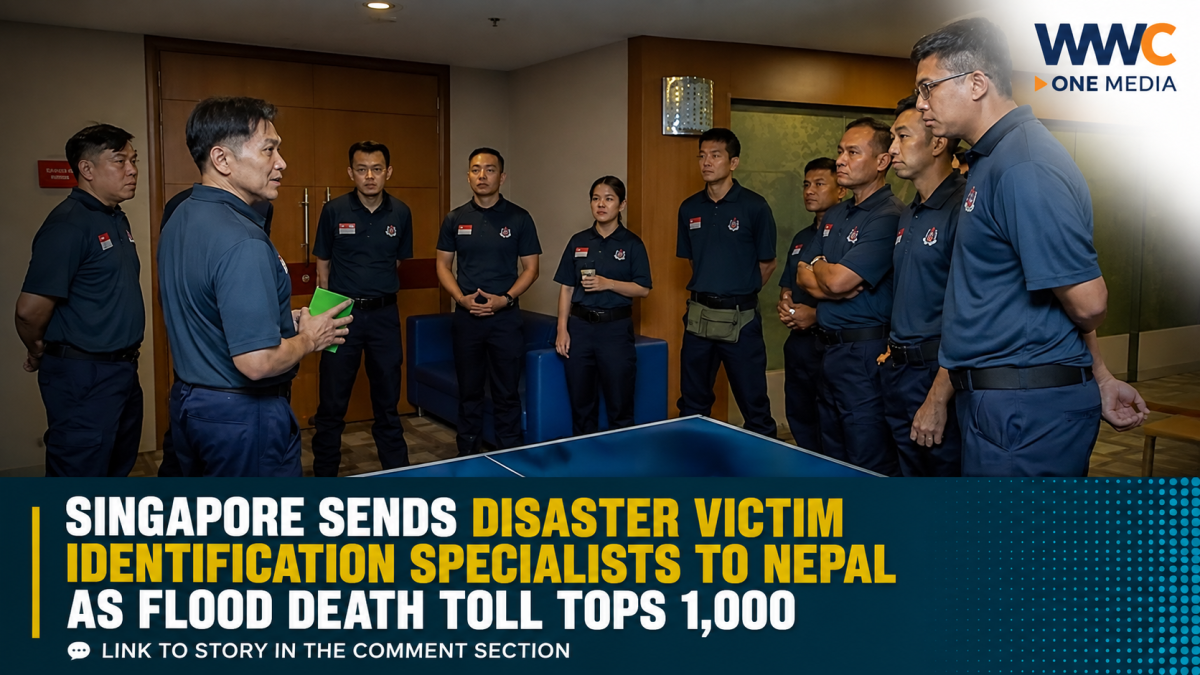
Singapore has deployed a specialist team to Nepal to help authorities identify victims of the catastrophic floods and landslides that have devastated communities along the Nepal-China border, as the humanitarian crisis enters a critical recovery phase.
The deployment follows a formal request from the Nepalese government for technical assistance, particularly in disaster victim identification (DVI), forensic work and aerial surveillance.
The Singapore Police Force (SPF) and Health Sciences Authority (HSA) are now sending personnel, while Singapore is also providing humanitarian supplies.
Singapore sends 33-member contingent
The latest update from The Straits Times says the Singapore contingent will comprise 33 personnel.
An advance group of 17 Singapore Police Force officers and two HSA officers from the Forensic Medicine Division departed for Nepal on Sept. 1 and 2. Another 14 police officers are expected to join them in the coming days.
The contingent is led by Assistant Commissioner of Police Patrick Tan and includes officers specialising in:
- Disaster Victim Identification
- Forensic medicine
- Aerial surveillance
Their mission is to support Nepalese authorities as they recover, document and identify victims in areas hit by the unprecedented floods.
Why DNA identification has become so important
The scale of the disaster has made identifying victims increasingly difficult.
Nepal has been recovering bodies from rivers, debris and heavily damaged communities, with some remains too badly decomposed to be identified visually.
Nepalese authorities have therefore been requesting DNA testing equipment, forensic expertise and other specialist resources from international partners.
Nepal’s government has specifically requested DVI assistance from Singapore, while India has also deployed forensic specialists focused on DNA analysis.
Singapore Police have also begun seeking DNA samples from relatives of the nine Singaporeans still missing following the disaster. SPF told CNA that the samples could assist in identifying recovered victims and form part of Singapore’s support for Nepal’s ongoing DVI operations.
Nine Singaporeans remain missing
The disaster has also become a major consular emergency for Singapore.
Nine Singaporeans remain unaccounted for, according to the latest reports.
Nepalese authorities previously identified the nine Singaporeans among tourists reported missing after the floods. They included people travelling with organised tour groups as well as at least one person believed to have been travelling independently.
Singapore’s MFA deployed a Crisis Response Team to Nepal on Aug. 27, one day after the disaster, to provide consular assistance.
Singapore has also contributed US$100,000 to the Singapore Red Cross’ fundraising appeal, which has raised around S$1 million for relief efforts, according to MFA’s reported figures.
Nepal’s disaster has reached catastrophic proportions
The floods began on Aug. 26, when a collapse involving glacial ice, rock and debris triggered a massive surge of water through Himalayan valleys along the Nepal-China border.
The destruction has been enormous.
Reuters reported on Sept. 2 that Nepal’s death toll had reached at least 1,114, with nearly 4,000 people still missing. Rescue teams are continuing to search devastated communities and hydropower facilities.
Earlier official figures cited by AP recorded 1,003 deaths and 3,916 missing people, including 583 foreign nationals. China separately reported deaths and missing people on the Tibetan side of the disaster.
The differing totals reflect the rapidly changing situation and the difficulty of reaching remote areas.
Rescue teams are facing another enormous challenge
Some of the most urgent operations are now focused on hydropower tunnels.
Around 900 workers from 12 hydropower projects have reportedly been listed as missing, with hundreds believed to be trapped inside tunnels filled with mud and debris.
International rescue teams from Nepal, India, China and other countries have been working alongside local authorities. Heavy equipment, helicopters, drones and specialist teams are being used to reach areas cut off by destroyed roads and bridges.
For Singapore’s DVI specialists, the mission is therefore unfolding alongside a much broader international rescue and recovery operation.
Singapore’s role goes beyond victim identification
Singapore’s assistance is not limited to forensic personnel.
The government has said it will also provide civilian and Singapore Armed Forces supplies to support Nepal’s relief operation.
Nepal has requested a wide range of technical assistance from international partners, including freezers for bodies, DNA testing kits, LiDAR equipment, drones, tunnel-rescue capabilities and forensic expertise.
The international response now includes assistance from countries including India, China, South Korea, the United States, Japan, the UAE and others, alongside international organisations.
A mission that could help families get answers
For families of those still missing, the work of DVI specialists carries a significance that goes far beyond statistics.
Identifying remains can provide families with confirmation of what happened to their loved ones and allow authorities to properly document victims and repatriate remains where appropriate.
For Singapore, the deployment also underscores the country’s willingness to provide specialised expertise during major disasters in the region.
As rescue operations continue and hopes of finding survivors diminish in some areas, the search for answers—and the careful identification of those who did not survive—has become an increasingly urgent part of Nepal’s response.
WWC ONE MEDIA J.M.D




Leave a Reply