
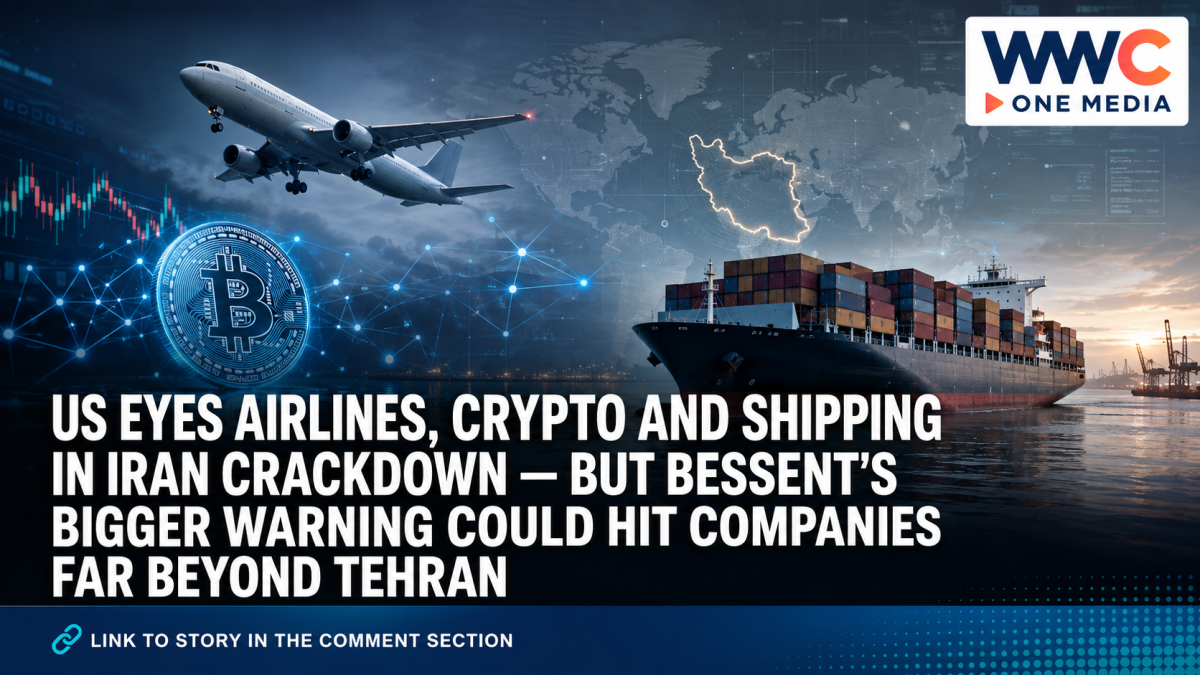
WASHINGTON — The United States is signaling that its escalating economic campaign against Iran could reach far beyond banks, with airlines, maritime businesses, digital assets and companies linked to the Islamic Revolutionary Guard Corps potentially facing heightened sanctions scrutiny.
U.S. Treasury Secretary Scott Bessent said Wednesday, September 2, that airlines, the maritime sector and digital assets could become targets as the Trump administration intensifies efforts to squeeze Iran’s economy.
The comments do not amount to an announcement of blanket sanctions against airlines, shipping companies or cryptocurrency businesses. Instead, they mark another warning that Washington is examining a wider range of businesses and financial channels it believes could help Tehran generate revenue, move money or evade existing restrictions.
Bessent’s message: Stay away from Iran
Speaking on Fox News after a Group of 20 finance gathering in North Carolina, Bessent issued a sweeping warning to governments and businesses that may be providing support to Tehran.
His message, in essence, was that companies and financial institutions should distance themselves from the Iranian government if they want to avoid becoming part of Washington’s expanding sanctions campaign.
Bessent said the United States was holding extensive discussions with parties supporting Iran and argued that cutting outside assistance would increase pressure on Tehran to end the conflict.
The warning came a day after Russian President Vladimir Putin publicly backed Iran, according to Reuters.
But the bigger story may be what Washington plans to do next.
New sanctions could keep coming week after week
Bessent has said the Treasury Department expects to roll out additional secondary sanctions on an almost weekly basis, initially concentrating on financial institutions.
Speaking to Reuters ahead of the G20 meetings, he said Washington wanted banks and other institutions to understand that helping move Iranian money could expose them to U.S. penalties.
Secondary sanctions are particularly powerful because they can affect non-U.S. businesses. Rather than targeting only an Iranian company or official, Washington can threaten foreign institutions with restrictions on their access to the U.S. financial system if they engage in certain sanctioned dealings.
Bessent has also raised the possibility of cutting targeted institutions off from the dollar-based financial system altogether.
That creates a much wider risk zone.
An airline lessor, shipping company, foreign bank, trading business or digital-asset platform would not necessarily need to be Iranian to attract U.S. scrutiny. Its dealings with sanctioned Iranian entities, the IRGC or networks accused of sanctions evasion could become the critical issue.
Airline leasing companies are now specifically on Washington’s radar
Aviation is one of the sectors receiving fresh attention.
On September 1, Bessent said the administration was examining airline leasing companies as well as other entities doing business with the IRGC.
That does not mean the entire airline-leasing industry is about to be sanctioned. It means Treasury is examining whether particular companies or transactions are helping Iranian entities obtain aircraft, services, logistics or other support.
Washington has already demonstrated that aviation-related networks are part of its enforcement strategy.
In July, the Treasury Department sanctioned six entities and individuals in China, India, Russia and Iran that it accused of helping Iran’s Mahan Air, including companies serving as general sales agents for the carrier.
Treasury says Mahan Air has provided transportation and other assistance connected to the IRGC and its Quds Force.
Crypto is not a new battlefield
Bessent’s reference to digital assets also does not mean cryptocurrency has suddenly entered Washington’s Iran strategy.
It is already there.
In June, Treasury targeted Nobitex and three other Iranian digital-asset exchanges as part of its sanctions campaign. The department alleged that Iranian authorities had used digital assets to circumvent restrictions and move funds.
Treasury said at the time that enforcement efforts had contributed to the freezing of nearly half a billion dollars in regime-linked cryptocurrency.
Then in August, Treasury sanctioned additional digital-asset exchanges it accused of laundering billions of dollars, helping Iran maintain access to international financial networks and supporting the IRGC.
The latest comments therefore suggest that Washington may broaden or deepen an existing crypto enforcement campaign rather than open an entirely new front.
Shipping remains another major pressure point
The maritime industry is equally important because Iran has historically relied heavily on energy exports and complex shipping networks to generate foreign currency.
Treasury has repeatedly sanctioned vessels, shipping companies, insurers and financial intermediaries it says have helped move Iranian petroleum products or disguise their origin.
In July, for example, Washington targeted more than 50 individuals, companies and vessels linked to a shipping network associated with Iranian businessman Mohammad Hossein Shamkhani.
Treasury has also sanctioned companies it says were involved in an IRGC-backed maritime insurance operation connected to vessels passing through the Strait of Hormuz, including a digital insurance platform that accepted Bitcoin and other digital assets.
That overlap between shipping, finance and cryptocurrency helps explain why Bessent is now naming all three areas together.
Washington is targeting the financial pipes, not just Iranian companies
The broader campaign is being carried out under Operation Economic Outcast, which Treasury formally announced on August 24.
The stated objective is to sever economic and financial channels sustaining the Iranian government while increasing sanctions exposure for outside entities that help Tehran move money or conduct sanctioned business.
The strategy was demonstrated days later.
On August 28, Treasury’s Financial Crimes Enforcement Network proposed restricting the U.S. correspondent-banking access of Banque Misr UAE.
Treasury alleged that the UAE operation processed roughly US$1.8 billion for 103 companies potentially connected to Iranian shadow-banking networks between January 2024 and June 2026.
Importantly, Treasury said the proposed measure applies to Banque Misr’s UAE operation, not Banque Misr operations in other countries.
That distinction matters because sanctions announcements can have consequences far beyond the specifically named company. Banks and businesses often reassess relationships when they believe counterparties could expose them to U.S. enforcement or threaten their access to dollar clearing.
The real warning may be aimed outside Iran
For Tehran, another round of American sanctions is hardly new.
For international banks, airlines, lessors, shipping groups and digital-asset companies, however, Bessent’s latest statements carry a different message.
Washington appears increasingly willing to look beyond Iran’s borders and focus on the foreign infrastructure that allows Iranian-linked money, goods and services to keep moving.
Exactly which companies could be targeted next remains unknown, and Bessent has not announced a comprehensive sanctions list covering airlines, maritime companies or digital assets.
But his comments, combined with Treasury’s recent actions, indicate that the U.S. campaign is widening.
And if Washington follows through on Bessent’s promise of repeated sanctions actions, the next major Iran-related announcement may not involve an Iranian company at all.
It could involve the foreign business that Washington believes helped keep it connected to the global economy.
WWC ONE MEDIA MJE



Leave a Reply