
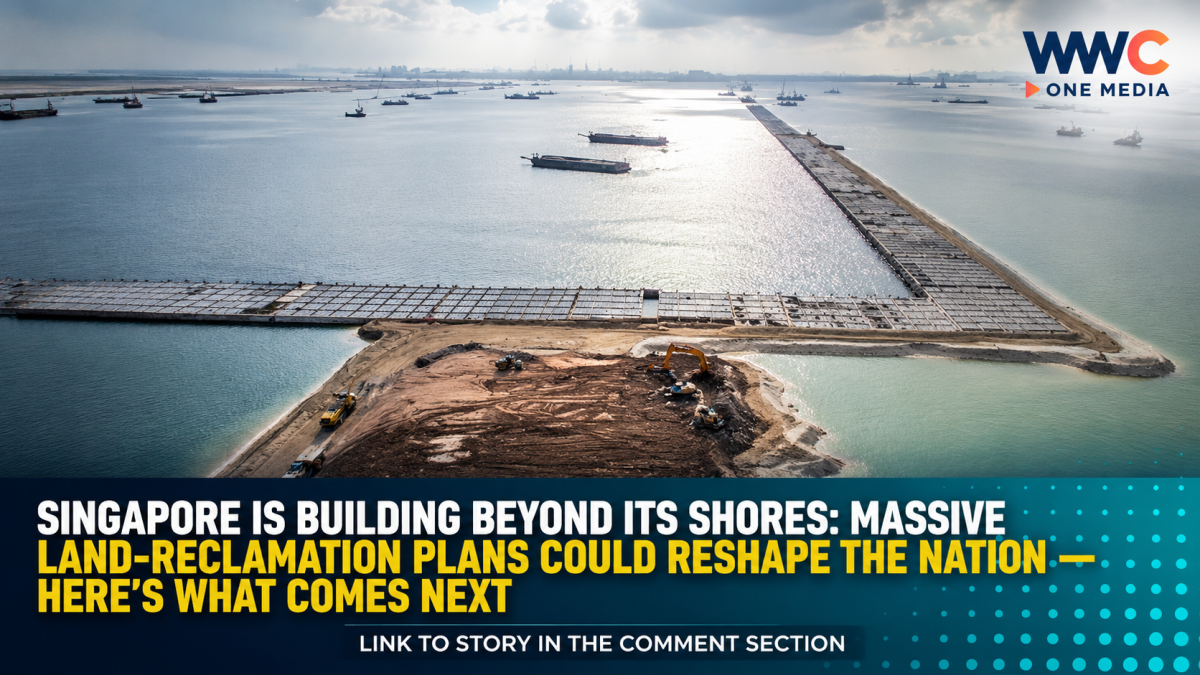
SINGAPORE — Singapore is looking decades into the future with an ambitious plan to create more land, strengthen its defences against rising seas and prepare space for industries that could shape the country’s next generation of economic growth.
The city-state already has one of the world’s highest proportions of reclaimed land, with reclaimed areas making up more than a quarter of its roughly 744 sq km territory. Now, Singapore is preparing for another major chapter in its long-running strategy of building land where the sea once stood.
The plans include a new Western Island, formed by potentially merging several islands south of Jurong Island, as well as Long Island, an approximately 800-hectare coastal-protection project off Singapore’s East Coast.
Although the two projects are separate, both reflect the same national challenge: Singapore has limited land, rising climate risks and growing long-term demands for space.
A NEW WESTERN ISLAND COULD CHANGE SINGAPORE’S INDUSTRIAL MAP
Prime Minister Lawrence Wong announced during Singapore’s 2026 National Day Rally that the Government intends, over the coming decades, to study the possibility of merging several southern islands into one larger Western Island.
Among the islands being considered are Pulau Bukom, Pulau Semakau and Pulau Sudong, along with several smaller islands.
The concept draws heavily from the success of Jurong Island, which was created by merging and reclaiming land around several offshore islands.
Jurong Island eventually became a major global energy and chemicals hub, supporting industrial activity, jobs and Singapore’s role in international energy markets.
Now, the Government sees an opportunity to repeat that long-term strategy for a new generation.
The proposed Western Island would not simply expand Singapore’s petrochemical capacity. According to the Government, it could accommodate advanced manufacturing, future power-generation infrastructure and defence facilities.
The proximity to Jurong Island could also create opportunities for a future energy hub. Analysts cited by The Business Times have pointed to potential applications involving technologies such as green hydrogen and, if Singapore eventually decides to pursue it, advanced nuclear-energy technologies. However, Singapore has not made a decision to adopt nuclear power.
BUT THERE IS A MAJOR ENVIRONMENTAL QUESTION
The proposed Western Island sits in an area known for significant marine biodiversity.
Scientists and nature groups have warned that reclamation could affect coral reefs, seagrass meadows, mangroves and other marine habitats.
Research highlighted by local reporting indicates that some reef habitats around places such as Pulau Hantu and Semakau date back thousands of years.
The Singapore Government has said the plans remain at an early, long-term planning stage.
Technical studies, including engineering and environmental assessments, will be carried out to better understand the potential impacts before detailed reclamation plans are finalised.
That means the proposed Western Island is not an immediate construction project. The transformation is expected to unfold over decades.
THEN THERE’S ‘LONG ISLAND’
Separately, Singapore is moving ahead with preparatory work for its ambitious Long Island project along the East Coast.
The project envisions reclaiming about 800 hectares of land while creating a new coastal defence system designed to protect low-lying parts of eastern Singapore from rising sea levels.
The planned development could eventually provide a new reservoir, additional land and around 20 kilometres of new waterfront parks.
The climate threat is significant.
Singapore’s third National Climate Change Study projects that mean sea level around the country could rise by as much as 1.15 metres by 2100. During extreme high tides combined with storm surges, water levels could potentially reach 4 to 5 metres.
With around 30% of Singapore’s land sitting less than five metres above mean sea level, the Government considers coastal protection a critical national priority.
PREPARATORY WORKS BEGIN AT THE END OF 2026
The first preparatory works for Long Island are scheduled to begin from the end of 2026.
The initial phase will take place in waters west of Bedok Jetty and cover approximately 570 hectares, stretching about 7km east to west and up to 1km from north to south.
The work will involve removing seabed obstructions, constructing temporary sand bunds and carrying out sand infilling. Work areas will be at least 130 metres from the shoreline and protected by measures such as silt screens and floating barriers.
A second preparatory phase east of Bedok Jetty will cover about 155 hectares, but it will begin only after major sporting events, including the 2029 Southeast Asian Games, have concluded in order to preserve sea space for water-based activities.
EAST COAST PARK WILL REMAIN OPEN
Despite the scale of the preparatory works, Singapore authorities say beaches along East Coast Park will remain accessible.
Near-shore swimming, jogging and cycling will continue, although sea users will have to keep away from designated construction areas and marine vessels.
Environmental monitoring will also track water quality, sediment levels, noise and dust during the works.
The Government’s environmental study found that the preparatory phase is expected to produce only localised effects, although some coral and seagrass areas could experience short-term impacts from sediment plumes.
Some water sports users, particularly kiteboarders, are expected to be affected by the reduction in available sea space.
WHY IS SINGAPORE DOING THIS?
At its core, Singapore’s strategy is about buying itself options for the future.
The country needs land for housing, businesses, transport infrastructure, utilities, defence and new industries. At the same time, it must prepare for climate change while trying to protect green spaces and biodiversity.
Singapore’s Government says it cannot wait until existing land is exhausted before planning for the next generation.
That philosophy explains why some of the projects announced in 2026 have timelines measured not in years, but in decades.
Long Island, for example, could take decades to fully realise, while the proposed Western Island is similarly a long-term undertaking.
THE BIGGER PICTURE
Singapore has repeatedly used reclamation to overcome its geographical limitations.
Large portions of today’s East Coast, including Marine Parade and East Coast Park, were developed on reclaimed land decades ago. Jurong Island similarly demonstrated how reclamation could be used not merely to create land, but to transform Singapore’s economic capabilities.
Now Singapore is attempting something even more ambitious: planning its coastline, industrial landscape and climate resilience simultaneously.
The Western Island could provide room for future industries and energy infrastructure.
Long Island could protect vulnerable coastal communities while creating new land, a reservoir and waterfront spaces.
And other projects, including further reclamation around Pulau Tekong, are also being considered as part of Singapore’s long-term land strategy. The Government estimates that around 500 hectares could eventually become available for civilian uses after defence requirements are met.
The result could be a Singapore that looks dramatically different several decades from now.
But the central question remains:
How much more of Singapore can be built from the sea — and how can the country balance the need for land with the environmental costs of creating it?
That debate is likely to become increasingly important as Singapore moves from long-term vision to detailed studies, environmental assessments and, eventually, major reclamation works.
WWC ONE MEDIA MJE



Leave a Reply