
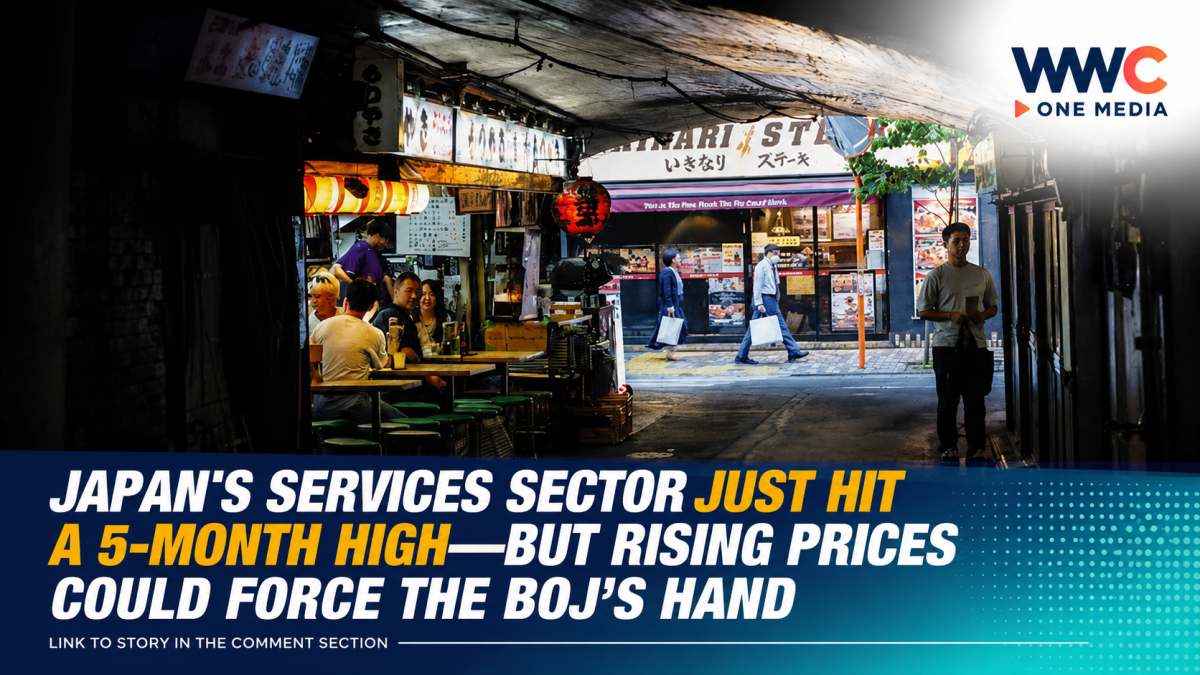
TOKYO — Japan’s services sector accelerated in August, recording its fastest expansion in five months as stronger domestic demand helped lift business activity and new orders. But beneath the upbeat numbers, rising prices are creating a new challenge for policymakers and could strengthen the case for another Bank of Japan interest-rate hike.
The S&P Global final Japan Services Purchasing Managers’ Index (PMI) climbed to 52.5 in August, up sharply from 51.2 in July. A PMI reading above 50 indicates expansion, meaning Japan’s services economy remained firmly in growth territory.
The improvement was driven primarily by stronger domestic demand. New business increased for the 26th consecutive month, with the pace of growth accelerating from July.
That suggests Japanese consumers and businesses are continuing to provide an important source of momentum even as the country’s economy faces higher costs and an uncertain global environment.
Export demand tells a different story
Not every part of the services economy improved.
New export business contracted for a fifth consecutive month, with the decline accelerating to its sharpest pace since November 2020. That contrast highlights an important divide in Japan’s recovery: domestic demand is providing support, while overseas demand remains more fragile.
Employment also continued to increase, marking the 12th consecutive month of job growth. However, hiring was only marginal and represented the slowest pace of employment growth in a year.
The inflation problem is not going away
The strongest warning sign in the latest survey may be prices.
Input-cost inflation eased to a four-month low, but remained among the fastest rates recorded over the past three and a half years. At the same time, companies increased the prices they charge customers at the second-fastest rate on record, indicating that businesses are passing higher costs through to consumers.
S&P Global Market Intelligence Economics Associate Director Annabel Fiddes said the August data showed that growth momentum had strengthened across Japan’s services sector.
But persistent cost pressures could have a much bigger consequence: they may keep official inflation elevated and increase pressure on the Bank of Japan (BOJ) to raise interest rates again.
Japan’s broader private sector is also gaining momentum
The services-sector improvement was accompanied by strong manufacturing activity.
Japan’s Composite PMI, which combines manufacturing and services, rose to 53.5 in August from 52.7 in July, marking the strongest overall private-sector expansion in six months.
Earlier August flash data had already pointed to strengthening momentum. S&P Global reported that private-sector output was expanding at its second-strongest pace in more than three years, with manufacturing particularly strong and services activity gaining momentum.
Manufacturing has been receiving additional support from demand for semiconductors and artificial-intelligence-related products. Reuters reported that Japan’s August manufacturing PMI reached 55.1, while new orders increased at their fastest rate since January 2018.
That combination—strong manufacturing alongside improving services—provides a more encouraging picture of Japan’s third-quarter economic momentum.
But Japan’s economy still has vulnerabilities
The stronger PMI figures arrive after official data showed that Japan’s economy grew more slowly than expected in the second quarter.
Reuters reported that Japan’s GDP expanded at an annualized 1.1% in the April-June quarter, below the 2.0% forecast. Private consumption and capital spending were both weak, highlighting the challenges facing domestic demand despite stronger export performance in areas such as AI-related components and hybrid vehicles.
Meanwhile, corporate investment has shown signs of strengthening. Japan’s Finance Ministry reported that capital spending increased in the second quarter, while corporate recurring profits reached a record level, adding to evidence that businesses remain willing to invest despite the uncertain environment.
Why the BOJ is now watching closely
The latest PMI data could complicate the Bank of Japan’s policy decisions.
The BOJ has been gradually moving away from the ultra-loose monetary policies that characterized Japan’s economy for decades. Persistent inflation, a weak yen and rising wages have increased pressure on the central bank to continue normalizing interest rates.
That pressure intensified this week.
BOJ Governor Kazuo Ueda said the central bank would debate the possibility of a September rate increase, while board member Hajime Takata argued that policymakers should take a flexible approach to future hikes rather than follow a rigid schedule.
Japan’s 10-year government bond yield has also climbed above 3%, its highest level since 1996, reflecting growing expectations for tighter monetary policy and concerns about inflation and government finances.
The bigger picture
Japan’s August PMI numbers offer a cautiously optimistic message: economic activity is strengthening, domestic demand is holding up and businesses are receiving more orders.
But the same recovery could create a new problem.
If stronger demand combines with persistent input costs and rapidly rising selling prices, inflation may remain uncomfortably high. That would give the BOJ another reason to consider higher interest rates—even as policymakers must balance inflation control against the risk of weakening household spending and economic growth.
For Japan, therefore, the question is no longer simply whether the economy is growing.
The bigger question is whether it can keep growing without pushing inflation—and interest rates—higher.
WWC ONE MEDIA MJE




Leave a Reply