
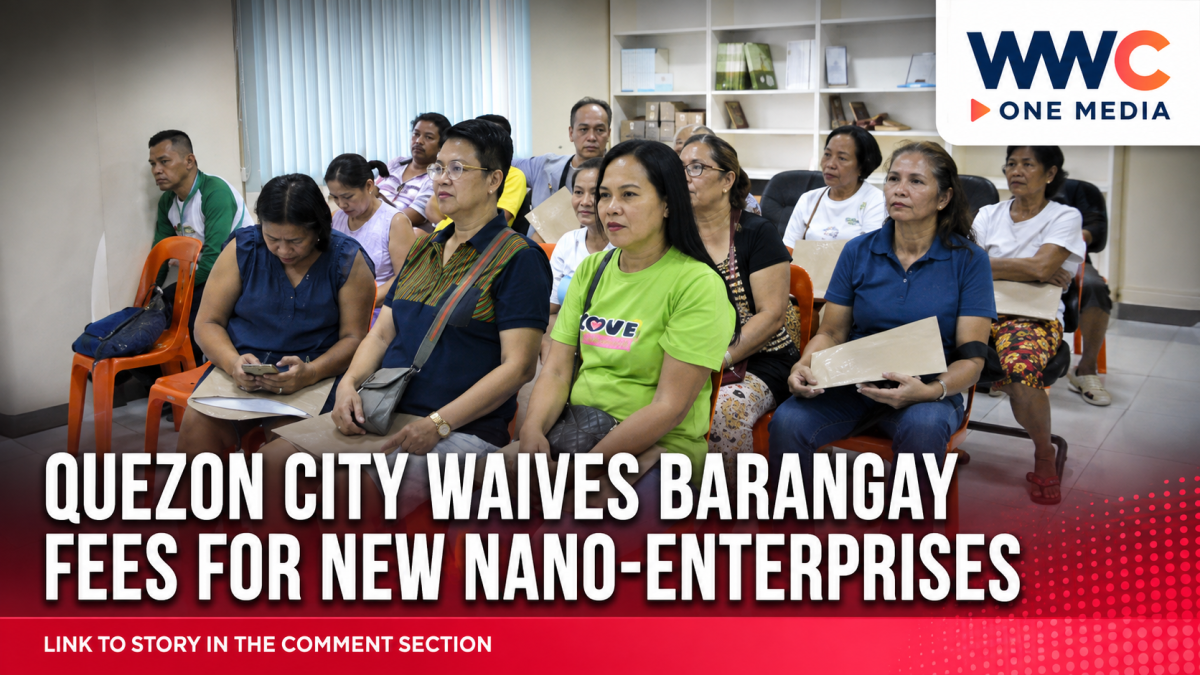
QUEZON CITY, Philippines — Starting a tiny business in Quezon City is about to become cheaper and potentially far less complicated after the city government removed barangay business clearance fees for newly registered nano-enterprises and moved to standardize business-related barangay charges across all 142 barangays.
The change could particularly benefit neighborhood businesses such as sari-sari stores, small carinderias and other community-based livelihoods whose owners often operate with only a small amount of working capital.
Under Ordinance No. SP-3525, Series of 2026, Quezon City is waiving the barangay business clearance fee for newly registered nano-enterprises while introducing a unified framework governing business-clearance charges across the city’s barangays. The Quezon City Council’s official ordinance registry confirms that SP-3525 establishes uniform maximum fees and rules for assessing and collecting barangay business-clearance charges citywide.
The move is more significant than simply removing another government fee.
For a sari-sari store owner starting with only tens of thousands of pesos, money that would otherwise go toward permits and administrative charges can instead be used to purchase inventory, equipment or other essentials needed to keep the business running.
Who actually qualifies as a nano-enterprise?
Quezon City’s definition is much narrower than the broader category of micro, small and medium enterprises.
Under the city’s Nano-Enterprise Registration Program, qualified businesses are operated by self-employed individuals or sole proprietorships with assets not exceeding ₱50,000 and annual gross sales or receipts not exceeding ₱250,000.
That means the program is aimed at businesses at the smallest end of the local economy—among them neighborhood stores, food stalls, home-based livelihoods and beneficiaries of city livelihood programs.
The nano-enterprise program itself is not new. Quezon City introduced its formal registration framework under Ordinance No. SP-3272, Series of 2024, giving qualified operators access to simplified registration as well as local tax and regulatory-fee incentives and priority consideration for certain financial assistance and training programs.
As of March 2026, 496 nano-enterprises had registered under the city program, according to Quezon City’s latest program information.
The new barangay-fee policy expands that push by targeting another cost faced by entrepreneurs at the local level.
One fee system across all 142 barangays
The second major part of the ordinance could have an even broader impact.
Businesses that do not qualify for the nano-enterprise exemption will have their barangay clearance charges tied to actual regulatory assessments imposed by the city, including applicable fees involving the mayor’s permit, sanitation, zoning, garbage collection, tourism and environmental regulation.
City officials say the objective is to eliminate situations in which businesses face substantially different or excessive barangay charges depending on where they operate.
The Quezon City government described the system as an attempt to create a more transparent and proportional fee structure while standardizing practices across its 142 barangays. The validity period of barangay business clearances will also be aligned with the Mayor’s Business Permit.
Separate reports from Pilipino Star Ngayon and the Daily Tribune also confirmed the waiver for newly registered nano-enterprises and the citywide standardization of barangay business-clearance fees.
Business payments are going digital, too
Quezon City is pairing the fee reform with another ordinance aimed at reducing face-to-face transactions.
Under Ordinance No. SP-3497, Series of 2026, the city’s 142 barangays are required to adopt secure electronic payment systems integrated with QC e-Services.
The system is intended to allow entrepreneurs to pay barangay business-clearance charges through a unified online platform instead of repeatedly visiting government offices or navigating different payment processes from one barangay to another.
Cash will not disappear completely.
The city said cash payments will remain available when online transactions are impractical, including during internet or system outages and for senior citizens, persons with disabilities, unbanked residents and people who lack access to digital-payment facilities.
That distinction is important because digitization can reduce red tape without making access to government services dependent entirely on smartphones, bank accounts or reliable internet connections.
Part of a bigger national anti-red-tape push
The policy also fits into the Philippines’ broader effort to simplify local business registration.
Republic Act No. 11032, or the Ease of Doing Business and Efficient Government Service Delivery Act of 2018, requires barangay clearances and permits related to doing business to be applied for, issued and collected through the city or municipality, with the barangays receiving their corresponding share of collections.
Quezon City’s latest ordinances effectively push that principle further by combining standardized fees, centralized assessments and electronic payments.
Mayor Joy Belmonte said the goal is to reduce red tape while allowing entrepreneurs to concentrate more of their resources on growing their businesses and generating jobs.
Why the policy matters beyond sari-sari stores
The reform is being introduced in the Philippines’ largest local economy.
Latest Philippine Statistics Authority data show that Quezon City generated about ₱1.40 trillion in economic output in 2025, equivalent to roughly 6% of national GDP—the largest contribution among all provinces and highly urbanized cities in the country.
Yet much of the city’s entrepreneurial base consists of far smaller operations. Quezon City’s Small Business and Cooperatives Development and Promotions Office says approximately 98% of registered enterprises in the city fall within the MSME sector, with small and micro businesses making up the majority.
That makes the new barangay-fee policy more than a symbolic concession.
The bigger test will be whether lower costs, standardized charges and online processing persuade more informal neighborhood businesses to register formally—and whether becoming registered gives those entrepreneurs meaningful access to financing, disaster assistance, training and new markets.
If that happens, the real impact of Quezon City’s zero-fee policy may not be the money small businesses save at the barangay counter.
It could be the businesses that finally decide to enter the formal economy because of it.
WWC ONE MEDIA MJE




Leave a Reply