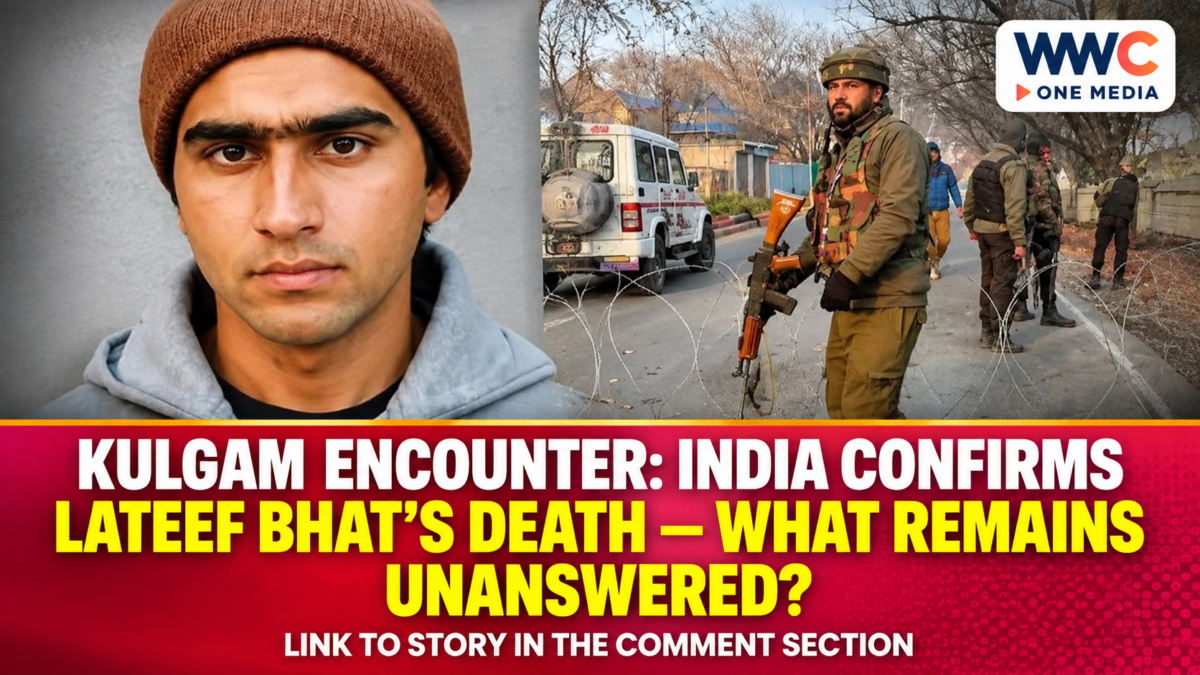
NEW DELHI, India — Nov. 21, 2026. India’s Home Ministry confirmed that Lateef Bhat was killed in a security operation in Kulgam, Jammu and Kashmir, on Nov. 18. Home Minister Amit Shah publicly credited the Jammu and Kashmir Police, Indian Army, Central Reserve Police Force (CRPF) and intelligence agencies with the operation.
The Kulgam encounter marks a reported operational success for Indian authorities, but it does not establish that all security risks in the region have ended. Official statements confirm the outcome and identify participating agencies; they leave important questions about the operation’s full sequence, the evidence against the deceased and future security conditions unanswered.
Kulgam Encounter: What the Government Confirmed
A Nov. 18 Home Ministry announcement identified the deceased as Lateef Bhat and described him as the last known active local member of Lashkar-e-Taiba in the Kashmir Valley. That description is a claim made by the Indian government, not a verified count of every armed operative who might be present in the region.
The announcement reproduced a statement from Home Minister Amit Shah praising a coordinated operation involving multiple security agencies. His statement placed Bhat’s death during the early morning of Nov. 18 and identified Kulgam as the district where it occurred.
The same statement said Umar Nisar, described as an associate of Bhat, had been killed in Kulgam the previous day. This establishes what the government publicly announced about the two deaths; the statement does not provide the underlying forensic material, investigative records or a complete timeline of either encounter.
The distinction matters. An announcement of an operation’s outcome is not the same as publication of its supporting evidence. Both may be important, but they answer different questions.
Why the Description ‘Last Known’ Matters
The phrase last known active local is narrower than a claim that militancy in Kashmir has ended. It refers to an assessment of a particular category of person known to authorities at the time of the announcement. It does not, on its own, establish the absence of other networks, recruits or future threats.
The Home Ministry’s broader policy documents describe a security approach that goes beyond individual encounters. Its July 2024 parliamentary response listed intelligence sharing, investigations into support structures, efforts against terrorist financing, prevention of infiltration and intensified search operations among government measures.
Those policies help explain why one operation cannot be treated as a substitute for sustained security assessments. Investigations, prevention and public protection continue to matter even when a highly sought person is no longer active.
WWC has previously examined how India–Pakistan military tensions can escalate beyond an individual incident. The present operation is a separate event, and the public record reviewed here does not establish that it caused a new cross-border confrontation.
The Longer-Term Security Picture
India’s official figures indicate that terrorist-initiated incidents in Jammu and Kashmir fell from 228 in 2018 to 12 in 2025. A government review published in 2026 also recorded 55 civilian deaths in terror-related incidents in 2018 compared with 28 in 2025, and 91 security-force fatalities in 2018 compared with 16 in 2025.
These figures describe different indicators. They should not be combined into a single statistic, and they do not measure the outcome of the Nov. 18 operation. The government’s published trend points to fewer incidents and deaths across those years, while still showing that people were harmed in 2025.
The official data therefore support a more careful conclusion than either declaring complete peace or dismissing the progress reflected in the numbers. Reduced violence is meaningful; it is not proof that every remaining risk has disappeared.
The same discipline applies in other security settings. WWC’s examination of a military-airfield security alert and its unresolved questions distinguished an official operational response from claims that had not been established. The events are unrelated, but the evidentiary distinction is useful.
What the Public Statement Does Not Establish
The Home Ministry’s announcement confirms Bhat’s reported death but gives no detailed account of the location within Kulgam, negotiations before the operation, use of force, damage to buildings, civilian evacuations or injuries during the encounter. Those points should not be presented as independently established details on the strength of this announcement alone.
Nor does the statement publish a case file proving that Bhat personally directed a particular earlier attack. The government’s description of his affiliation and status must be distinguished from a court finding or independently published evidence about any specific incident.
This is especially important when violence intersects with religious sites or populated areas. Accuracy about buildings, civilian safety and the sequence of an operation requires specific supporting records, not inference from the outcome.
In its separate coverage of claims involving civilian infrastructure during armed conflict, WWC has made a similar distinction between a formal claim and independently established consequences. There is no suggestion here that the two incidents are connected.
What This Could Mean for Kashmir
Analysis: The government’s confirmation may demonstrate the practical value of coordination among police, military, paramilitary and intelligence organisations. That is consistent with its longstanding stated approach to counterterrorism, including sharing intelligence and maintaining security operations.
Yet the public-interest question extends beyond whether the security agencies achieved their immediate objective. Residents also need dependable information about local safety, the protection of civilian spaces, the rules governing operations and whether authorities can substantiate allegations about prior attacks.
The official figures provide context for a longer-term reduction in violence, not a prediction about the coming weeks. Future conditions will depend on developments that a single government announcement cannot establish.
What Happens Next
The clearest next step would be publication of fuller official operational details, where disclosure is compatible with lawful security and investigative needs. Updates could clarify the circumstances of the encounter, any effects on civilians or property, and the legal or investigative basis for allegations concerning earlier attacks.
A later government assessment could also explain how authorities define and count active local militants, making the description used on Nov. 18 easier for the public to evaluate. Until then, the confirmed death should be reported precisely without turning it into a claim that Kashmir’s security challenges are over.
Frequently Asked Questions
Who was killed in the Kulgam encounter?
India’s Home Ministry identified Lateef Bhat as the person killed in a security operation in Kulgam on Nov. 18, 2026. It described him as Lashkar-e-Taiba’s last known active local militant in the Kashmir Valley.
Which forces participated in the operation?
Home Minister Amit Shah identified the Jammu and Kashmir Police, Indian Army, CRPF and intelligence agencies as participants in the coordinated operation.
Was anyone else reported killed?
The ministry’s Nov. 18 statement said Umar Nisar, described as Bhat’s associate, was killed in Kulgam the previous day.
Does this mean militancy in Kashmir has ended?
No such conclusion follows from the announcement. The government described Bhat as the last known active local militant of a particular organisation, not as the final possible security threat in the region.