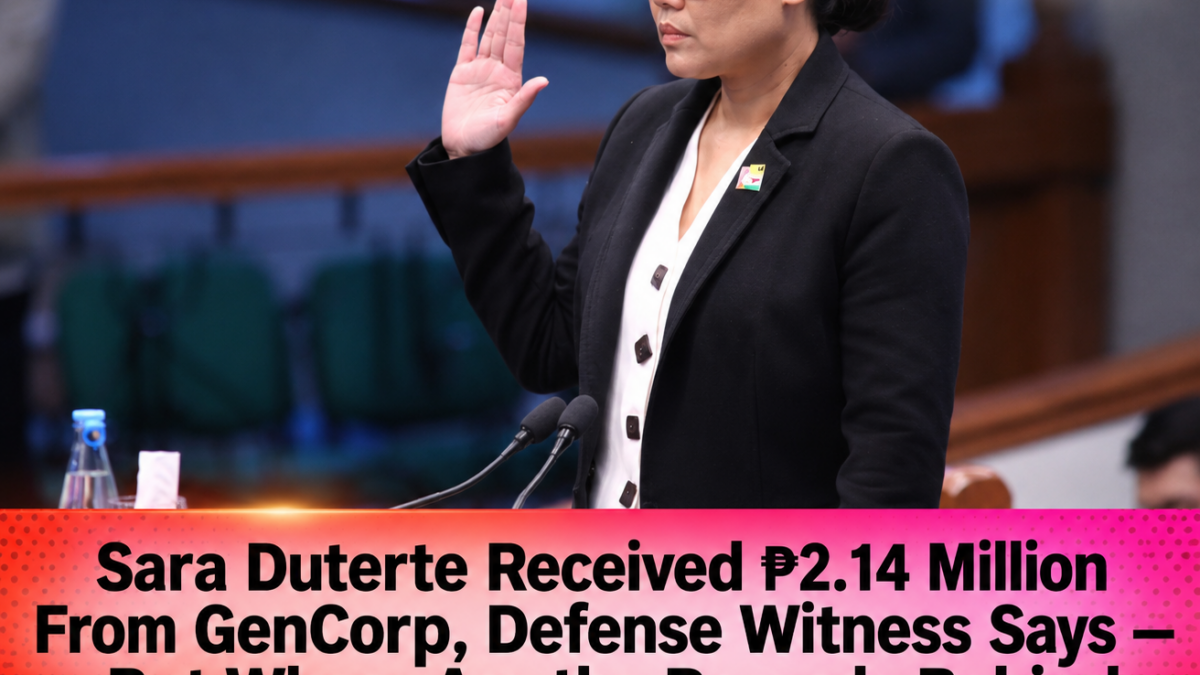
MANILA, Philippines — Vice President Sara Duterte received more than ₱2.14 million from GenCorp Industries Inc. between 2022 and 2025, according to testimony from a defense witness at her impeachment trial. But the explanation behind those payments has raised another round of questions inside the Senate impeachment court.
Lawyer Suzette Balucanag-Punay, the in-house counsel of GenCorp and Metro City Chow Foods Corp., confirmed that Duterte received a total of ₱2,142,369.14 in payments that the company described as a “return of capital.”
The money was reportedly connected to an earlier financial contribution Duterte made to a business venture involving the Jollibee Times Square branch in Davao City.
However, during questioning, Punay acknowledged that she had not seen written documentation establishing the exact amount of Duterte’s original investment.
That missing documentation became a central issue during the November 11 hearing, as senator-judges questioned how an investment allegedly made years earlier could generate more than ₱2.14 million in payments without clear supporting records.
The testimony came on the 42nd day of Duterte’s impeachment trial, where the defense presented Punay to address allegations involving the Vice President’s business interests and financial disclosures.
How Much Did Sara Duterte Receive From GenCorp?
According to company records presented by Punay, the payments to Duterte were distributed over four years:
- 2022: ₱337,500
- 2023: ₱555,750
- 2024: ₱612,419.14
- 2025: ₱636,700
The total reached ₱2,142,369.14.
The payments were reportedly made through checks drawn from a bank account connected to the Jollibee Times Square branch, which is associated with GenCorp.
Punay maintained that the money was not dividend income from GenCorp shares. Instead, she described it as the return of Duterte’s earlier contribution to Davao Bounty Times Food Corp., a company originally intended to operate the Jollibee Times Square branch.
According to her explanation, the original business venture did not obtain the franchise. The franchise was instead granted to Great Jolly Times Foods Corp., which eventually became connected to the operations later handled by GenCorp.
Punay said Duterte’s earlier contribution was carried over through these corporate developments.
However, the witness could not provide a written document confirming the exact original investment amount.
GMA News, Philstar and ABS-CBN News also reported on the disclosure, with their coverage highlighting the distinction between the defense’s explanation and the questions raised by senator-judges.
The ₱46,875 Investment That Became a ₱2.14-Million Question
One of the most important exchanges involved the amount Duterte reportedly contributed to Davao Bounty Times Food Corp.
Philstar reported that Senate Presiding Officer Francis “Chiz” Escudero pointed out that Duterte’s documented capital contribution was ₱46,875.
The ₱2.14-million amount she subsequently received was approximately 45 times that figure.
This comparison prompted questions about whether the payments could reasonably be described as merely returning the original capital.
Punay said she could not explain how the amount reached ₱2.14 million and acknowledged that she had not seen written records establishing the precise amount of the original investment.
The issue is significant because a return of capital and a return on investment do not necessarily mean the same thing.
A return of capital generally refers to money returned from an investor’s original contribution. A return on investment refers to earnings or gains generated by that investment.
During the hearing, Escudero emphasized the difference and questioned whether the payments were more accurately characterized as earnings rather than simply the restoration of the original amount.
The distinction matters because the impeachment court is examining not only the amount received but also the nature of Duterte’s financial relationship with the companies involved.
Defense Witness Says Duterte Was Not a GenCorp Shareholder
Another issue raised during the hearing was whether Duterte directly owned shares in GenCorp.
Punay testified that Duterte’s name did not appear in GenCorp’s General Information Sheets from 2022 to 2025. Based on those corporate records, she maintained that the Vice President was not a shareholder of GenCorp during those years.
She also said the company had not declared dividends during the period, meaning the payments to Duterte were not dividend distributions.
However, the testimony became more complicated because Duterte and her husband, Manases Carpio, had listed GenCorp or its former corporate names among their business interests in their joint Statements of Assets, Liabilities and Net Worth, or SALNs.
The prosecution presented those declarations as evidence of Duterte’s business interests.
This created a dispute over how the Vice President’s personal declarations should be understood alongside GenCorp’s corporate records.
Senator Panfilo “Ping” Lacson raised the evidentiary significance of Duterte’s notarized SALN compared with the company’s General Information Sheets.
The defense and prosecution offered competing arguments about the weight that should be given to each document. The senator-judges, however, will ultimately have to evaluate the evidence.
The hearing did not establish a final legal determination on the ownership question.
Senators Question Whether the Payments Still Represent Business Participation
The debate also moved beyond whether Duterte formally owned shares in GenCorp.
Senator Francis Pangilinan questioned the witness’s earlier position that Duterte had no participation or role in the company.
He pointed out that receiving financial benefits from a corporation could still make someone a beneficiary of its business arrangements.
Punay acknowledged that Duterte was a recipient of the payments.
Senator Risa Hontiveros also questioned the description of the payments as a return of capital. She argued that the money received during Duterte’s vice-presidential term represented income generated through the arrangement.
The legal question is important because Article VII, Section 13 of the 1987 Philippine Constitution restricts the President, Vice President, Cabinet members and their deputies or assistants from participating in business or holding certain financial interests in government contracts and privileges during their tenure.
The prosecution’s position is that Duterte’s alleged business interests and financial transactions raise questions under these constitutional restrictions.
However, the existence of payments alone does not automatically establish a constitutional violation. The nature of the arrangement, the applicable legal provisions and the evidence must still be evaluated by the impeachment court.
GenCorp’s Government Contracts Raise Another Conflict-of-Interest Question
The testimony also drew attention to GenCorp’s business transactions with the Davao City government.
Senate President Sherwin Gatchalian raised a possible conflict-of-interest concern, citing 19 contracts between GenCorp and the Davao City government from 2022 to 2025.
Davao City is currently led by Mayor Sebastian “Baste” Duterte, the Vice President’s brother. Sara Duterte previously served as the city’s mayor.
Gatchalian questioned whether it was appropriate for a company making payments to the Vice President to also have business transactions with a local government led by her brother.
The concern was raised as a question during the hearing, not as a final finding that corruption or an unlawful transaction had occurred.
Earlier testimony from Mayor Sebastian Duterte indicated that the Davao City government had awarded GenCorp contracts worth approximately ₱33 million. He also said he was unaware of his sister’s connection to the company.
The issue adds another layer to the impeachment proceedings because the senators are examining both the Vice President’s financial interests and the company’s dealings with government.
Why the ₱2.14 Million Is Different From the Earlier ₱212 Million Allegation
Another important distinction concerns the larger financial figures previously discussed during the impeachment proceedings.
GMA News reported that the ₱2.14 million cited by Punay was significantly lower than the approximately ₱212 million in alleged returns earlier presented by prosecution witness and financial forensic expert Alexander Cabrera.
These are separate figures based on different testimony and financial interpretations.
The ₱2.14 million represents the payments Punay attributed to the supposed return of Duterte’s earlier investment in the Jollibee Times Square venture.
The approximately ₱212 million figure was part of the prosecution’s earlier financial evidence and should not be confused with the payments confirmed by Punay.
The difference is important for readers following the case. Treating the two amounts as the same transaction would misrepresent what the witnesses presented to the impeachment court.
What Happens Next in Sara Duterte’s Impeachment Trial?
Punay’s testimony is part of the defense’s effort to respond to allegations involving Duterte’s wealth, business interests and SALN declarations.
Article II of the impeachment complaint concerns allegations involving unexplained wealth, financial disclosures and possible violations of constitutional restrictions on business participation while holding public office.
The witness’s confirmation of the ₱2.14-million payments provided the senator-judges with additional information, but it also left questions about the original investment and the documentation supporting the payments.
According to GMA News, Escudero said additional documents would be sought to clarify the basis for the payouts.
The impeachment court must still assess the evidence from both sides before reaching a decision.
For now, the central question remains: if the payments were simply the return of an earlier investment, what documents can establish the original contribution and explain how the amount eventually reached more than ₱2.14 million?