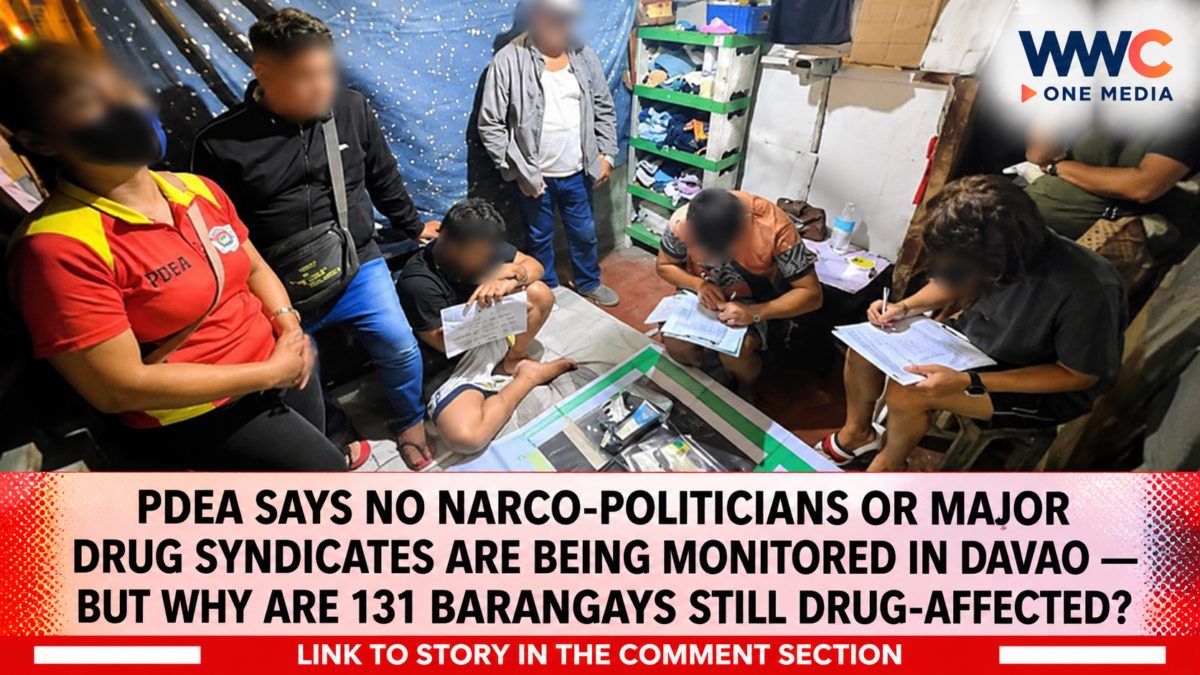
DAVAO CITY, Philippines — The Philippine Drug Enforcement Agency in the Davao Region (PDEA-Davao) says it is not currently monitoring any major drug syndicates, clandestine drug laboratories or politicians allegedly involved in the illegal drug trade in Davao City and the wider Davao Region.
The assessment was disclosed by PDEA-Davao Regional Director Benjamin Gaspi during a Davao Peace and Security Press Corps briefing at The Royal Mandaya Hotel on November 11.
Gaspi said the agency’s intelligence gathering and coordination with other intelligence units had not produced reports confirming the presence of clandestine laboratories manufacturing illegal drugs in the region. He also described allegations of drug manufacturing in Davao as unverified.
On the question of narco-politics, Gaspi said PDEA-Davao had not received reports identifying politicians involved in the illegal drug trade or using drug proceeds to finance political campaigns or buy votes.
“Sa ngayon wala pang naire-report sa amin ‘yung tinatawag na narcopoliticians,” he said, as reported by SunStar Davao.
The statement may sound reassuring, but it comes with an important qualification: PDEA is describing what its intelligence network is currently monitoring—not certifying that drug trafficking, organized criminal activity or political links to illegal drugs do not exist anywhere in the region.
That distinction matters, particularly because government data show that law enforcement agencies seized more than ₱197 million worth of illegal drugs across the Davao Region in 2025, while 131 barangays remained classified as drug-affected.
What PDEA-Davao Actually Said About Narco-Politicians
Gaspi explained that narco-politics refers to the alleged involvement of politicians in the proliferation of dangerous drugs, including the possible use of money from illegal drug activities to finance political ambitions or buy votes.
He said the agency had not received reports identifying politicians engaged in those activities in Davao City or the wider region.
The regional director also said PDEA-Davao had not identified any major organized drug group operating in its current monitoring.
These statements are significant because allegations involving politicians and illegal drugs can carry serious reputational and legal consequences. Without verified evidence, individuals should not be labeled as narco-politicians or accused of participating in drug trafficking.
At the same time, the agency’s statement should not be interpreted as a declaration that all possible political connections have been ruled out. Intelligence assessments reflect available information at a particular time and can change as new evidence emerges.
For now, PDEA-Davao’s position is that it has no current intelligence reports identifying narco-politicians or major drug syndicates in the region.
No Clandestine Drug Laboratories Reported, but Allegations Remain Under Scrutiny
Gaspi also said PDEA-Davao’s intelligence gathering and coordination with the intelligence community had not yielded reports of clandestine laboratories manufacturing illegal drugs in Davao City or elsewhere in the region.
He rejected claims linking Davao to alleged illegal drug manufacturing operations, describing them as unverified allegations.
A clandestine laboratory is an illegal facility used to manufacture controlled substances. Its discovery can point to a different level of drug activity from street-level distribution or the transportation of drugs produced elsewhere.
However, the absence of a laboratory identified through current intelligence does not establish that illegal drugs are not entering or circulating in the region.
Authorities themselves have previously discussed possible supply routes bringing drugs into Davao from outside the area, including Northern Mindanao and routes linked to Malaysia and Indonesia.
That distinction—local manufacturing versus trafficking and distribution—is central to understanding the region’s drug situation.
The ₱197-Million Drug Seizure Figure Raises a Bigger Question
PDEA-Davao’s latest assessment must be viewed alongside the agency’s reported enforcement figures.
According to a year-end report published in February 2026 and covered by Mindanao Times, law enforcement agencies seized more than ₱197 million worth of illegal drugs across the Davao Region during 2025.
The combined figures included:
- ₱93.65 million worth of substances seized through PDEA XI operations.
- ₱103.41 million worth of substances seized by the Philippine National Police and other law enforcement agencies.
- More than 27 kilograms of shabu seized during the year, alongside marijuana plants, marijuana oil and infused products.
These figures show that drug enforcement operations continued to intercept substantial quantities of illegal substances even without PDEA currently identifying major syndicates or clandestine laboratories in the region.
The seizure value, however, should not be treated as the amount of drugs that would necessarily have been sold on the street. It is an official estimated value of confiscated substances, and it does not independently measure the total size of the illegal drug market.
The numbers also do not establish that all seized drugs originated in Davao. Some supplies may have been transported into the region from elsewhere.
131 Barangays Remain Drug-Affected Across the Davao Region
The same 2025 year-end figures identified 131 drug-affected barangays out of the region’s 1,162 barangays.
The breakdown reported by Mindanao Times was:
- Davao City: 66 drug-affected barangays
- Davao del Norte: 38
- Davao del Sur: 15
- Davao de Oro: 9
- Davao Oriental: 3
- Davao Occidental: 0
Davao City accounted for the largest number in the regional breakdown.
The classification does not mean that every resident in those communities is involved in illegal drugs. It identifies barangays assessed as affected under the government’s drug-clearing framework.
It is also important to distinguish between a drug-affected barangay and a drug-cleared barangay. These are administrative classifications used in the government’s community-based anti-drug program; they are not a declaration that every individual in a particular community is involved in drug activity.
The figures underline why PDEA’s latest statement should be read carefully. Not monitoring a major syndicate or narco-politician does not mean the region has no remaining drug-related concerns.
International Drug Shipments Show How Supply Can Reach the Philippines
PDEA-Davao’s assessment comes as national authorities continue intercepting suspected illegal drugs entering the country through international parcels and cargo.
In July 2026, the Bureau of Customs, PDEA and the Philippine Postal Corporation intercepted 39 inbound international parcels containing suspected dangerous drugs worth more than ₱41 million.
According to the Bureau of Customs, five parcels originating from India contained approximately 4.344 kilograms of suspected shabu, with an estimated street value of ₱29.539 million.
The remaining 34 parcels came from the United States, Spain, Germany, Canada, the Netherlands and the United Kingdom. They contained suspected marijuana, including kush, and ecstasy.
The shipments were addressed to recipients in several locations, including Metro Manila, Cavite, Laguna, Pampanga, Cebu, Cagayan de Oro, Surigao and Antique. The seized substances were turned over to PDEA for laboratory examination and further investigation.
In a separate operation in June 2026, Customs also intercepted 14 parcels containing suspected illegal drugs valued at approximately ₱56 million. The shipments originated from countries in Asia, Europe and the United States.
These cases demonstrate that drug trafficking can involve international postal and cargo systems, not only land-based routes or street-level transactions.
They do not establish that the parcels were connected to any politician, major syndicate or clandestine laboratory in Davao. The destinations and investigations must be treated separately unless authorities establish a connection.
WWC ONE MEDIA previously reported on the interception of a major shipment in PDEA Seizes ₱1.36 Billion Worth of Shabu at Manila Port in Unclaimed Laos Shipment — Who Was Supposed to Receive the Massive Drug Cargo?. The case highlights how international cargo can be exploited to move suspected illegal drugs into the country—and why identifying the intended recipients is as important as confiscating the shipment.
Why Mindanao Remains Important in Regional Drug-Trafficking Routes
Although PDEA-Davao says it has not identified major drug syndicates in its current monitoring, regional trafficking routes remain a concern.
The United Nations Office on Drugs and Crime (UNODC), in its report on synthetic drugs in East and Southeast Asia, has described the area around Mindanao as an important distribution hub and a gateway for methamphetamine flows from Sabah, Malaysia, through the Sulu archipelago.
The report discusses trafficking routes involving maritime transport, transnational criminal networks and the movement of drugs across borders. It also cites information from Philippine authorities about the Sabah–Zamboanga-Sulu-Tawi-Tawi corridor.
This regional assessment provides context for the risks facing Mindanao, but it should not be treated as proof that a particular syndicate is currently operating in Davao City.
PDEA-Davao has separately said that some supplies entering the region may originate outside it, particularly Northern Mindanao, with possible sources traced to Malaysia and Indonesia.
The distinction is important: a region can be exposed to international trafficking routes even if local authorities have not identified a major organized group or drug-manufacturing facility within their current area of monitoring.
WWC ONE MEDIA has also followed the international dimension in ₱3.5-B Shabu Shipment Foiled in Laos — Why Authorities Are Now Pointing to an Ex-Bangsamoro Lawmaker. The investigation concerns a separate suspected shipment and allegations that remain subject to investigation and due process.
A Separate ₱3.5-Billion Drug Shipment Investigation Shows the Scale of the Challenge
The Laos case also illustrates why authorities need to look beyond the drugs themselves and investigate the people who allegedly finance, arrange and receive large shipments.
In October 2026, authorities in Laos intercepted 521 kilograms of suspected shabu estimated to be worth approximately ₱3.5 billion. Philippine investigators subsequently pursued possible local connections to the shipment.
The Philippine National Police–Criminal Investigation and Detection Group reportedly subpoenaed at least 21 individuals to obtain information as part of its investigation.
Being subpoenaed or named as a person of interest does not establish guilt. Investigators must still gather evidence and determine whether criminal charges are warranted.
The case is separate from PDEA-Davao’s assessment and has not been established as connected to drug activity in Davao.
For more on the investigative developments, see WWC ONE MEDIA’s report, ₱3.5-B Laos Shabu Haul: CIDG Subpoenas 21 People—What Will Investigators Uncover Next?.
What PDEA’s Statement Means—and What It Does Not
PDEA-Davao’s announcement is an assessment of its current intelligence picture. It means the agency says it has not received reports identifying major drug syndicates, clandestine laboratories or politicians involved in narco-politics in the region.
It does not mean:
- Illegal drugs are no longer entering Davao or the wider region.
- Drug distribution has stopped.
- Every barangay is free from drug-related activity.
- All possible trafficking networks have been identified or ruled out.
- Allegations against any particular individual have been proven or disproven through a court process.
The reported 2025 seizure figures and the 131 drug-affected barangays show why enforcement and prevention remain necessary.
A more complete assessment of the region’s drug situation would require continuing publication of comparable data on seizures, arrests, case outcomes, drug-clearing progress, rehabilitation and the dismantling of trafficking networks.
The Bigger Test: Can Authorities Keep Drug Networks Out of Davao?
PDEA-Davao’s statement offers reassurance that its current intelligence monitoring has not identified major drug syndicates, clandestine laboratories or narco-politicians in the region.
But the wider evidence points to a continuing challenge: illegal drugs are still being seized, communities remain classified as drug-affected, and international trafficking routes continue to threaten the Philippines.
The real measure of success will not be the absence of names on an intelligence watchlist alone. It will also depend on whether authorities can prevent illegal drugs from entering communities, identify the people financing and distributing them, strengthen local prevention programs and secure convictions when evidence supports prosecution.
For now, PDEA-Davao says no narco-politicians or major drug syndicates are under its current monitoring. The question that remains is whether sustained intelligence work and enforcement can keep that assessment true as trafficking networks continue to operate across the region and beyond.