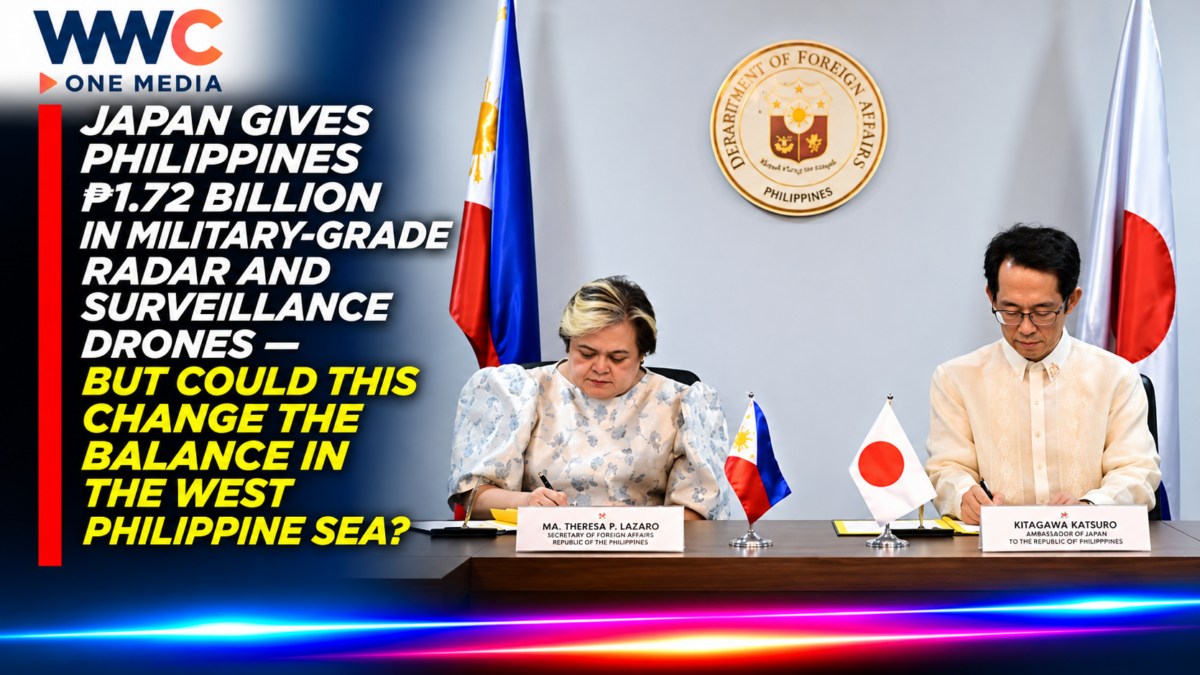
MANILA, Philippines — November 11, 2026 — Japan is preparing to strengthen the Philippines’ maritime defenses with a massive ¥4.3-billion security assistance package, equivalent to approximately ₱1.72 billion, that will equip the Armed Forces of the Philippines (AFP) with new surveillance drones and military-grade coastal radar.
The landmark agreement, signed on November 9, marks the first transfer of a complete defense equipment system under Japan’s Official Security Assistance (OSA) program and represents the largest grant awarded under the initiative since its establishment in 2023.
The Philippine Air Force (PAF) will receive unmanned aerial vehicles (UAVs) for intelligence, surveillance and reconnaissance missions, while the Philippine Navy will obtain a coastal radar system designed to strengthen monitoring of strategically important maritime areas.
The development comes as Manila intensifies its military modernization program and faces continuing tensions with Beijing in the South China Sea, including waters within the Philippines’ exclusive economic zone.
For the AFP, the new equipment promises a potentially significant improvement in its ability to detect and monitor activities across the country’s vast maritime territory.
But the strategic question is bigger than the drones and radar themselves: Will improved surveillance capabilities help the Philippines respond more effectively to maritime security threats, or will the country still need substantially greater military resources to protect its waters?
Japan Signs Historic ₱1.72-Billion Defense Grant With the Philippines
Foreign Affairs Secretary Maria Theresa Lazaro and Japanese Ambassador to the Philippines Kitagawa Katsuro formalized the agreement through an exchange of diplomatic notes in Manila on November 9.
The package forms part of Japan’s fiscal year 2026 Official Security Assistance program, which provides equipment, supplies and infrastructure support to partner countries seeking to strengthen their security capabilities.
According to Japan’s Ministry of Foreign Affairs, the assistance includes two major components:
- Philippine Air Force: Unmanned aerial vehicles intended for monitoring, intelligence gathering and surveillance.
- Philippine Navy: A military-grade coastal radar system designed to improve the detection and monitoring of maritime activity.
The agreement is notable because Japan has previously provided surveillance equipment to the Philippines, but the newly announced radar system is classified by Tokyo as defense equipment.
This makes the 2026 project the first such transfer under the OSA framework.
The grant also highlights the Philippines’ increasingly important position in Japan’s regional security strategy.
Located near the South China Sea and the Luzon Strait, the Philippines occupies a strategically significant position along maritime routes linking East Asia to the Pacific Ocean and beyond.
Tokyo views stronger Philippine monitoring capabilities as beneficial not only to Manila’s security but also to the protection of sea lanes vital to Japan’s economy.
Philippine Air Force Welcomes New Surveillance Drones
Philippine Air Force spokesperson Colonel Alvin Jay Capinguian welcomed the planned transfer, saying the additional unmanned aircraft would strengthen the military’s existing intelligence, surveillance and reconnaissance capabilities.
According to Bilyonaryo News Channel, Capinguian explained that the new systems would complement the Air Force’s current surveillance assets.
For the Philippine military, surveillance drones provide an important advantage: They can gather information about maritime activities without requiring a crew to be physically aboard the aircraft.
Depending on their specifications, UAVs can support missions such as observing vessels, collecting visual intelligence and monitoring developments across coastal and offshore areas.
They can also help military planners assess situations before deploying ships or other aircraft.
However, Japan has not publicly detailed the number, specific models, operating range or endurance of the UAVs included in the latest package.
Consequently, it would be premature to claim that the new drones can continuously monitor the entire West Philippine Sea or independently neutralize threats.
Their actual contribution will depend on the equipment delivered, operational training, maintenance arrangements and integration with existing AFP surveillance systems.
Philippine Navy Plans Stronger Coastal Monitoring
The Philippine Navy is also preparing to expand its surveillance capabilities through the acquisition of military-grade coastal radar.
Navy spokesperson Captain Marissa Martinez said the new radar and UAV systems could strengthen the AFP’s maritime domain awareness and help support round-the-clock monitoring operations.
Maritime domain awareness refers to the ability to detect, identify, understand and track activities occurring in the maritime environment.
For an archipelagic country such as the Philippines, that capability is essential.
The country must monitor extensive maritime areas that include commercial shipping routes, fishing grounds, offshore resources and strategically sensitive locations.
A coastal radar system can provide information about vessel movements within its detection coverage.
When combined with aircraft, drones, vessels and other intelligence sources, that information can help military authorities build a more comprehensive picture of maritime activity.
According to Bilyonaryo News Channel, Philippine defense authorities are assessing strategic locations for the radar installation.
Specific deployment sites have not been publicly confirmed.
The Navy is expected to consider operational priorities when determining where the system can provide the greatest surveillance benefit.
Why the West Philippine Sea Makes This Agreement Important
The security package arrives amid continuing maritime disputes between the Philippines and China.
Beijing claims extensive areas of the South China Sea, including waters where Manila asserts sovereign rights under the United Nations Convention on the Law of the Sea (UNCLOS).
The Philippines refers to portions of the South China Sea within its maritime jurisdiction as the West Philippine Sea.
A 2016 arbitral tribunal rejected China’s claims to historic rights over maritime areas beyond those permitted under UNCLOS.
China rejects the ruling.
The disagreement has contributed to repeated encounters involving Philippine and Chinese government vessels, particularly around contested maritime features.
In this environment, surveillance has become a critical part of the Philippines’ defense strategy.
Better monitoring can help authorities detect unusual vessel activity, document maritime incidents and maintain situational awareness.
As previously reported by WWC ONE MEDIA in its coverage of China’s island-building activities on Philippine-claimed reefs, the physical presence of vessels and installations in contested waters continues to create challenges for Manila despite its legal position under international maritime law.
Japan’s assistance could strengthen the Philippines’ ability to observe developments in sensitive maritime areas.
Nevertheless, improved surveillance does not automatically establish control over disputed waters or prevent confrontations.
Why Japan Is Investing in Philippine Maritime Security
Japan’s expanding defense cooperation with the Philippines reflects its wider Free and Open Indo-Pacific strategy.
Tokyo places significant importance on freedom of navigation, respect for international law and the security of regional shipping routes.
The South China Sea carries major commercial significance because it connects important markets and production centers across Asia.
The Luzon Strait, situated between northern Luzon and Taiwan, is also an important passage between the South China Sea and the Philippine Sea.
Disruptions in these waterways could have consequences for commercial shipping, energy supplies and regional security.
Japan and the Philippines have therefore expanded their defense relationship beyond traditional diplomatic cooperation.
Their partnership now includes military exercises, defense equipment assistance, training and agreements supporting operational coordination.
In related coverage, WWC ONE MEDIA examined the Philippines-Japan defense logistics agreement and its implications for regional military cooperation.
The Acquisition and Cross-Servicing Agreement supports the exchange of supplies and services during eligible activities involving the two countries’ armed forces.
Together with the Reciprocal Access Agreement, which took effect in 2025, these arrangements create a stronger foundation for bilateral defense cooperation.
The new UAV and radar package adds another dimension by directly supporting Philippine military surveillance capabilities.
Japan’s Security Assistance Has Been Growing Since 2023
The latest agreement is part of a longer series of Japanese security commitments to the Philippines.
Japan established its Official Security Assistance framework in 2023 to provide grants supporting the security capabilities of partner countries.
The Philippines became its first recipient.
Tokyo’s initial ¥600-million package funded five coastal radar systems for the Philippine Navy.
Those systems arrived in January 2026 and were formally handed over in February.
A subsequent ¥1.6-billion security package followed in December 2024, providing additional assistance involving the Philippine Navy and Air Force.
In January 2026, the two governments also signed a ¥900-million assistance project supporting infrastructure for rigid-hulled inflatable boats.
The latest ¥4.3-billion package represents a significant increase in the scale of assistance.
BusinessMirror reported that the new award is the largest OSA grant since the program’s creation.
It is important to distinguish this latest grant from previous deliveries.
The earlier coastal radar systems have already been handed over, while the military-grade radar and UAVs covered by the November 2026 agreement remain part of a future procurement and transfer process.
According to Japanese Embassy officials cited by BusinessMirror, procurement and delivery could take approximately two to three years.
That projected timeline means the new capabilities may not become operational immediately.
Japan and the Philippines Discuss Another Major Defense Transfer
The security assistance agreement also follows discussions about transferring retired Japanese naval vessels to the Philippines.
Associated Press and Euronews reported that Tokyo and Manila have been exploring the possible transfer of Japan Maritime Self-Defense Force Abukuma-class destroyer escorts.
Such vessels could potentially enhance the Philippine Navy’s surface fleet, subject to their condition, transfer arrangements, refurbishment and operational requirements.
However, discussions about a possible ship transfer should not be confused with an agreement that the vessels have already been delivered.
Further negotiations and preparation would be necessary.
The interest in additional naval assets highlights the Philippines’ broader effort to strengthen its external defense capabilities.
The AFP has been acquiring modern warships, missiles, aircraft and surveillance technologies as it shifts more attention toward territorial and maritime defense.
The challenge now is integrating those assets into an effective military network.
AFP Modernization: Why Drones and Radar Are Only Part of the Answer
Surveillance technology can help military forces detect suspicious activity, but effective maritime defense requires a wider range of capabilities.
A modern surveillance network must connect information from radar stations, aircraft, drones, ships and other intelligence sources.
That information must then be communicated rapidly to personnel responsible for analysis and operational decisions.
For the Philippine military, the process requires reliable communications networks, trained personnel, maintenance facilities and sufficient operational funding.
It also requires the capability to respond appropriately when surveillance identifies an incident.
The AFP has been pursuing a broader modernization program involving additional maritime assets and more advanced defense technologies.
As discussed in WWC ONE MEDIA’s analysis of whether the Philippines is modernizing its armed forces quickly enough, the central issue is no longer simply acquiring new equipment.
It is whether the military can integrate and sustain its expanding capabilities.
Japan’s assistance may help address important gaps in surveillance.
But technology alone cannot eliminate the need for continued investment in training, logistics and operational readiness.
China Remains a Major Factor in Regional Security
The agreement comes as China continues to expand its military and maritime capabilities.
Beijing has repeatedly criticized security arrangements it believes are designed to contain its regional influence.
China also maintains that its activities in disputed waters are lawful and necessary to protect what it regards as its sovereignty and maritime interests.
The Philippines, meanwhile, insists that it has the right to defend its maritime entitlements and strengthen security partnerships with other countries.
Japan has framed the latest assistance as a contribution to regional peace, maritime security and the protection of important sea lanes.
The new agreement does not establish that conflict between China and the Philippines is imminent.
Nor does the transfer of surveillance equipment mean Japan is committing itself to direct military intervention in the event of a maritime confrontation.
Its immediate purpose is to improve the Philippines’ monitoring and defense-support capabilities.
Regional Defense Cooperation Is Becoming More Important
The Philippines’ growing security relationship with Japan also fits into a wider trend of cooperation among Indo-Pacific governments.
Regional defense discussions increasingly focus on maritime security, intelligence sharing, military readiness and the ability to respond to emerging threats.
These issues featured prominently during the October 2026 ASEAN defense meetings in Cebu.
As WWC ONE MEDIA reported in its coverage of the ASEAN defense ministers’ meetings hosted at Mactan Expo, defense officials gathered amid heightened concern over regional security and maritime disputes.
The Philippines’ position as a major archipelagic state gives it an important role in discussions concerning maritime monitoring and regional stability.
Japan’s latest security package represents another practical example of how bilateral cooperation can support those objectives.
Will the ₱1.72-Billion Grant Change the Balance in the West Philippine Sea?
The most immediate effect of the Japan-Philippines agreement is the promise of additional equipment that could improve the AFP’s intelligence gathering and maritime surveillance.
For the Philippine Air Force, the UAVs may provide new opportunities to monitor maritime activity.
For the Philippine Navy, military-grade radar could improve the detection and tracking of vessels in strategically important areas.
But the long-term value of the assistance will depend on several factors.
The equipment must first be procured, delivered, installed where applicable, and integrated into Philippine military operations.
Personnel must be trained to operate and maintain the systems.
The AFP must also ensure that information gathered through these assets can support timely and lawful operational decisions.
The delivery timeline could become especially important as regional maritime tensions continue.
Additional surveillance systems may strengthen deterrence by making activities more visible and improving the Philippines’ ability to document developments.
However, maritime surveillance does not provide the same capability as naval firepower, air defense or sustained patrol presence.
It improves the information available to commanders and policymakers, rather than automatically determining the outcome of a confrontation.
The Bottom Line
Japan’s ¥4.3-billion, approximately ₱1.72-billion, security grant represents a major milestone in its defense partnership with the Philippines.
The planned transfer of surveillance drones to the Philippine Air Force and military-grade coastal radar to the Philippine Navy could help the AFP improve its awareness of activities across strategically important maritime areas.
The agreement also reinforces Japan’s commitment to security cooperation with Manila as both countries navigate an increasingly complex Indo-Pacific environment.
But with delivery still subject to procurement and implementation, the full benefits will take time to materialize.
For the Philippines, the greater challenge is turning better maritime intelligence into stronger defense readiness, more effective deterrence and reliable protection of its maritime interests.
And as regional tensions continue, one question could define the next phase of the country’s military modernization:
Will Japan’s drones and military-grade radar give the Philippines the surveillance advantage it needs in the West Philippine Sea—or will the AFP discover that seeing a threat is only the beginning of defending against it?