TOKYO, JAPAN / MONTREAL, CANADA / MANILA, PHILIPPINES — November 11, 2026 | WWC ONE MEDIA | Global Gaming, Technology and Entertainment
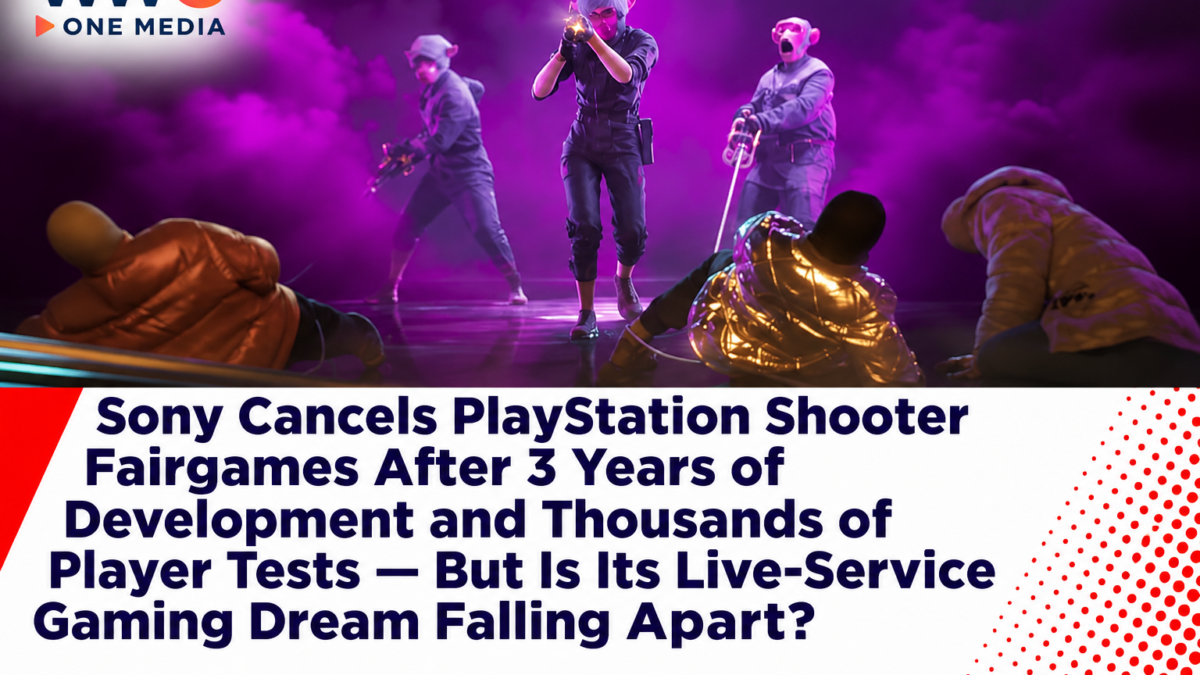
Sony’s PlayStation division has canceled Fairgame$, its long-awaited online multiplayer shooter developed by Haven Studios, dealing another major setback to the Japanese gaming giant’s ambitious and increasingly troubled live-service strategy.
The surprise decision ends more than three years of public anticipation for a game that was once positioned as an important addition to Sony’s PlayStation 5 and PC gaming portfolio.
According to Bloomberg’s November 10 investigation, the cancellation followed a large-scale player test involving thousands of participants that failed to deliver the engagement and retention results Sony expected.
The decision was communicated to employees in an internal email from PlayStation executives Sean Decker and John Doyle.
But unlike several other high-profile PlayStation cancellations, this one comes with an important difference.
Sony says Haven Studios will not close, and no employees will lose their jobs as a direct result of Fairgames being canceled.
Instead, the Montreal-based developer will shift toward supporting other teams within PlayStation Studios while exploring new creative opportunities.
The development marks another turning point in Sony’s efforts to build profitable multiplayer games capable of keeping players engaged for years.
Fairgames now joins a growing list of PlayStation projects canceled, restructured or discontinued as Sony reassesses its push into the highly competitive live-service gaming industry.
With years of development ending without a commercial release, could Fairgames become the clearest warning yet that Sony’s multiplayer expansion strategy needs a complete overhaul?
Why PlayStation Canceled Fairgames After Years of Development
Sony’s decision followed disappointing results from a recent large-scale playtest.
According to Bloomberg, thousands of players participated in the testing process, allowing the company to assess gameplay performance, engagement and the likelihood that users would continue playing.
The internal review found that several operational aspects of the project performed well.
However, player feedback was mixed and retention metrics failed to meet Sony’s expectations.
In the November 10 internal email reviewed by Bloomberg, Decker and Doyle also identified difficult market conditions for player-versus-player shooters as a contributing factor.
That distinction matters.
Sony was not necessarily saying that every technical element of Fairgames had failed.
Rather, the company concluded that the game did not demonstrate a strong enough combination of player appeal, sustained engagement and commercial potential to justify continued development.
For live-service games, these measurements can be particularly important.
Unlike traditional single-player titles that may generate most of their revenue through initial purchases, live-service games often rely on continued engagement, regular updates and ongoing spending.
Developers need players to return repeatedly.
A multiplayer title that attracts initial curiosity but struggles to retain users may face serious financial difficulties after launch.
Sony’s decision suggests that management was unwilling to continue funding Fairgames without stronger evidence of long-term player demand.
However, Sony has not disclosed the exact retention percentages, the game’s development budget or the financial write-off associated with the cancellation.
Any specific claim about how much money Sony lost on the project would therefore be speculative.
What Was Fairgames Supposed to Be?
Fairgame$, also commonly written as Fairgames, was designed as a competitive multiplayer heist shooter.
The game was officially unveiled during the May 2023 PlayStation Showcase.
Its initial promotional trailer introduced a world in which players would compete to infiltrate wealthy targets, steal valuable items and outmaneuver rival teams.
The project combined elements of competitive shooting, team-based strategy and extraction-style gameplay.
It was planned for PlayStation 5 and PC.
Sony positioned it as part of a broader initiative to develop multiplayer games with long-term commercial potential.
Fairgames was the debut project from Haven Studios, a Montreal-based developer founded by veteran game producer Jade Raymond.
Raymond is known for her work on major franchises including Assassin’s Creed and her experience at Ubisoft, Electronic Arts and Google’s Stadia initiative.
Sony acquired Haven Studios in 2022, bringing the developer into its first-party PlayStation organization.
At the time, the acquisition reflected Sony’s interest in expanding its development capabilities beyond traditional console exclusives.
The expectation was that Haven could create a new multiplayer franchise capable of attracting players across multiple platforms.
But after its 2023 reveal, official updates became increasingly limited.
The game never received a confirmed commercial release date.
In the years that followed, reports suggested that its direction was being reconsidered internally.
Bloomberg’s latest investigation confirmed that the project had undergone several revisions before its eventual cancellation.
Fairgames Was Reportedly Being Reworked Before Sony Pulled the Plug
The cancellation arrived after a prolonged period of uncertainty.
According to Bloomberg’s reporting, Fairgames had been reworked several times over the preceding three years.
The company had also been preparing to reveal the project again under a different title.
Reports circulated that the game could be renamed Break In, although Sony did not formally announce that name as an official replacement.
Those developments suggested that Haven Studios was trying to refine the game’s identity and appeal.
A reworked game can sometimes recover from difficult development conditions.
However, extensive revisions can also increase costs and delay commercial release.
In the case of Fairgames, Sony ultimately concluded that the latest testing results did not justify continuing.
Gaming publication Gematsu reported that the playtest may have been connected to a previously identified testing initiative called Project Espresso.
That connection remains a reported possibility rather than a detail fully confirmed by Sony.
What is established is that the final assessment involved thousands of players and produced results below the company’s internal targets.
The absence of a publicly confirmed budget also means the financial scale of the cancellation cannot be accurately quantified.
But the strategic implications are substantial.
Sony acquired Haven to help build its multiplayer gaming future, and the studio’s first major announced project will now never reach commercial release.
Haven Studios Survives as Sony Promises No Job Cuts
One of the most significant elements of the announcement concerns Haven Studios’ employees.
Sony confirmed that the cancellation would not result in layoffs.
A PlayStation spokesperson said the studio would redirect its resources toward collaborating with other development teams while considering future creative work.
That means Haven will remain part of PlayStation Studios.
The decision contrasts with previous occasions when canceled projects were followed by studio closures or job losses.
However, Haven’s new role is still being defined.
Sony has not announced which specific PlayStation projects its developers will support.
It has also not confirmed when Haven might return to developing an original game of its own.
The shift could allow the studio’s programmers, designers, artists and other specialists to contribute to ongoing first-party productions.
But the cancellation removes the project around which the studio’s public identity was originally built.
For Sony, retaining the team could preserve valuable development expertise while avoiding the disruption caused by closing another studio.
Whether the arrangement becomes a long-term success will depend on the responsibilities Haven receives and the performance of the projects it supports.
Jade Raymond’s Departure Was an Earlier Warning Sign
Haven Studios’ difficulties became more visible after founder Jade Raymond left the developer in 2025.
Raymond established Haven in 2021 before Sony acquired the business the following year.
Her departure came as reports emerged that Fairgames had encountered problems during development and testing.
However, Sony did not publicly establish that the game’s difficulties were the sole reason for Raymond’s exit.
Nor did her departure automatically mean Fairgames had been canceled.
At the time, Sony continued to support Haven and its project.
The November 2026 cancellation now confirms that the studio’s original flagship game will not be released.
The sequence highlights the difficulties associated with creating entirely new multiplayer franchises.
Even experienced developers backed by large publishers can struggle to develop games that attract and retain sufficiently large audiences.
For Sony, the challenge is especially important because its strongest first-party reputation has historically been associated with narrative-driven games rather than a broad portfolio of competitive online shooters.
Concord’s Failure Still Haunts PlayStation’s Live-Service Strategy
Fairgames is not the first major setback for Sony’s multiplayer expansion.
In 2024, PlayStation launched Concord, a team-based multiplayer shooter developed by Firewalk Studios.
The game struggled to attract a substantial player base.
Sony took Concord offline shortly after its August 2024 release and subsequently shut down Firewalk Studios.
The failure became one of the most widely discussed examples of the risks involved in developing expensive live-service games.
Concord entered an already crowded market dominated by established multiplayer franchises.
Players had numerous alternatives, many of which were free to access and supported by years of additional content.
A new competitor therefore needed a strong reason for players to abandon existing games or divide their time between multiple services.
Fairgames faced a similar underlying challenge.
Sony’s executives specifically cited difficult conditions in the competitive shooter market when explaining the cancellation.
The decision may indicate that the company is now applying stricter standards before allowing major multiplayer projects to launch.
Rather than releasing an uncertain title and risking another expensive commercial failure, Sony chose to end development.
The approach may prevent additional spending on a game with weak retention prospects.
But repeated cancellations also raise questions about project selection, development oversight and the company’s ability to identify commercially viable multiplayer concepts early enough.
Sony’s Canceled Multiplayer Projects Are Adding Up
Sony’s live-service ambitions were once considerably larger.
During its earlier strategic expansion, PlayStation discussed plans to release more than a dozen live-service titles.
The initiative was designed to increase recurring revenue through ongoing player spending.
But several projects have since been canceled or discontinued.
Naughty Dog ended development of its planned standalone multiplayer game based on The Last of Us in 2023.
The studio explained that maintaining a live-service title would require extensive long-term resources that could affect its ability to produce narrative-driven games.
Sony also canceled multiplayer projects associated with other internal developers.
Bluepoint Games and Bend Studio were among the teams affected by changes in Sony’s live-service plans.
Bluepoint was subsequently closed in 2026.
Other reported projects, including multiplayer concepts linked to established PlayStation franchises, have also encountered cancellations or restructuring.
Fairgames adds another example to that broader pattern.
However, it would be inaccurate to conclude that Sony has abandoned live-service gaming entirely.
The company continues to operate and support multiplayer titles, and it remains interested in commercially successful online experiences.
The change appears to involve a more selective approach rather than a complete withdrawal.
Helldivers 2 Proves Sony Can Still Succeed in Online Gaming
Despite the setbacks, Sony has achieved success with some live-service titles.
Helldivers 2, developed by Arrowhead Game Studios and published by Sony Interactive Entertainment, became a major commercial hit following its 2024 release.
The cooperative multiplayer shooter attracted a substantial international audience and developed an active online community.
Its performance demonstrated that Sony can participate successfully in the market when a game delivers a compelling experience.
But Helldivers 2 also illustrates why multiplayer success cannot be guaranteed through investment alone.
Its cooperative gameplay, humor and community-driven mechanics offered a distinctive experience.
By contrast, entering a crowded competitive shooter category can require a new title to compete directly against well-established franchises.
Games such as Fortnite, Valorant, Apex Legends and other long-running multiplayer titles have accumulated large communities and substantial content libraries.
New entrants must compete for players’ limited time and attention.
The success of one online game therefore does not establish that every live-service project will be profitable.
Sony’s challenge is identifying titles with strong long-term appeal before development costs become excessive.
Marathon Faces Pressure as PlayStation Reassesses Multiplayer Games
Another important part of Sony’s online gaming strategy involves Bungie, the studio behind Destiny.
Sony acquired Bungie in 2022 as part of its push to strengthen expertise in multiplayer and live-service development.
Bungie’s extraction shooter Marathon launched in 2026.
According to gaming industry reporting, the title experienced a difficult start and continues to face pressure to expand its audience.
Bungie has announced additional gameplay features planned for a December update, including new cooperative and competitive experiences.
Marathon’s long-term performance will provide another indication of whether Sony can build sustainable online franchises.
The company is also developing a multiplayer project connected to the Horizon universe.
Reports indicate that the project has undergone significant revisions following internal testing.
However, the Horizon project has not been confirmed as canceled.
The distinction is important.
Fairgames has been discontinued.
Marathon remains active.
Sony’s Horizon-related multiplayer plans are still under development, although their direction may change.
Together, these projects demonstrate that PlayStation has not abandoned multiplayer gaming but faces important decisions about where to allocate development resources.
Sony’s Gaming Strategy Faces Pressure From Rising Costs and Slower Console Sales
The Fairgames cancellation comes during a broader period of financial uncertainty for Sony’s gaming business.
PlayStation remains one of the world’s most valuable console ecosystems, supported by hardware sales, first-party games, subscriptions and digital transactions.
But developing major games has become increasingly expensive.
Studios require substantial teams, sophisticated technology and longer production schedules.
At the same time, Sony must manage the financial pressures associated with maintaining its hardware platform.
In a related report, WWC ONE MEDIA examined Sony’s ¥1.72 trillion profit ambitions, slowing PlayStation 5 sales and rising component costs as major entertainment releases approach.
The cancellation of Fairgames does not establish that Sony’s gaming division is in financial distress.
Sony has not disclosed the project’s cancellation costs.
However, the decision may reflect a growing emphasis on financial discipline and stronger evidence of player demand before committing additional resources.
A successful live-service game can generate substantial recurring revenue.
But an unsuccessful project can require years of spending without producing meaningful commercial returns.
Sony now appears increasingly focused on distinguishing between those outcomes earlier in the development process.
GTA VI Could Create a Different Kind of Opportunity for PlayStation
While Fairgames will never reach commercial release, PlayStation is preparing for one of the industry’s most anticipated launches.
Grand Theft Auto VI is scheduled for November 19, 2026, on PlayStation 5 and Xbox Series X|S.
The title is developed by Rockstar Games and published by Take-Two Interactive, not Sony.
Nevertheless, its release could support PlayStation console demand, digital storefront activity and overall player engagement.
The contrast between GTA VI and Fairgames demonstrates two different approaches to the gaming market.
GTA VI is built on an established entertainment franchise with a large international following.
Fairgames was an entirely new intellectual property trying to establish itself in a competitive multiplayer category.
Both business models involve risks.
But recognized franchises may benefit from existing consumer awareness, while new live-service properties often need to build an audience from scratch.
Sony’s broader gaming strategy must balance investment in original development with the commercial opportunities generated by popular third-party releases.
Take-Two’s Results Show That Even Major Gaming Companies Face Uncertainty
Sony is not alone in facing challenges within the gaming market.
Major publishers are experiencing changing consumer demand, higher production costs and increased competition.
In related coverage, WWC ONE MEDIA examined Take-Two Interactive’s recent earnings disappointment, including the performance of NBA 2K27 and expectations surrounding GTA VI.
The developments illustrate an important financial reality.
A company can own globally recognized franchises and still face disappointing results from individual titles.
For new multiplayer games, the risks may be even greater.
Players can quickly switch to competing products, and the success of ongoing content updates depends on maintaining an active community.
This is particularly challenging in markets where established games already provide frequent updates and familiar social experiences.
Publishers must therefore assess how their products will compete not only at launch but also over several years.
Sony’s decision to cancel Fairgames suggests that management was unconvinced the project could meet those requirements.
China and Mobile Gaming Are Adding to Global Competition
Sony’s difficulties are unfolding as competition intensifies across the international gaming industry.
Chinese game publishers have expanded their presence in mobile and online gaming through substantial investments in development, technology and international distribution.
Companies such as Tencent and NetEase compete across multiple game categories.
Mobile gaming and console shooters are not identical markets.
However, they compete for consumer spending and entertainment time.
Cross-platform games, free-to-play titles and online communities have also changed expectations about how games are distributed and monetized.
For Sony, those changes make it essential to offer experiences that stand out.
Simply producing another multiplayer shooter is unlikely to guarantee commercial success.
The company must demonstrate why players should invest time and money in a new title instead of returning to an established favorite.
What the Cancellation Means for Filipino PlayStation Gamers
For PlayStation fans in the Philippines, the immediate consequence is straightforward.
Fairgames will no longer launch on PlayStation 5 or PC.
Players who were interested in the game’s competitive heist concept will need to look elsewhere for similar experiences.
The cancellation does not affect the ability of existing PlayStation 5 owners to play their current games.
It also does not mean PlayStation Network is shutting down or that Sony has stopped supporting multiplayer gaming.
Sony continues to publish and distribute games across its platforms.
For Filipino gamers, the larger significance concerns the types of experiences Sony may prioritize in the future.
The company could focus more resources on established franchises, proven multiplayer concepts or new projects that demonstrate strong player retention during testing.
However, Sony has not announced a complete replacement for Fairgames.
Nor has it identified a new Haven Studios title intended to take the canceled game’s place.
Any claim that a specific successor project is already in development would therefore go beyond the confirmed information.
Five Questions Sony Must Answer After Fairgames
1. What happens next to Haven Studios?
Sony says the studio will support other PlayStation teams, but it has not identified the projects or responsibilities involved.
2. How much money was spent on Fairgames?
The company has not disclosed the full development budget or any cancellation-related financial charge.
3. Will Sony continue investing in original live-service games?
The company still operates and develops online titles, but its future investment priorities may become more selective.
4. Can PlayStation avoid another Concord-style failure?
More demanding playtests could help identify problems earlier, although no testing process can guarantee success.
5. What will replace the canceled project in Sony’s release pipeline?
Sony has not announced a direct replacement or a new release timetable tied to Haven Studios.
These unanswered questions will influence how gaming investors and PlayStation fans evaluate Sony’s longer-term strategy.
The Bottom Line: Fairgames Is Gone, but Sony’s Biggest Multiplayer Challenge Remains
Sony’s cancellation of Fairgames is another significant setback for its ambitious live-service gaming expansion.
The project was announced in 2023, backed by a studio acquired in 2022 and designed to help PlayStation develop a new generation of multiplayer franchises.
But after years of work and extensive player testing, Sony concluded that the game did not meet its standards for sustained player engagement.
The company has confirmed that Haven Studios will survive and that the cancellation will not directly result in layoffs.
That offers some reassurance to the developers affected by the decision.
However, it does not eliminate the strategic questions surrounding PlayStation’s online gaming investments.
Sony has experienced major success with Helldivers 2, but it has also faced the collapse of Concord and cancellations involving several other multiplayer projects.
The company now needs to demonstrate that it can consistently identify games with enough appeal to justify years of development and ongoing support.
For players, the cancellation means one fewer anticipated PS5 title.
For Sony, it is another reminder that even a major gaming company cannot guarantee success in the increasingly competitive live-service market.
PlayStation has canceled Fairgames before another costly commercial launch could put the game to the ultimate test. But after years of abandoned projects, shifting studio strategies and mixed multiplayer results, can Sony finally build its next global online gaming hit—or is its live-service dream becoming one of the most expensive strategic experiments in PlayStation history?