
BENGALURU — In parts of rural India, a smartphone is starting to do jobs that once required specialist equipment, trained technicians or a long trip to a hospital.
In Chagallu village in Andhra Pradesh, community health workers are asking residents to cough into a phone.
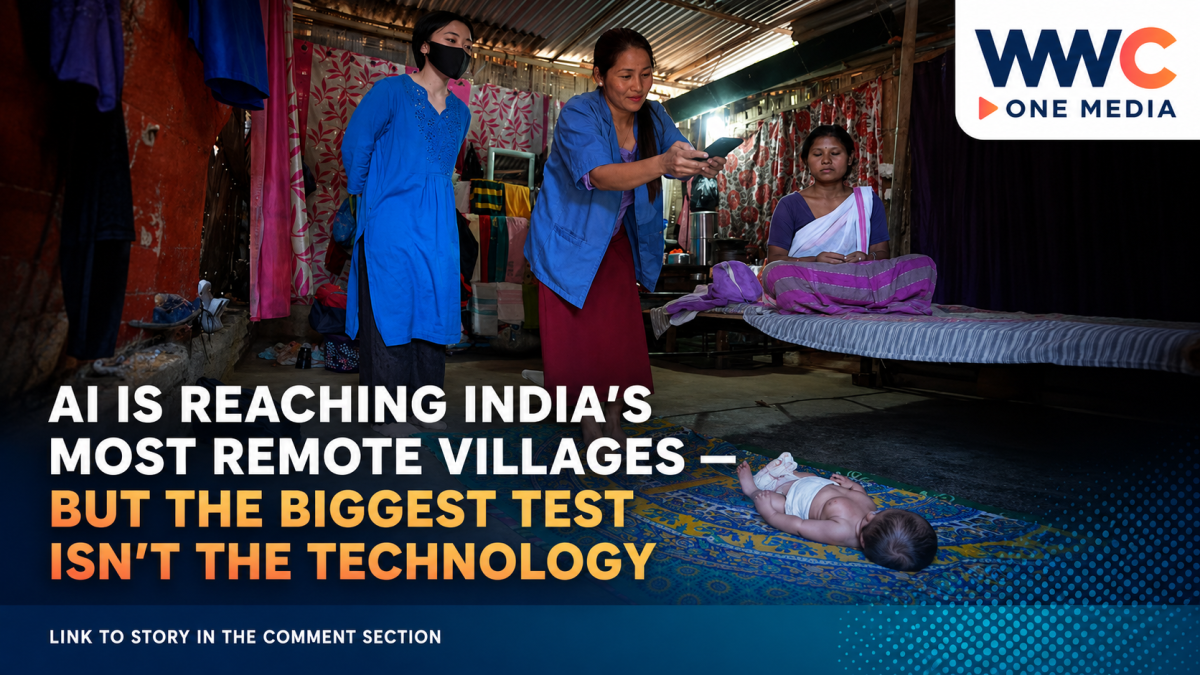
Hundreds of kilometres away, other frontline workers are recording short videos of newborn babies so artificial intelligence can estimate their weight and other body measurements.
And in Goa, AI is being added to routine chest X-rays to help doctors identify suspicious lung abnormalities that might otherwise wait days for specialist review.
These projects are part of a much bigger experiment unfolding across India: whether artificial intelligence can help one of the world’s largest healthcare systems reach people in places where doctors, radiologists and diagnostic equipment remain scarce.
But the real test may have surprisingly little to do with how sophisticated the algorithms become.
It is whether the technology can fit into the daily lives of the already stretched health workers expected to use it.
A COUGH INTO A PHONE COULD FLAG SOMEONE FOR TB TESTING
One of the most striking examples is Swaasa, an AI-based respiratory screening platform developed by Hyderabad-based Salcit Technologies.
The system records cough sounds through a smartphone and combines acoustic patterns with other patient information to estimate whether someone may be at elevated risk of respiratory disease.
In a pilot described by CNA in Chagallu, Accredited Social Health Activists, or ASHAs, went door to door using the technology as part of tuberculosis screening.
The significance is not that a smartphone can definitively diagnose TB — it cannot.
Instead, it could help identify people who should receive further medical testing, including people who may not display the obvious symptoms normally used to decide who gets screened. CNA reported that some residents flagged for further examination were subsequently diagnosed with TB and began treatment.
That distinction matters.
The Indian Express reported in February 2026 that Swaasa had undergone testing and validation at medical institutions including Apollo Hospitals, Christian Medical College Vellore and AIIMS-linked facilities. Medical specialists told the newspaper that the technology is intended as an accessible screening aid rather than a replacement for established diagnostic procedures such as spirometry or confirmatory TB testing.
A peer-reviewed study published in Scientific Reports provides additional evidence of the technology’s potential — while also showing why human medical oversight remains essential.
Researchers evaluated the Swaasa model using data from 567 people, including 278 pulmonary TB-positive cases. In that validation, the model reported sensitivity of 90.36 percent and specificity of 84.67 percent.
Those results are promising for a screening system, but they are not the same as perfect diagnostic accuracy. Positive AI findings still need to be followed by established clinical testing.
And the need is enormous.
The World Health Organization estimates that India accounted for roughly one-quarter of the world’s new tuberculosis cases in 2024, making it the single largest contributor to the global TB burden.
That makes a cheap screening tool that can travel inside a smartphone potentially powerful — especially in communities where access to specialist diagnostics can be limited.
AI IS ALSO BEING ASKED TO ‘WEIGH’ NEWBORNS
Another experiment is targeting a completely different healthcare problem.
Shishu Maapan, developed by Wadhwani AI, allows a frontline worker to take a short smartphone video of a newborn and use artificial intelligence to estimate measurements including weight, length and head circumference.
The tool is intended for babies up to 42 days old.
For an urban hospital equipped with digital scales, that may sound like a minor convenience.
For an ASHA worker travelling from house to house, sometimes across difficult terrain, it could mean carrying fewer pieces of equipment while recording measurements digitally instead of repeatedly transferring them into paper registers.
YourStory reported in March 2025 that about 450 ASHA workers had already been trained to use Shishu Maapan in Dadra and Nagar Haveli and Daman and Diu.
The report said measurements can be stored when internet access is unavailable and synced later, an important feature in areas where connectivity cannot be taken for granted.
CNA reported that the underlying AI model was trained using data from more than 30,000 infants and was designed to operate on relatively inexpensive Android phones while tolerating imperfect lighting and movement.
The potential public-health impact goes beyond convenience.
UNICEF reported in its February 2025 nutrition brief that about 18 percent of babies born in India have low birth weight, defined as less than 2.5 kilograms.
UNICEF also identifies prematurity and low birth weight as major contributors to neonatal mortality in India.
Being able to identify a baby who is failing to gain sufficient weight during early home visits could therefore give health workers an opportunity to intervene sooner.
INDIA’S MILLION-STRONG FRONTLINE HEALTH NETWORK IS THE REAL KEY
Behind both technologies is one of the most important — and often overlooked — parts of India’s healthcare system.
India has roughly 1.02 million ASHA workers, according to government figures cited by CNA, serving communities across hundreds of thousands of rural villages.
An ASHA worker can effectively become the first link between a family and the formal healthcare system, particularly for maternal care, immunisation, newborn monitoring and tuberculosis programmes.
That makes them an obvious distribution network for AI healthcare.
It also creates the technology’s biggest weakness.
These workers already carry extensive responsibilities. Giving them another application, another login, another device or another dataset to record could make their jobs harder rather than easier.
CNA reported that some health workers initially struggled with the Swaasa workflow because of differences in digital familiarity and connectivity.
There was also a more practical problem: asking someone suspected of carrying an infectious respiratory disease to cough near a health worker’s personal phone.
Officials involved with the pilot suggested that a large-scale programme might require dedicated devices rather than relying on workers’ own smartphones.
That is precisely where the glamorous story of artificial intelligence meets the less glamorous reality of public healthcare.
An algorithm may work perfectly in a laboratory and still fail if the person using it has poor connectivity, an overloaded schedule or no clear process for dealing with the result.
GOA SHOWS WHAT HAPPENS WHEN AI BECOMES PART OF THE SYSTEM
Goa may provide a glimpse of what happens when AI moves beyond an isolated pilot.
The state has incorporated Qure.ai software into its public healthcare network to analyse routine chest X-rays for abnormalities, including pulmonary nodules that may indicate lung cancer risk.
Rather than replacing doctors, the software acts as an additional screening layer.
India Today reported in February 2026 that Goa’s programme was being examined as a potential model for wider adoption after AI was embedded into routine chest-X-ray workflows.
Goa government documentation confirms the state established an early lung-cancer detection programme using Qure.ai software in collaboration with AstraZeneca, with AI interpretation of digital chest X-rays followed by additional clinical investigation when necessary.
CNA described another crucial element: patient navigators.
When the AI flags a suspicious image, the system does not simply generate a result and leave the patient on their own.
Navigators help connect people to physicians, CT scans and additional testing.
A Goa chest physician told CNA that a pathway that could previously stretch over three to four weeks had been reduced to roughly three to four days in some cases.
That could be the most important lesson of all.
AI alone does not shorten a patient’s journey.
AI connected to doctors, referral systems, transportation, follow-up and human health workers potentially can.
THE NEXT BATTLE IS NO LONGER JUST BUILDING BETTER AI
India is hardly short of healthcare AI pilots.
The harder question is how many will survive once demonstrations end, grants expire and governments have to decide whether the technology belongs inside routine public healthcare.
Swaasa illustrates the problem clearly.
Its technology has been tested in multiple programmes, but CNA reported that its developer has not yet secured a nationwide or statewide government rollout for the particular programme described in the report.
That gap between a promising pilot and permanent adoption is where many healthcare technologies struggle.
Scaling requires more than accuracy.
Governments need equipment, training, technical support, data safeguards, integration with existing health databases, clinical protocols and — perhaps most importantly — somewhere for every patient flagged by the AI to go next.
Without that final piece, better detection could simply create a new queue.
AI MAY CHANGE THE FRONTLINE — BUT IT ISN’T REPLACING IT
For years, predictions about artificial intelligence in medicine have focused on whether machines might eventually replace doctors.
India’s rural healthcare experiment points toward a different future.
The more immediate opportunity may be using AI to extend the reach of people already working inside communities.
A phone might identify an unusual cough pattern.
An algorithm might estimate a baby’s weight.
Software might highlight a tiny shadow on a chest X-ray.
But none of those things can persuade a frightened patient to travel 40 kilometres for another test, explain a suspicious result to a family, counsel a mother whose newborn is underweight or ensure someone diagnosed with tuberculosis continues treatment.
Those tasks still depend heavily on people.
And that may ultimately decide whether India’s rural AI revolution succeeds.
The biggest breakthrough may not come when artificial intelligence becomes powerful enough to replace a health worker.
It may come when the technology becomes simple and reliable enough that the health worker barely notices it is there.




Leave a Reply