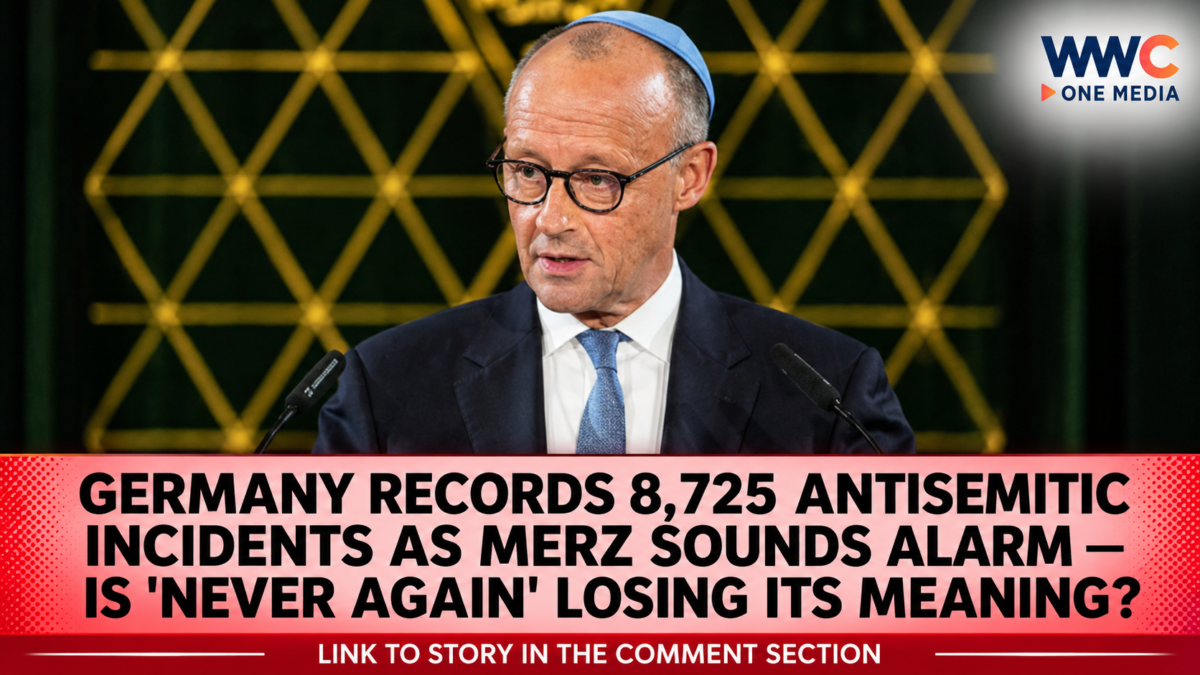
German Chancellor Friedrich Merz has warned that Germany is facing a historic test of its commitment to protecting Jewish people, declaring that antisemitism has become increasingly visible across society as Jewish institutions continue to require extraordinary security measures.
Speaking at a synagogue in Munich on November 9, 2026, Merz described the sight of kindergartens and synagogues protected by bulletproof glass and armed police as horrifying. He said the country must now prove that its promise of “Never again” means more than commemorating the atrocities of the Nazi era.
His remarks came on the 88th anniversary of Kristallnacht, the November 1938 pogrom in which Nazi-led mobs attacked Jewish communities, destroyed synagogues and businesses, and terrorised Jewish families across Germany and Austria.
The warning comes amid a sharp increase in recorded antisemitic incidents. Germany’s monitoring organisation, the Federal Association of Departments for Research and Information on Antisemitism (RIAS), documented 8,725 antisemitic incidents in 2024, more than three times the 2022 figure. That represents approximately 24 reported incidents every day. Reuters+2
For Merz, the issue is not simply about protecting religious buildings. It is about whether Jewish people can live, study, worship and participate in German society without fear.
Merz Says Germany’s Promise of ‘Never Again’ Is Facing a Moment of Truth
Addressing the Jewish community during an event at Munich’s Ohel Jakob synagogue, Merz said antisemitism was appearing in streets, schools, clubs, parliaments and communities across Europe and beyond.
He warned that the growing visibility of hatred against Jewish people was testing Germany’s commitment to the historical lessons of the Holocaust.
The chancellor pledged that his government would do everything within its power to protect Jewish life in Germany and abroad.
He also reaffirmed Germany’s support for Israel, describing that commitment as part of the country’s historical responsibility because of Nazi Germany’s persecution and murder of six million European Jews.
Merz’s message carried particular significance because Germany has long treated the protection of Jewish life and the fight against antisemitism as central responsibilities arising from its history.
However, the latest figures suggest that public declarations alone have not been enough to eliminate the problem. Reuters+1
8,725 Antisemitic Incidents Recorded in Germany in One Year
The scale of the reported incidents is among the most concerning elements of the debate.
RIAS documented 8,725 antisemitic incidents in Germany in 2024, compared with substantially lower figures in 2022. The organisation has described the increase following the outbreak of the Gaza war in October 2023 as dramatic.
The total works out to roughly 24 reported incidents per day.
These figures cover incidents recorded by the monitoring network and should not be confused with the number of criminal convictions or necessarily with police-recorded offences. Monitoring organisations may document a wider range of experiences, including threats, harassment, antisemitic propaganda and other forms of hostility.
The figures nevertheless provide a significant indication of the pressure experienced by Jewish communities.
The increase has also intensified debate about security at synagogues, Jewish schools, community centres and public events.
For Jewish families, the concern is not limited to the possibility of physical attacks. Verbal abuse, threats, intimidation and discrimination can also affect whether people feel safe openly expressing their religious and cultural identity.Reuters+1
Why Kristallnacht Still Matters 88 Years Later
Merz delivered his warning on the anniversary of one of the most important turning points in Nazi Germany’s persecution of Jewish people.
Kristallnacht, commonly translated as the Night of Broken Glass, began on November 9, 1938, and continued into November 10.
Nazi officials and supporters organised widespread attacks against Jewish communities throughout Germany and annexed territories.
According to the United States Holocaust Memorial Museum:
- More than 1,400 synagogues were burned or attacked.
- Thousands of Jewish-owned businesses were vandalised.
- Jewish homes were invaded and destroyed.
- Jewish people were assaulted and killed.
- Approximately 26,000 Jewish men were arrested and sent to concentration camps.
The violence was not an isolated outbreak of public anger. It was a state-sponsored pogrom coordinated by Nazi authorities, marking a major escalation in the systematic persecution of Jews.
The attacks helped prepare the ground for the Holocaust, during which Nazi Germany and its collaborators murdered six million European Jews. Holocaust Encyclopedia+1
The anniversary is therefore more than a historical remembrance event. It serves as a warning about how discrimination, propaganda and dehumanisation can escalate when hatred is tolerated or encouraged.
Holocaust Survivor Returns to Berlin With a Warning for Younger Generations
The anniversary also brought renewed attention to the testimony of George Shefi, a Holocaust survivor who witnessed Kristallnacht as a six-year-old child.
According to Associated Press reporting, Shefi returned to Berlin at the age of 94 to share his memories of the attacks.
As a child, he remembered being kept at home while violence swept through his neighbourhood. When he was finally allowed outside, the Jewish school inside a synagogue had been burned, nearby businesses had been vandalised and people were jeering at a Jewish shopkeeper trying to clean up the destruction.
In 1939, his mother sent him to England through the Kindertransport, a rescue programme that helped Jewish children escape Nazi persecution. His mother was later deported to Auschwitz and murdered.
Shefi now speaks to students and members of the public about the importance of understanding history and recognising the consequences of hatred.
His message is particularly urgent as the generation of people who directly experienced the Holocaust becomes smaller.
The Associated Press report highlighted his warning that younger generations will be responsible for what happens in the future, even though they were not responsible for the crimes committed decades earlier. AP News+1
Jewish Institutions Still Need Armed Police and Bulletproof Protection
One of the strongest points in Merz’s speech was his criticism of the security arrangements required to protect Jewish institutions.
The chancellor said it was horrifying that kindergartens and synagogues needed bulletproof glass and armed police officers simply to function safely.
Such protection has become a visible feature of security planning around some Jewish institutions in Germany.
The situation illustrates the gap between the country’s commitment to religious freedom and the reality experienced by communities that require additional protection because of threats.
Jewish families should be able to send their children to school, attend religious services and gather for cultural celebrations without having to consider whether an attack might occur.
Bavarian parliament speaker Ilse Aigner also condemned the insecurity experienced by Jewish people, describing it as a disgrace for Germany.
Her remarks reinforced the seriousness of the issue beyond the federal government. Reuters+1
Gaza War Has Intensified Germany’s Antisemitism Debate
The increase in antisemitic incidents has taken place against the backdrop of the Israel-Gaza war, which began after the Hamas-led October 7, 2023 attack on Israel.
The attack killed approximately 1,200 people in Israel, according to figures cited in international reporting. Israel’s subsequent military campaign in Gaza has resulted in tens of thousands of Palestinian deaths, according to Palestinian health authorities.
The conflict has triggered demonstrations, political disagreements and intense public debate across Europe.
Germany has faced the challenge of responding to antisemitism while also dealing with protests, criticism of Israeli government policy and concerns about the humanitarian situation in Gaza.
An important distinction must be maintained: criticism of the Israeli government or its military actions is not automatically antisemitic. However, targeting Jewish people collectively, using antisemitic stereotypes, threatening Jewish institutions or justifying violence against Jews because of their identity constitutes antisemitism.
The distinction matters because combating hatred requires protecting Jewish communities without treating legitimate political debate as inherently discriminatory.
In October 2026, Merz also vowed to fight antisemitism while marking the third anniversary of the October 7 attack. He called on political parties to confront antisemitism in all its forms. AFP+1
Germany’s Historical Responsibility Faces a Modern Challenge
Germany’s commitment to protecting Jewish life is deeply connected to its responsibility for the Holocaust.
Successive German governments have repeatedly described the security and freedom of Jewish communities as a national responsibility.
Former chancellors Angela Merkel and Olaf Scholz also made public commitments to fighting antisemitism and protecting Jewish institutions.
But the latest rise in reported incidents has renewed questions about whether political commitments are translating into effective protection.
The challenge involves more than policing. It also includes education, public awareness, the prevention of online radicalisation and action against groups that promote hatred.
Germany must confront antisemitism wherever it appears, including in extremist political movements, online communities and public demonstrations.
The country must also ensure that efforts to combat hatred are applied consistently and do not become a justification for suppressing legitimate criticism or peaceful political expression.
UN Warns Hate Speech Is Becoming More Dangerous in the Digital Age
Germany’s struggle reflects a wider international problem.
United Nations Secretary-General António Guterres warned in September 2026 that artificial intelligence, algorithms and digital platforms were giving hate speech new ways to spread across borders.
He cautioned that online hatred can deepen divisions, dehumanise communities and contribute to discrimination and violence.
The UN has specifically identified antisemitism, anti-Muslim hatred, racism, misogyny and xenophobia as forms of prejudice that require a coordinated response.
WWC ONE MEDIA examined the warning in UN Chief Warns Hate Speech Is Weaponizing AI and New Technologies as UN Calls for Global Action.
The issue is especially relevant because antisemitic propaganda can circulate rapidly online, including through conspiracy theories, historical distortion and content designed to portray Jewish communities as collectively responsible for political events.
UNESCO has also warned that Holocaust denial and distortion remain significant problems on social media. Its research has found that 16% of Holocaust-related content examined in one study contained denial or distortion.
The organisation says accurate Holocaust education and digital literacy are important tools for preventing the spread of historical misinformation. UNESCO+1
Antisemitism Concerns Are Also Emerging Across Asia
The issue is not limited to Europe.
In Thailand, a Jewish New Year celebration in Phuket was cancelled in September 2026 after security officials raised concerns about possible violence amid protests involving Israeli visitors and the local Jewish community.
WWC ONE MEDIA reported on the incident in Phuket Jewish New Year Event Cancelled Over Security Concerns.
The controversy also raised questions about the difference between criticism of individual tourists, opposition to Israeli government policies and hostility directed at Jewish people as a religious community.
Israel’s ambassador to Thailand, Alona Fisher-Kamm, subsequently called for efforts to prevent tensions from spreading into broader hostility. Read the related report: Israeli Ambassador to Thailand Plays Down Anti-Israel Protests as Tensions Rise Over Israeli Tourists.
Another incident involved a Jewish cemetery in Thailand, where authorities investigated the discovery of four bodies and questions about the site’s licensing. WWC ONE MEDIA covered the investigation in Four Bodies Found at Thai Jewish Cemetery as Government Probe Deepens.
These incidents are different from the situation in Germany and should not be treated as evidence of one coordinated pattern. However, they illustrate why the safety of Jewish communities and the distinction between political criticism and religious discrimination remain important international issues.
What Happens Next for Germany’s Jewish Communities?
Merz’s speech has renewed attention on the responsibility of German authorities to protect Jewish people, but the country’s challenge will be measured by what happens beyond commemorative statements.
Security at Jewish institutions remains essential, but long-term progress will also depend on whether authorities can prevent threats, investigate attacks, hold perpetrators accountable and address the spread of antisemitic propaganda.
Schools, political institutions, technology companies and civil society groups will also play important roles.
The government must demonstrate that Jewish people can participate fully in public life without being forced to accept extraordinary security risks as normal.
At the same time, the fight against antisemitism must be grounded in clear definitions and consistent enforcement, protecting Jewish communities while preserving legitimate political debate and freedom of expression.
Germany’s history gives this responsibility particular weight. The lessons of Kristallnacht and the Holocaust are not simply about remembering what happened. They are about recognising warning signs before discrimination becomes normalised and violence becomes harder to stop.
Merz has described the present moment as a test of Germany’s promise of “Never again.”
But with antisemitic incidents rising and Jewish institutions still requiring armed protection, can Germany turn its historic pledge into a reality—or is the country facing a warning it cannot afford to ignore?