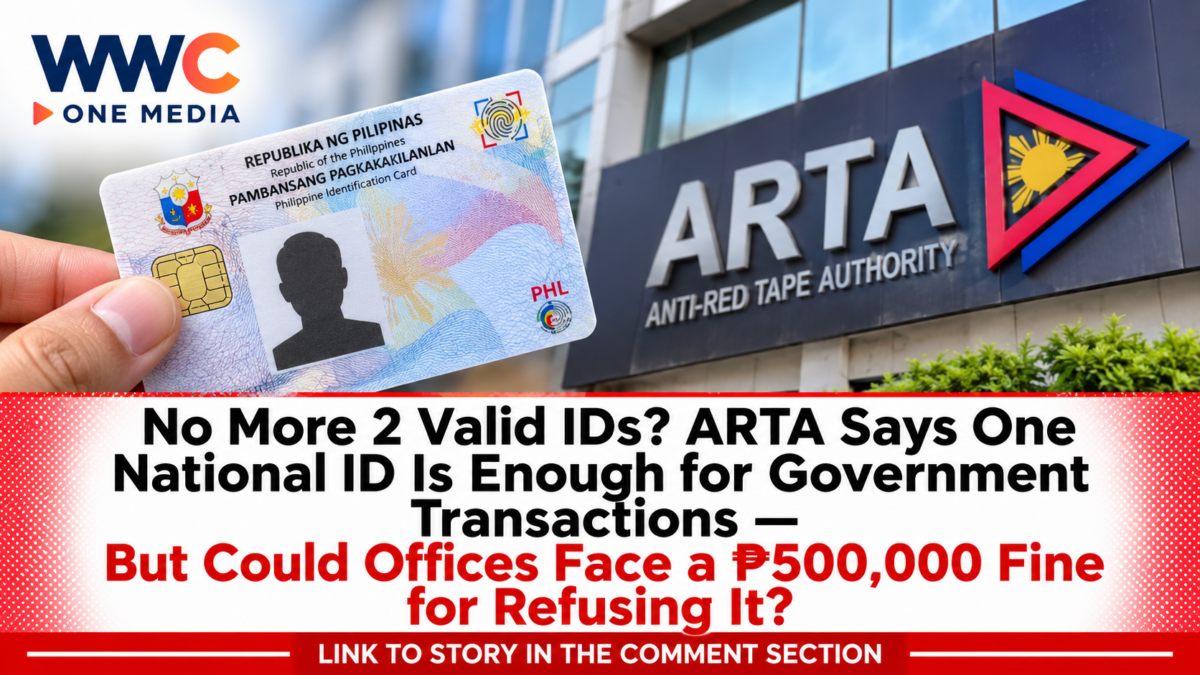
MANILA, PHILIPPINES — November 8, 2026 — Filipinos who have spent hours lining up at government offices only to be told they need another valid identification card may finally have stronger grounds to challenge the requirement.
The Anti-Red Tape Authority (ARTA) has reiterated that one valid ID is generally sufficient for identity verification in government transactions, particularly when the document presented is the Philippine National ID.
ARTA Director General Secretary Ernesto Perez clarified the policy during a November 6 interview on GMA Network’s Unang Hirit, following complaints from Filipinos who said they were still being asked to present two government-issued identification cards.
Perez emphasized that requiring a second ID simply to establish a person’s identity is unnecessary when the first document already provides sufficient verification.
The clarification is particularly important for millions of Filipinos who rely on the Philippine Identification System, or PhilSys, to access public services, open bank accounts and complete other transactions.
Under existing national identification laws, institutions that refuse to recognize a valid National ID without sufficient legal justification can face a ₱500,000 fine.
But the announcement also raises important questions about implementation.
Some government offices continue to impose requirements that citizens say are redundant. Other transactions legitimately require additional documents for purposes unrelated to identity.
The challenge now is ensuring that agencies, banks and frontline employees understand the difference—and that Filipinos no longer face unnecessary paperwork just to access services they are entitled to receive.
ARTA Chief Ernesto Perez: One Valid ID Should Be Enough
Perez made his position clear during his November 6 television interview.
The ARTA chief said the agency had already acted on complaints involving government offices that demanded two valid IDs.
He stressed that the National ID is an officially recognized identification document and should not be treated as insufficient simply because a citizen cannot present another card.
Perez urged Filipinos to file complaints if institutions continue imposing unnecessary identification requirements.
He also mentioned banks among the institutions that should be reported when customers encounter questionable demands for multiple IDs.
His comments follow years of public frustration with complicated government procedures.
Many Filipinos carry several IDs because different offices have historically applied different requirements.
Others struggle to complete transactions because they have only one identification document available.
The Philippine National ID system was established partly to reduce these difficulties.
It provides citizens and eligible resident aliens with a standardized means of establishing their identity.
ARTA’s latest reminder reinforces that purpose.
However, the statement should not be interpreted to mean that every transaction must proceed with absolutely no other supporting documentation.
The legal distinction is between proof of identity and documents needed to establish eligibility, ownership, authorization or other transaction-specific requirements.
The National ID Is Already Protected by Philippine Law
The single-ID principle is not merely an informal recommendation.
Republic Act No. 11055, also known as the Philippine Identification System Act, established the legal basis for recognizing the National ID.
Section 12 provides that a PhilID or PhilSys Number, subject to proper authentication, constitutes sufficient proof of identity for transactions with government agencies.
The law also requires private entities to recognize the identification system under applicable conditions.
Section 13 identifies a broad range of transactions where the National ID can be used.
These include applications for government benefits, social services, passports, driver’s licenses, tax-related transactions, banking services, educational enrollment and employment-related identification.
The protection was reinforced by Executive Order No. 162, signed on February 14, 2022.
The executive order directed government agencies and covered institutions to recognize authenticated PhilSys credentials as sufficient proof of identity and age, except where another law provides otherwise.
It also directed government agencies to update their Citizen’s Charters to reflect the National ID system.
This means the latest ARTA announcement is a reminder of existing legal obligations, not the introduction of a completely new identification law.
Can Government Offices Really Be Fined ₱500,000?
Yes, a statutory penalty exists—but it applies under specific circumstances.
Section 19 of Republic Act No. 11055 provides for a ₱500,000 fine against a person or entity that refuses, without just and sufficient cause, to accept or recognize the PhilID or PhilSys Number as official identification, subject to authentication.
The rule is important because it gives legal weight to the National ID system.
An institution cannot simply dismiss the card as invalid without a legitimate reason.
However, the penalty is not an automatic charge imposed whenever someone asks for an additional document.
Whether a violation occurred depends on the circumstances and the applicable legal requirements.
An institution may have a valid reason to request information necessary for a separate legal purpose.
Likewise, authentication and fraud-prevention procedures may still apply.
Akbayan Representative Chel Diokno previously reminded the public that refusing the National ID without proper justification can carry serious consequences.
His remarks reinforce the importance of compliance among government offices and private institutions.
For ordinary Filipinos, the most practical protection is knowing that the National ID is legally recognized and that unjustified refusal can be reported.
Does the One-ID Rule Apply to Banks?
Banks are also covered by laws and regulatory requirements concerning identity verification.
The Philippine Identification System Act requires private entities to accept the National ID as official identification, subject to authentication.
Executive Order No. 162 likewise recognizes PhilSys credentials for private transactions.
However, banks must also follow Bangko Sentral ng Pilipinas regulations and applicable anti-money-laundering requirements.
Those obligations may involve verifying customer information, identifying beneficial owners and examining the purpose or nature of certain financial relationships.
The important distinction is that additional due-diligence requirements do not necessarily mean a customer should automatically be required to present a second identity card.
A bank may need supporting documents for particular transactions, but those documents should serve an identifiable regulatory or operational purpose.
For example, proof of address, business registration or evidence of authority to act for another person may be required under specific circumstances.
Such documents are different from demanding another ID solely because the first one is considered insufficient.
Customers who believe a bank is imposing redundant identification requirements may raise the issue with the institution and the appropriate regulator.
ARTA has also encouraged the public to report questionable practices.
Can Filipinos Use the Digital National ID?
The Philippine National ID system is no longer limited to a physical card.
The government has expanded access to digital identity services, allowing registered individuals to use authenticated digital credentials through authorized channels.
Under the PhilSys legal framework and implementing rules, recognized PhilSys credentials may be accepted for identity verification, subject to applicable authentication requirements.
This can be particularly helpful for people who have registered but have not yet received a physical card.
However, users should access their identification information through legitimate government platforms.
They should avoid sharing sensitive credentials or personal information through unverified websites and social-media accounts.
The government’s continuing investment in identity infrastructure is intended to improve the reliability and accessibility of these services.
As previously reported by WWC ONE MEDIA, a ₱2.48-billion public-private partnership project was approved to support improvements in the country’s digital National ID system.
Related WWC ONE MEDIA coverage: ₱2.48-Billion PPP Approved to Upgrade Philippines’ Digital National ID System
The proposed project covers improvements in registration, card production, authentication and related technical infrastructure.
However, approval of the PPP proposal does not mean every upgrade has already been completed.
Can Government Offices Still Require Other Documents?
Yes, when those documents serve a legally required purpose other than merely confirming identity.
For example, a government agency processing an application for financial assistance may need evidence that a person meets the program’s eligibility requirements.
A business permit application may require registration documents or proof of compliance with relevant rules.
A person acting on behalf of someone else may be asked to present proof of authorization.
These requirements are different from simply demanding a second government-issued identification card.
ARTA has clarified that agencies should request the specific document needed to establish the relevant fact.
A redundant second ID should not be used as a substitute for properly identifying what information is required.
This distinction is especially important because public transactions vary significantly.
The rules applicable to opening a bank account may differ from those for transferring land ownership or claiming a government benefit.
Citizens should therefore check the relevant agency’s Citizen’s Charter, which identifies its official documentary requirements, steps and fees.
An additional requirement should have a legitimate basis rather than being imposed arbitrarily by frontline personnel.
ARTA Also Warns Against Undeclared Photocopy Fees
The issue of unnecessary IDs is part of a broader discussion about government service quality.
During his GMA interview, Perez also addressed complaints about expensive photocopying services inside public offices.
Some Filipinos reported being charged unexpectedly high fees when required to produce additional document copies.
Perez said government agencies may offer photocopying services for the convenience of clients.
However, the service and its corresponding fees should be properly disclosed in the office’s Citizen’s Charter.
He cited examples of charges ranging from ₱1 to ₱5 per copy.
Those amounts were illustrations, not a universal nationwide photocopying price schedule.
The essential rule is transparency.
People should know in advance which services are offered and what official fees apply.
Undeclared charges can create opportunities for overcharging and confusion.
Perez emphasized that photocopying fees not included in an agency’s Citizen’s Charter should not be imposed.
The reminder reinforces ARTA’s broader objective of preventing unnecessary costs and undocumented requirements in public transactions.
Long Queues, Hot Waiting Areas and Poor Service Also Draw Complaints
Perez also discussed complaints about uncomfortable waiting areas, long lines and inadequate facilities in government offices.
Some citizens reported having to wait for extended periods without sufficient seating, ventilation or shelter.
ARTA said it had issued a circular through its Compliance Monitoring and Evaluation Office addressing the need for appropriate waiting facilities.
The agency also emphasized the importance of public assistance and complaints desks.
Senior citizens and persons with disabilities should have access to appropriate priority or special lanes.
These standards reflect the principle that government services should be accessible and reasonably convenient.
Perez additionally reminded public employees of their obligations under Republic Act No. 6713, the Code of Conduct and Ethical Standards for Public Officials and Employees.
The law requires government personnel to uphold professionalism, responsibility and appropriate conduct in public service.
The reminder responds to complaints about rude or dismissive treatment at government counters.
However, determining whether a particular employee violated applicable rules requires an examination of the facts.
Citizens who experience inappropriate conduct should use formal complaint mechanisms rather than assume that every unpleasant interaction automatically constitutes a legal offense.
Why ARTA Wants Filipinos to Report Red Tape
The Anti-Red Tape Authority is responsible for monitoring compliance with the Ease of Doing Business and Efficient Government Service Delivery Act.
Republic Act No. 11032 aims to reduce unnecessary requirements, simplify public transactions and improve government accountability.
A key feature of the law is the requirement for agencies to establish and publish Citizen’s Charters.
These documents are intended to tell citizens what they need to submit, how much a transaction should cost and how long processing should take.
That transparency makes it easier to identify unnecessary steps.
If a frontline officer asks for documents beyond the officially published requirements, citizens can seek clarification.
ARTA can examine complaints involving potentially excessive or redundant demands.
The agency also supports efforts to streamline processes and reduce opportunities for fixers.
Perez said ARTA has observed improvements in addressing fixers, particularly in dealings involving the Land Transportation Office.
However, the existence of enforcement initiatives does not mean all red tape has been eliminated.
Government service quality continues to vary between agencies and locations.
Davao City’s Digital Signature Plan Could Reduce Government Paperwork
Efforts to simplify identity verification are part of a broader push toward digital government services.
Local governments are exploring systems intended to reduce paperwork, speed up approvals and improve document authentication.
Davao City, for example, has moved to establish its own digital-signature registration capability in coordination with the Department of Information and Communications Technology.
The initiative aims to reduce delays involving digital certificates used by government personnel.
As WWC ONE MEDIA previously reported, Davao City could become the first local government unit authorized to act as a registration authority under the Philippine National Public Key Infrastructure.
Related WWC ONE MEDIA coverage: Davao City Set to Become First LGU to Approve Its Own Digital Signatures — Could This Finally End Months of Government Paperwork Delays?
The planned arrangement is intended to improve the speed of official digital transactions.
But the authorization process and actual implementation should not be confused.
The initiative will need to be operational before its promised benefits can be evaluated.
The connection to ARTA’s latest announcement is straightforward: government services become easier when institutions eliminate redundant requirements and use trusted verification systems.
SSS and eGovPH Integration Could Make Identification More Convenient
Another development involves the Social Security System’s planned integration with the eGovPH government services platform.
The SSS and DICT have signed an agreement to make selected membership information and a digital representation of the MySSS Card accessible through the application.
The initiative is expected to improve convenience for employees, self-employed members, freelancers and pensioners.
However, it is important to distinguish the MySSS Card from the Philippine National ID.
The MySSS Card is a functional identification document for SSS services.
Its acceptance by other institutions may depend on their applicable policies and regulations.
It should not automatically be treated as having exactly the same statutory recognition rules as the PhilSys National ID.
As WWC ONE MEDIA reported, the planned integration is also separate from the broader government project to upgrade the National ID system.
Related WWC ONE MEDIA coverage: SSS Card and Contribution Records Are Coming to eGovPH — But When Can Millions of Filipino Members Finally Use Them?
The expansion of digital government platforms could make it easier to access legitimate identification and membership records.
But reliable authentication, data privacy and consistent institutional acceptance will remain essential.
Cebu’s Digitalization Roadmap Highlights the Nationwide Challenge
The effort to reduce government paperwork also extends to provincial administrations.
Cebu Province has presented a three-year digitalization roadmap designed to improve online services, information systems and cybersecurity.
The plan includes efforts to connect government offices and make services more accessible.
Separately, Cebu City has established a government services hub offering certain transactions outside ordinary office hours.
These initiatives demonstrate how national and local governments are experimenting with different approaches to improving public-service delivery.
As previously examined by WWC ONE MEDIA, Cebu’s roadmap reflects the growing importance of digital systems, reliable records and secure transactions.
Related WWC ONE MEDIA coverage: Cebu Launches Three-Year Digitalization Roadmap to Modernize Capitol Services — But Can It Protect Residents’ Data From Cyberattacks?
The challenge is ensuring that digitalization simplifies processes rather than simply transferring unnecessary paperwork to online forms.
For citizens, a successful system should reduce repeat submissions, clarify requirements and improve access to assistance.
But technology alone cannot guarantee better service.
Government personnel must also understand and consistently apply the rules.
How to Complain if an Office Still Demands Two Valid IDs
Filipinos encountering questionable identification requirements can seek clarification and document the transaction.
The following steps can help:
- Present the National ID or another identification document accepted under the applicable rules. If using PhilSys credentials, comply with the legitimate authentication process.
- Ask why a second ID is needed. Clarify whether the additional document is intended only to verify identity or to establish some other legal requirement.
- Check the Citizen’s Charter. Look for the official list of requirements and fees for the service.
- Record the details. Note the name and location of the institution, the date, the transaction and the explanation given for rejecting the document.
- File a complaint if necessary. Report potentially redundant requirements through the appropriate government channels.
ARTA accepts complaints through:
Email: complaints@arta.gov.ph
Website: https://arta.gov.ph
For concerns specifically involving recognition of the National ID, the Philippine Statistics Authority also provides assistance.
PhilSys email: info@philsys.gov.ph
PhilSys hotline: 1388
A complaint should describe the actual circumstances accurately.
Citizens should avoid publicly disclosing their National ID numbers, personal identification details or other sensitive information.
Reporting an incident does not automatically establish that an institution violated the law.
The relevant authority must assess the facts and applicable requirements.
The Bigger Picture: Will One National ID Finally End Redundant Government Requirements?
ARTA’s latest reminder addresses a familiar problem for millions of Filipinos.
People often prepare multiple IDs, photocopies and supporting documents because they are uncertain about what different government offices will accept.
The result can be wasted time, additional costs and repeated visits.
The Philippine National ID system was created partly to solve this problem by providing a recognized means of establishing identity.
Republic Act No. 11055 and Executive Order No. 162 already require institutions to accept authenticated PhilSys credentials under applicable conditions.
Yet public complaints suggest that inconsistent implementation remains a concern.
Perez’s November 6 announcement puts renewed attention on the responsibility of agencies and frontline employees to follow these rules.
For citizens, the immediate benefit is knowing that a valid National ID generally should not be rejected simply because another identification card is unavailable.
For government offices, the challenge is updating procedures, training personnel and ensuring published requirements reflect existing law.
For banks and private institutions, the task is balancing legitimate verification and compliance obligations with the legal recognition of the National ID.
The principle is straightforward: Filipinos should not be required to produce redundant identification documents when their identity has already been properly established.
But achieving that principle nationwide will depend on consistent enforcement and reliable systems—not just public reminders.
And as ARTA urges citizens to report offices still demanding unnecessary IDs, one question remains: Will the government’s renewed warning finally eliminate redundant paperwork—or will Filipinos continue facing the same frustrating requirements despite laws already designed to protect them?