LOS ANGELES / NEW YORK / MANILA — November 8, 2026 | WWC ONE MEDIA | Global Entertainment, Business, Technology and Cinema
Hollywood’s battle to bring audiences back to movie theaters is taking an extraordinary new direction, with giant wraparound screens transforming classic films into immersive experiences that traditional televisions and home streaming services cannot easily reproduce.
At the center of the transformation is Cosm, an American entertainment technology company whose enormous dome-shaped theaters are turning familiar films into shared, visually expansive attractions.
And some of Hollywood’s biggest companies are starting to pay attention.
Sony Pictures Entertainment has invested $100 million in Cosm, taking a minority ownership stake as the company expands beyond live sporting events into premium movie screenings.
According to CNBC’s November 7 report, Cosm has already opened four venues across the United States and is preparing another location in Cleveland in 2027.
Its expanding film lineup includes The Matrix, Harry Potter and the Sorcerer’s Stone, Willy Wonka & the Chocolate Factory and It.
The company has also reached an agreement with Universal to bring Shrek to its theaters beginning December 16.
But the experience comes with a premium price.
Tickets can range from approximately $18 for certain matinee screenings to $70 for premium seats or popular events, before additional food, beverage and other charges.
The strategy represents a major bet on the future of moviegoing.
Instead of competing with streaming services by offering only a bigger screen, Cosm wants to provide an entertainment experience that audiences feel they cannot recreate at home.
Could giant immersive theaters become Hollywood’s next major business opportunity—or will their expensive technology and premium ticket prices prevent them from reaching mainstream audiences?
Cosm Is Turning Traditional Movies Into Immersive Experiences
Cosm’s business began with technology used for planetariums, where audiences experience visual presentations projected across large domes.
The company has adapted that expertise to develop entertainment venues combining giant LED displays, live sports and cinema.
Cosm calls its approach Shared Reality.
The concept is designed to create the sensation of being surrounded by the environment shown on the screen.
For sporting events, audiences can watch broadcasts produced using specialized camera positions that create perspectives similar to being close to the action.
For movies, the presentation works differently.
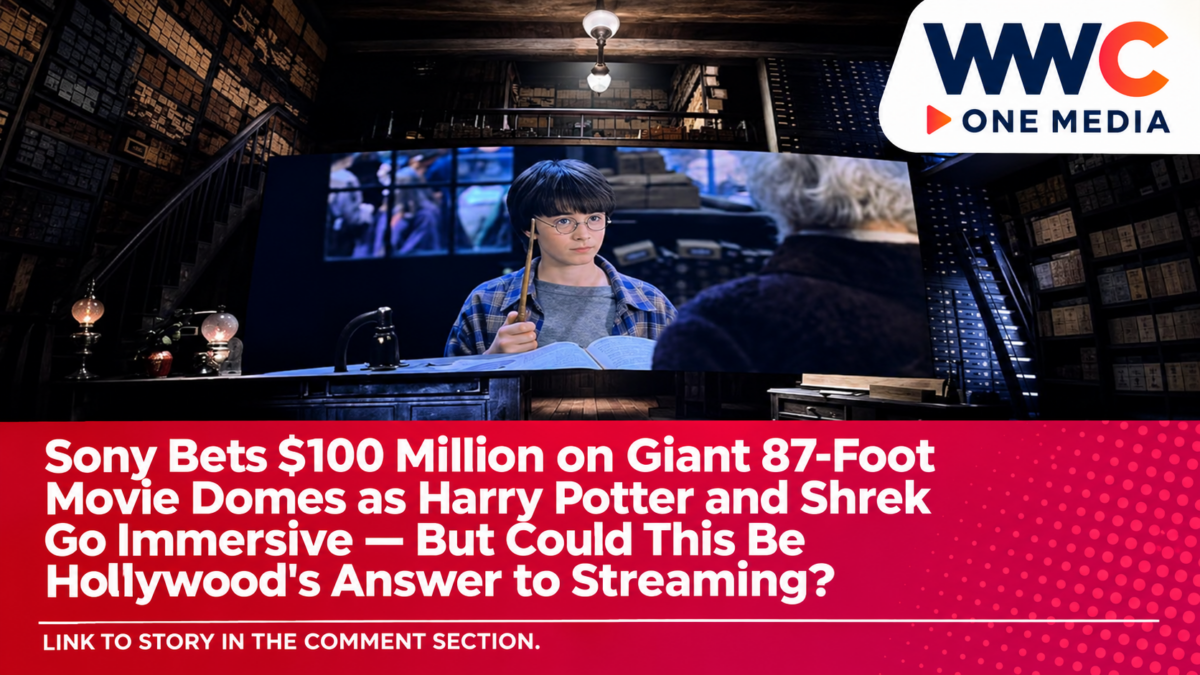
The original film remains visible in a central rectangular section of the dome.
Additional visual effects fill the surrounding space, making the world of the film appear to extend beyond its traditional boundaries.
For example, during a scene in Harry Potter and the Sorcerer’s Stone involving letters flooding into the home of Harry’s relatives, animated envelopes can appear across the surrounding dome.
The effect is intended to make viewers feel closer to the story while keeping the original film intact.
This distinction matters.
Cosm is not converting every classic film into an entirely new 360-degree movie. It is creating an expanded visual environment around the original presentation.
Sony’s $100-Million Investment Changes the Stakes
Sony Pictures Entertainment announced its investment in Cosm on June 24, 2026.
The company became the lead investor in Cosm’s Series C financing round and acquired a minority ownership interest.
Sony Pictures chairman and CEO Ravi Ahuja also joined Cosm’s board of directors.
The transaction was independently reported by Reuters, Variety and the Los Angeles Times.
Cosm CEO Jeb Terry said the capital would support venue expansion and further development of the company’s technology.
For Sony, the investment provides exposure to a growing entertainment format that could create new ways to use film and television properties.
Sony already has substantial experience in the theatrical industry.
In 2024, the company acquired Alamo Drafthouse Cinema, a theater chain known for combining movies with food and beverage service.
Sony has also pursued plans to restore and reopen the historic Cinerama Dome in Los Angeles.
These developments suggest that the studio sees value in cinema experiences that go beyond ordinary film exhibition.
However, Sony’s $100-million investment is not evidence that it has acquired Cosm outright.
Cosm remains privately held, and the exact percentage of Sony’s ownership stake has not been publicly disclosed.
Four Theaters Are Already Operating, With Cleveland Next
Cosm currently operates four immersive entertainment venues in the United States.
Its locations serve the Los Angeles, Dallas, Atlanta and Detroit metropolitan areas.
The Los Angeles-area venue is located at Hollywood Park in Inglewood.
Its Dallas-area facility operates at Grandscape in The Colony, Texas.
Atlanta’s venue is located at Centennial Yards, while the Detroit-area location extends the company’s presence into another major entertainment and sports market.
Cosm’s current domes feature screens approximately 87 feet in diameter.
That is roughly 26.5 meters across.
The Los Angeles and Dallas theaters can accommodate approximately 350 people each.
The newer Atlanta and Detroit venues have capacity for as many as 500 guests.
A fifth venue is scheduled to open in Cleveland in 2027.
It is expected to feature a larger dome measuring approximately 100 feet in diameter.
The proposed expansion demonstrates Cosm’s ambition to develop a network of venues rather than operate a single experimental theater.
But growth also creates substantial capital requirements.
Building and maintaining specialized entertainment facilities involves technology, real estate, construction, staffing and content production costs.
The company has not disclosed financial results sufficient to determine whether its existing venues have generated sustainable profits.
Harry Potter, The Matrix and It Bring Hollywood Classics Into the Dome
Cosm’s move into movies depends heavily on well-known film franchises.
The company has worked with Warner Bros. on immersive presentations involving The Matrix, Harry Potter and the Sorcerer’s Stone, Willy Wonka & the Chocolate Factory and It.
These films already have established fan communities.
For Cosm, that provides an advantage.
Audiences know the characters and stories, allowing the company to promote a different way of experiencing familiar titles.
The strategy also appeals to nostalgia.
Older viewers may return to films they enjoyed years earlier, while younger audiences can discover them through an unconventional theater format.
However, the company is not simply screening the films on a curved display.
The surrounding visual environment requires extensive production work.
Cosm collaborates with experiential production company Little Cinema and creative studio MakeMake to design additional effects.
The process can involve storyboarding, visual-effects production and technical testing.
According to CNBC, preparing an immersive version of a film can take up to a year.
That means the format introduces a substantial new production expense.
Whether studios can generate enough ticket sales to justify those costs will be an important test of the business model.
Shrek Becomes Cosm’s First Animated Movie Experience
The next major release will involve DreamWorks Animation’s Shrek.
Cosm has partnered with Universal and DreamWorks Animation to bring the film to its immersive venues.
The first scheduled screening is December 16, 2026, coinciding with the movie’s 25th anniversary year.
The company’s official booking page confirms the date.
Cosm describes Shrek as its first animated film presented in Shared Reality.
The experience will expand environments associated with the original movie, including Shrek’s swamp, Duloc and other recognizable settings.
The venue will also offer themed food, drinks and merchandise.
That reflects another aspect of Cosm’s strategy.
A movie screening can create revenue opportunities beyond admission tickets.
Special merchandise, themed menus and event packages may encourage fans to spend more during their visit.
But those purchases are optional, and actual customer spending varies.
The company has not published a revenue forecast for its Shrek screenings.
Why Cosm Tickets Can Cost as Much as $70
The premium price is central to Cosm’s business model.
CNBC reported that some matinee tickets cost approximately $18, while prime seats and popular screenings can approach $70.
Prices depend on location, event and seat selection.
Additional fees and concessions can increase the total cost of a visit.
For comparison, entertainment data company EntTelligence estimates that an average standard US movie ticket costs approximately $13.
Premium large-format movie tickets average more than $18.
That means a high-end Cosm ticket can cost several times the price of a conventional movie admission.
The company is betting that audiences will accept the difference because of the unusual experience.
But the price also limits accessibility.
A family purchasing several premium tickets could face a substantial bill before transportation, food or other expenses.
For Cosm, the challenge is whether enough consumers will view the experience as a special event worth paying more to attend.
A venue can attract considerable attention without necessarily generating sufficient returns to cover its operating and development costs.
Why Hollywood Is Betting on Premium Experiences
The broader movie industry continues adjusting to changes in consumer behavior.
Streaming services have made it easier for audiences to watch films at home.
Meanwhile, higher production and marketing expenses have increased pressure on theatrical releases to perform well.
Premium formats have become an important part of the industry’s response.
IMAX, Dolby Cinema, ScreenX and 4DX attempt to differentiate moviegoing through larger screens, advanced sound, expanded visual presentation or physical effects.
Cosm approaches the challenge by building an environment around a familiar film.
That puts it in a different category from a traditional cinema upgrade.
Its offering combines specialized infrastructure, entertainment technology and event-style hospitality.
As previously examined by WWC ONE MEDIA in its report on private investment reshaping Hollywood, the film business is attracting alternative sources of financing as traditional studios become more selective about expensive projects.
Sony’s investment in Cosm represents a related trend.
Rather than financing only new movies, entertainment companies are also investing in different ways of distributing and experiencing existing intellectual property.
Could Immersive Movies Rescue Underused Cinema Space?
The emergence of premium entertainment formats raises questions about the future of conventional movie theaters.
In the Philippines, some mall developers have begun converting underused cinema areas into other attractions.
As WWC ONE MEDIA reported on Philippine mall developers’ ₱184-billion investment pipeline, commercial property owners are increasingly experimenting with leisure activities that can generate more customer visits.
That includes sports venues, dining concepts and other experiential entertainment.
Cosm’s expansion provides a contrasting example.
Instead of removing the cinema experience, it attempts to make the viewing environment more distinctive and valuable.
But an immersive dome cannot automatically replace a conventional movie theater.
Its construction costs, technical requirements and seating arrangements are different.
Property owners would need to evaluate the economics of such an investment carefully.
A premium attraction may work well in a large entertainment district while being unsuitable for a smaller community mall.
The Philippines Has a Potential Audience for Experiential Cinema
Filipino moviegoers have demonstrated interest in international films, anime, festivals and specialized cultural screenings.
For example, WWC ONE MEDIA recently covered the Japanese Film Festival’s 2026 screenings across six Philippine cities.
The event features Japanese cinema and other cultural programming across multiple locations.
Although a film festival is very different from a Cosm venue, both illustrate how programming can offer reasons to watch movies outside the home.
The appeal is not always the novelty of a new release.
Sometimes it is the opportunity to experience a familiar story in a different environment or as part of a community.
For Philippine cinema operators, immersive formats could be worth studying.
However, Cosm has not announced a confirmed Philippine venue in the reporting reviewed.
There is also no verified opening date, local investment amount or Philippine ticket price for a Cosm theater.
Any claim that the company is already building a Manila location would therefore be premature.
Virtual Reality Is Another Competitor in Immersive Entertainment
Cosm is not the only company exploring new ways for people to experience digital content.
Meta has been developing wearable devices and virtual-reality systems that can display entertainment in immersive environments.
As WWC ONE MEDIA reported on Meta’s wearable AI and VR entertainment initiatives, the technology company has demonstrated features designed to make digital experiences more engaging.
But there is a major difference between those approaches.
Virtual-reality systems typically rely on individual headsets or specialized wearable equipment.
Cosm uses a large physical venue where hundreds of people can share the same experience.
That communal element is central to its commercial strategy.
Audience members can attend with friends and family, react together and enjoy associated hospitality services.
For supporters of immersive theaters, the shared experience helps distinguish the format from entertainment consumed privately at home.
Cosm’s Live Sports Business Provides Another Revenue Opportunity
The company originally attracted considerable attention through its live sports screenings.
Specialized cameras positioned at sporting venues can transmit perspectives that create the sensation of being close to the playing field.
This allows fans to experience major events without traveling to the stadium.
Cosm says its sports presentations frequently sell out.
However, those are company-reported claims, and publicly available financial data do not establish overall venue profitability.
Expanding into cinema could provide additional programming when major live sporting events are not scheduled.
That is one of the attractions of the new studio partnerships.
Classic films can be screened repeatedly.
Unlike live sports, they do not depend on a particular game taking place at a specific time.
The company can potentially use its facilities across a wider range of days and viewing periods.
But movie attendance and sports demand may differ considerably.
A venue that attracts strong crowds for a championship game may not necessarily generate equivalent demand for a decades-old film.
Cosm will need to evaluate those differences as its content library expands.
The Biggest Financial Risk: Can the Company Scale Profitably?
Cosm has already attracted major investors.
Its financial backers include Sony Pictures Entertainment, Mirasol Capital, Avenue Sports Fund, Rock and Bolt Ventures.
In 2024, the company raised approximately $250 million in financing at a valuation exceeding $1 billion.
Sony’s new $100-million investment increases the resources available for expansion.
But funding does not automatically establish profitability.
Each new dome requires substantial investment.
The company must also secure suitable real estate, obtain rights to present content and manage production expenses.
Specialized visual effects can add another layer of cost.
The economics will depend on ticket sales, occupancy, food and beverage spending, licensing terms and operating efficiency.
The private company has not disclosed comprehensive revenue, earnings or cash-flow figures.
Consequently, investors and audiences cannot yet determine whether its expanding theater network will generate consistent long-term returns.
Three Possible Outcomes for the Future of Immersive Cinema
Scenario 1: Immersive cinema becomes a major premium entertainment category.
If audiences continue paying higher prices for unique experiences, studios and theater operators may expand investments in giant-format and shared-reality venues.
Scenario 2: Cosm remains a successful but specialized attraction.
The company could build a profitable business in selected major markets without becoming a replacement for traditional movie theaters.
Scenario 3: Expansion costs challenge the business model.
If venue construction, film conversion and operating expenses rise faster than revenue, the company may need to slow its rollout or rethink pricing.
These are potential outcomes, not confirmed financial forecasts.
The Bigger Question: Can Hollywood Make Moviegoing Feel Special Again?
The rise of Cosm represents an important shift in entertainment strategy.
Studios and investors are looking for ways to encourage audiences to leave their homes and pay for experiences that streaming services cannot easily reproduce.
Sony’s $100-million investment indicates that at least one major Hollywood studio believes immersive venues could become an attractive distribution channel.
Cosm is now building a network of theaters with enormous dome screens, live sports presentations and expanded versions of recognizable movie franchises.
Its planned Shrek experience will provide another test of consumer demand.
But the company’s financial performance remains undisclosed.
There is no evidence that its venues have already replaced conventional cinemas or changed the economics of the entire movie industry.
What is confirmed is that Cosm has four operating US venues, an expanding library of immersive films and a $100-million investment from Sony to support further growth.
The next challenge is proving that the experience can attract enough paying customers over time to justify its considerable costs.
And as Hollywood searches for new ways to compete with streaming and declining traditional movie attendance, one question could shape the industry’s future:
Will giant immersive domes finally give audiences a reason to pay premium prices for moviegoing again—or could Hollywood’s latest technological gamble become another expensive attraction that never reaches the mainstream?