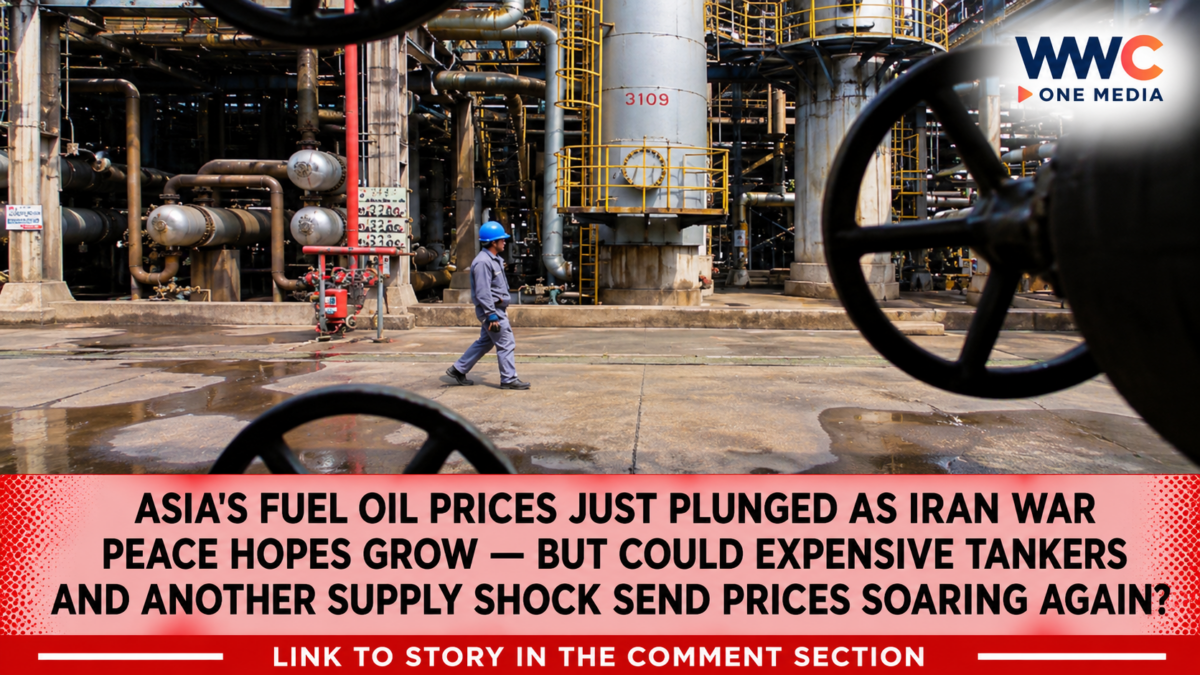
Asian fuel oil prices have fallen sharply as energy traders increasingly anticipate that diplomatic efforts could ease the US-Israeli war with Iran and allow more Middle Eastern supplies to reach international markets.
The decline is particularly significant for Singapore, one of Asia’s major oil-trading and bunkering hubs, where fuel oil is widely used by ships and industrial operators.
According to a Reuters report published on November 5, 2026, the benchmark refining margin for 380-centistoke high-sulphur fuel oil (HSFO) swung from a premium of US$5.34 per barrel at the beginning of the week to a discount of US$2.29 per barrel on Thursday.
That was its weakest level since mid-September.
The market shift reflects expectations that a possible reduction in Middle East hostilities could restore more oil and refined-fuel exports, easing the supply pressures that have supported prices during the conflict.
However, the decline does not mean the energy crisis is over. Tanker freight rates remain elevated, shipping through the region continues to face security risks, and traders warn that Asian fuel oil markets could tighten again toward the end of the year. Reuters+2
Asian Fuel Oil Benchmark Drops as Traders Price in Possible Iran Peace Deal
The sharpest move reported by Reuters involved the Dubai-based refining margin, or crack spread, for 380-cst HSFO.
The benchmark moved from a US$5.34-per-barrel premium at the start of the week to a US$2.29-per-barrel discount on November 5.
A crack spread measures the difference between the value of a refined petroleum product and the crude oil used to produce it. A weaker crack indicates that refiners are receiving less value for the fuel oil relative to crude.
The decline suggests that traders are reassessing the possibility of tighter Middle Eastern supplies.
If diplomatic efforts produce a meaningful reduction in hostilities, more crude and refined products could become available to international buyers. That prospect has encouraged traders to lower the geopolitical risk premium built into energy prices.
The market has also responded to political developments in the United States. The Democratic Party’s capture of Congress in the November midterm elections has prompted investors to consider whether President Donald Trump’s administration may face greater pressure to seek an end to the conflict.
But political pressure is not the same as a peace agreement. The negotiations remain uncertain, and the possibility of renewed military escalation continues to influence energy prices. Reuters+2
UAE Fuel Oil Exports to Singapore and Malaysia Reach Eight-Month High
One important factor behind the price decline is the improvement in regional fuel oil supply.
Data from shipping analytics firm Kpler cited by Reuters showed that fuel oil exports from the United Arab Emirates destined for Singapore and Malaysia reached approximately 729,000 metric tons in October 2026.
That was the highest monthly volume in eight months.
Higher exports from the UAE’s Fujairah energy hub have helped ease regional supply concerns and put downward pressure on fuel oil prices.
The development is particularly relevant because Singapore is a major destination for fuel oil cargoes and an important centre for marine fuel trading.
When more cargoes reach the region, buyers have greater access to alternative supplies. That can reduce competition for available shipments and weaken spot-market premiums.
Emril Jamil, a senior oil research manager at Kpler, told Reuters that traders were anticipating more Middle Eastern oil flows if a peace agreement materialised.
The expectation of additional supply has therefore become a major factor in the latest market decline. Reuters+1
Very Low-Sulphur Fuel Oil Prices Also Weaken
The downturn was not limited to high-sulphur fuel oil.
The market for 0.5% very low-sulphur fuel oil (VLSFO) also softened during the week, with spot premiums for both Singapore HSFO and VLSFO weakening.
These products are important to the shipping industry because vessels must use marine fuels that comply with applicable sulphur-emission requirements.
VLSFO is commonly used as a compliant marine fuel under the International Maritime Organization’s global sulphur limit, while HSFO is generally associated with vessels equipped with exhaust-gas cleaning systems, commonly known as scrubbers.
When prices for these products fall, ship operators may benefit from lower fuel procurement costs.
Refineries may also face lower feedstock costs, although the actual benefit depends on crude prices, refining margins, supply contracts and operating expenses.
The latest decline could therefore provide some relief to parts of the shipping and refining industries if lower prices are sustained. Reuters+1
Asian Fuel Oil Arrivals Exceed 6 Million Tonnes in October
Despite the price decline, the region’s supply outlook remains complicated.
Kpler and LSEG ship-tracking data cited by Reuters showed that total fuel oil arrivals in Asia exceeded 6 million tonnes in October, reaching a seven-month high.
The increase suggests that more cargoes were available to regional buyers during the month.
However, traders expect arrivals to decline in November.
That potential slowdown matters because a temporary increase in supply does not guarantee that the market will remain well supplied throughout the final months of the year.
If Middle Eastern exports increase but shipments from Europe become more expensive, Asian buyers could still face higher replacement costs.
This is one reason traders are reluctant to assume that the recent price decline will continue uninterrupted. Reuters+1
Tanker Shipping Costs Remain a Major Threat to Asia’s Fuel Supply
One of the biggest obstacles to cheaper fuel oil is the cost of transporting it.
Reuters reported that dirty tanker freight rates on the Rotterdam-to-Singapore route reached a record of approximately US$168 per tonne in mid-October.
By November 5, the rate had eased to around US$95 per tonne.
Although that represents a substantial decline, shipping costs remain elevated compared with earlier levels.
High freight expenses can make it uneconomical for traders to move cargoes from Europe to Asia, even when the underlying fuel oil is available.
This creates a potential supply bottleneck.
In other words, lower fuel oil benchmark prices do not automatically translate into equally lower delivered prices for Asian buyers.
A shipment may become cheaper at its point of sale but remain expensive once transportation, insurance, port charges and other costs are included.
A Singapore-based fuel oil trader quoted by Reuters said the market could still find support toward year-end because expensive freight continues to raise the cost of resupplying Asia. Reuters+1
Crude Oil Prices Also Plunged — Then Recovered as War Risks Remained
The fuel oil decline coincided with a dramatic move in international crude markets.
On November 4, Brent crude futures settled at US$94.62 per barrel, down US$8.98, or 8.7%.
US West Texas Intermediate (WTI) crude fell US$7.97, or 8.3%, to US$88.12.
Both benchmarks recorded their lowest settlements since August 31.
The sell-off followed the US midterm election results, which changed the balance of power in Congress and encouraged investors to reassess the likelihood of a negotiated end to the war.
However, the market quickly demonstrated that optimism remained fragile.
On November 5, Brent and WTI recovered as investors weighed the possibility of renewed attacks on energy shipping and the absence of a confirmed agreement between Washington and Tehran.
Reuters reported that Brent was trading around US$96.92 and WTI around US$90.27 during Thursday’s trading session.
The rebound highlighted a critical difference between market expectations and actual developments: traders may anticipate peace, but the conflict has not been conclusively resolved. Yahoo Finance+2
Qatar’s Mediation Efforts Have Not Yet Produced a Confirmed Peace Agreement
Diplomatic efforts involving Qatar have helped shape market expectations.
Qatar has been working to prevent further escalation, while Iranian officials have held discussions with regional counterparts about possible ways to reduce tensions.
However, Reuters reported on November 5 that the United States and Iran remained far from an agreement.
The two sides continue to face disagreements over the terms of any settlement, including sanctions and security arrangements.
Iranian Foreign Minister Abbas Araqchi has discussed diplomatic developments with officials from Qatar and Saudi Arabia, but those conversations do not establish that a final agreement is imminent.
The uncertainty means that oil and fuel markets remain highly sensitive to statements from political leaders, military developments and changes in shipping activity.
A successful agreement could encourage more Middle Eastern exports and ease prices. A breakdown in negotiations could quickly reverse the market’s recent optimism. Yahoo Finance+1
Strait of Hormuz Remains Critical to Asia’s Energy Security
The Strait of Hormuz remains one of the most important factors shaping the outlook for Asian energy markets.
The narrow waterway connects the Persian Gulf with the Gulf of Oman and the Arabian Sea. It is a crucial route for crude oil, petroleum products and liquefied natural gas shipments from major Middle Eastern producers.
Any serious disruption can increase transportation costs, delay deliveries and force buyers to seek alternative supplies.
Even when shipments continue, security concerns can raise insurance premiums and tanker costs.
This is especially important for Asian economies that depend heavily on imported energy.
The Associated Press previously reported that the prolonged Iran conflict had placed significant pressure on Asian economies, with higher energy and shipping costs feeding into transport, electricity and consumer prices.
The report also warned that ending the conflict would not immediately restore normal supply conditions because damaged infrastructure, interrupted production and shipping delays could take weeks or months to resolve. AP News+1
WWC ONE MEDIA has previously examined the regional consequences of the conflict in Middle East War Pushes ASEAN to Strengthen Energy Security Plans.
The report highlights how Southeast Asian governments are being forced to reconsider their dependence on imported energy as the conflict exposes weaknesses in regional supply chains.
Singapore Could Benefit From Lower Fuel Oil Prices — But Consumers May Not See Immediate Relief
Singapore occupies a central position in the Asian fuel oil market because of its role as a major refining, trading, storage and marine-bunkering hub.
Lower fuel oil prices could help reduce procurement expenses for shipping companies and some industrial users.
However, the effect on consumers is more complicated.
Fuel oil is not the same product as the petrol and diesel sold at retail stations. A fall in HSFO or VLSFO benchmarks does not automatically mean that motorists will see immediate reductions in pump prices.
Retail petrol and diesel prices are influenced by crude oil, refined-product benchmarks, exchange rates, taxes, operating costs and individual retailers’ pricing decisions.
Singapore motorists have already experienced the effects of energy-market volatility.
WWC ONE MEDIA reported on the latest increases in Singapore Petrol Prices Rise for Fourth Straight Week as Middle East Conflict Keeps Fuel Markets on Edge.
Although global crude prices have since experienced sharp declines, retail adjustments can lag behind movements in international markets.
The latest fuel oil decline should therefore be viewed as a possible easing of costs for specific energy users, not a guarantee that every household or motorist will immediately pay less.
Philippines Also Remains Exposed to Global Oil Market Volatility
The Philippines is another energy-importing economy vulnerable to fluctuations in international petroleum prices.
When global crude and refined-product prices rise, the effects can reach domestic transport, logistics, manufacturing, agriculture and household budgets.
The peso-dollar exchange rate also matters because petroleum imports are generally priced in US dollars.
A sustained reduction in international energy prices could eventually ease import costs, but the impact on local pump prices depends on the timing of shipments, inventory costs, exchange-rate movements and domestic pricing adjustments.
WWC ONE MEDIA previously examined the financial pressure on the country’s largest oil company in Petron’s Profit Crashes 44% to ₱5.4 Billion Despite ₱928-Billion Revenue Surge.
The broader risk of renewed fuel-price increases was also discussed in Diesel Could Jump ₱5.50 a Liter Tuesday — But the Philippines’ Fuel Problem Is Getting Bigger Than One Price Hike.
For both Singapore and the Philippines, the key question is whether lower international prices can last long enough to translate into cheaper energy imports.
Why Fuel Oil Prices Could Rebound Before the End of 2026
Despite the sharp decline, several factors could prevent Asian fuel oil prices from falling much further.
First, tanker freight remains expensive. Although Rotterdam-to-Singapore rates have eased from their October peak, the cost of transporting fuel across long distances remains elevated.
Second, November arrivals could decline. Traders expect Asia’s fuel oil imports to taper after October’s seven-month high.
Third, the Middle East conflict remains unresolved. Renewed attacks or a breakdown in negotiations could quickly restore the geopolitical premium in energy markets.
Fourth, winter demand could provide support. Seasonal demand and the need to replenish inventories may increase competition for certain fuel grades.
Sparta Commodities’ November 2–6 market update also showed that Asian HSFO premiums and outright prices had weakened during the first days of November. However, it noted that peak winter bunker demand and constraints on certain supply routes could help support the market.
That assessment reinforces the central message: the market is easing, but it is not necessarily returning to normal. Sparta+1
The Bigger Question: Is Asia Finally Getting Relief From the Iran Energy Shock?
The latest fall in Asian fuel oil benchmarks is an important development for Singapore’s energy and shipping industries.
The shift in the HSFO refining margin from a US$5.34 premium to a US$2.29 discount, combined with increased UAE exports to Singapore and Malaysia, suggests that traders are beginning to price in a more favourable supply outlook.
But the decline is being driven partly by expectations rather than a confirmed end to the war.
Tanker security remains a concern, freight costs are still high, and the expected reduction in November arrivals could tighten the regional market again.
For now, lower fuel oil prices offer a potential reprieve for ship operators and refiners. Whether that relief reaches wider Asian economies will depend on how quickly supplies normalise and whether diplomatic efforts can prevent another escalation.
The energy market is sending a hopeful signal — but until a durable agreement is reached and shipping flows become reliably secure, Asia’s fuel-price outlook remains far from settled.