WELLINGTON, NEW ZEALAND — November 5, 2026
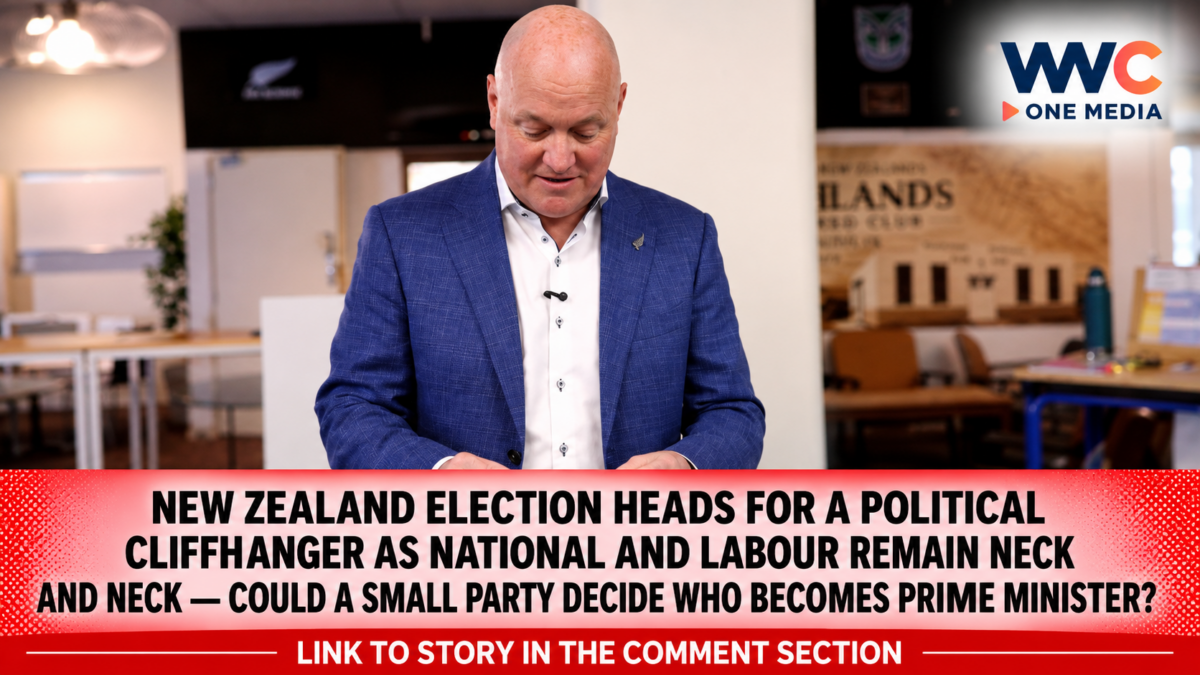
New Zealand is heading towards one of its closest general elections in years, with Prime Minister Christopher Luxon’s governing National Party and the opposition Labour Party separated by just one percentage point in the latest major poll.
But the biggest question may not be which major party finishes first. It is whether either political bloc can secure enough parliamentary seats to govern without support from smaller parties.
The November 7 election is shaping up as a contest between Luxon’s centre-right National Party and Chris Hipkins’ centre-left Labour Party. However, New Zealand’s proportional voting system makes it difficult for either side to govern alone.
The centrist Opportunity Party, led by Qiulae Wong, could become particularly influential if it crosses the 5 per cent party-vote threshold.
That possibility creates a difficult political calculation for Luxon. He has repeatedly ruled out working with Opportunity because of its proposed land-value tax, even though the party could become important to the governing arithmetic.
The election is also taking place against a challenging economic backdrop. Inflation, unemployment, housing affordability, healthcare and public services have become major concerns for voters.
With polling day only days away, New Zealand’s next government could depend on negotiations involving parties that currently sit outside the country’s two largest political blocs.
National and Labour Are Almost Tied Ahead of November 7
The latest 1News Verian poll, released on November 3, showed National narrowly ahead of Labour.
The results were:
- National Party: 30 per cent
- Labour Party: 29 per cent
- Green Party: 16 per cent
- ACT New Zealand: 10 per cent
- New Zealand First: 8 per cent
- Opportunity Party: 6 per cent
- Te Pāti Māori: Approximately 0.4 per cent
The figures show that neither major party has established a commanding lead.
National gained one percentage point from the previous poll, while Labour improved by two points. The Greens also increased by one point, while ACT and New Zealand First each lost two points.
A separate Taxpayers’ Union/Curia poll reported by The Guardian placed National at 28.9 per cent and Labour at 28.4 per cent.
Although the precise numbers differ between surveys, both point towards a closely contested election.
The polling also suggests that smaller parties could have a significant influence on the final result.
That is particularly important because New Zealand does not simply award government to whichever party receives the most votes. The distribution of parliamentary seats and the ability to secure support from other parties determine who can govern.
Christopher Luxon Is Fighting to Secure a Second Term
National Party leader Christopher Luxon is seeking another term as prime minister after leading the party to victory in the 2023 general election.
A former chief executive of Air New Zealand, Luxon entered Parliament in 2020 and became National’s leader in 2021.
His campaign has focused heavily on economic management, fiscal discipline and improving the country’s business environment.
National wants to restore the government’s budget surplus, reduce unnecessary regulation and support economic growth through lower taxes and cheaper energy.
The party has also proposed expanding the national KiwiSaver retirement savings scheme.
However, Luxon’s leadership has faced considerable pressure during the current parliamentary term.
He survived two internal confidence votes in April and August 2026 amid weak polling, economic difficulties and tensions within the governing coalition.
The August challenge was triggered by former defence minister Chris Penk.
The close election race now presents another major test for Luxon.
A National victory would give him the opportunity to continue his economic programme. A defeat could end his government’s term after only one parliamentary cycle.
Chris Hipkins Wants Labour Back in Government
Labour leader Chris Hipkins is attempting to return to the prime minister’s office three years after his party lost power.
Hipkins became prime minister in January 2023 following Jacinda Ardern’s resignation.
He remained Labour’s leader after the party’s defeat later that year and has spent the current parliamentary term positioning himself as an alternative to Luxon’s government.
Labour’s campaign focuses on reducing household expenses, improving access to healthcare and public transport, supporting jobs and investing in housing and infrastructure.
The party has also called for stronger action against excessive pricing by dominant companies.
Its economic message is built around the argument that households need more direct support with everyday costs and access to essential services.
Labour’s challenge is to convince voters that it can improve economic conditions while maintaining financial stability.
The latest polling suggests that Hipkins has a realistic opportunity to challenge National, but the party would still need support from other political groups to form a government.
Opportunity Party Could Become the Biggest Political Surprise
One of the most important developments in the final days of the campaign is the rise of the centrist Opportunity Party.
Led by Auckland businesswoman Qiulae Wong, the party is polling around 6 per cent in the latest 1News Verian survey.
That puts it above New Zealand’s 5 per cent party-vote threshold, potentially giving it a meaningful presence in Parliament.
Opportunity’s central economic proposal is a land-value tax.
The party has proposed an annual tax of 1.75 per cent on residential land and 0.5 per cent on rural land.
It argues that the measure could raise approximately NZ$24 billion annually and allow broader changes to the country’s tax system.
However, the proposal has created a major obstacle in its relationship with National.
Luxon has repeatedly ruled out working with Opportunity, arguing that its proposed land tax conflicts with National’s commitment not to introduce new taxes.
Wong has said her party would negotiate first with whichever party secures the highest number of votes.
This position could create a difficult situation if National finishes first but cannot secure enough parliamentary support without Opportunity.
If Luxon maintains his refusal, National could face a more complicated path towards forming a government.
Opportunity’s final vote share could therefore become one of the most consequential figures of the entire election.
Why New Zealand’s Smaller Parties Matter So Much
New Zealand uses a mixed-member proportional (MMP) electoral system.
Under this system, voters receive two votes:
- A party vote, which largely determines how many parliamentary seats each political party receives.
- An electorate vote, which determines the representative elected for a local constituency.
A party generally needs at least 5 per cent of the party vote or must win an electorate seat to qualify for parliamentary representation.
This system makes coalition governments common because the largest party does not necessarily receive enough seats to govern alone.
A party can also support a government through a confidence-and-supply arrangement without formally joining the governing coalition.
That distinction matters because political negotiations do not always require every supporting party to hold ministerial positions.
The final balance of seats can also be affected by electorate victories and so-called overhang seats, where a party wins more electorate seats than its proportional party-vote allocation would otherwise provide.
The result is a political system in which smaller parties can become influential even if they receive only a fraction of the votes won by National or Labour.
ACT, New Zealand First and the Greens Could Shape the Next Government
Although Opportunity is attracting attention as a potential kingmaker, several established smaller parties will also be important.
ACT New Zealand: David Seymour’s Push for Smaller Government
ACT is led by David Seymour, who has served as deputy prime minister since mid-2025.
The party describes itself as classically liberal and right-libertarian.
Its campaign has focused on reducing government involvement in the economy, deregulation and stricter immigration policies.
ACT has proposed measures including additional charges on temporary work visas and restrictions on access to certain government benefits for new residence-class visa holders.
The party is currently part of the governing arrangement with National and New Zealand First.
Its final parliamentary strength could determine whether Luxon can continue with a similar coalition.
New Zealand First: Winston Peters’ Populist Agenda
New Zealand First is led by veteran politician Winston Peters, who has participated in coalition governments led by both National and Labour over several decades.
The party has proposed restricting voting in New Zealand elections to citizens.
It also wants changes to the electricity sector and has called for a restructuring of major supermarket operations.
Peters has advocated withdrawing New Zealand from the Paris climate agreement and changing the Reserve Bank’s policy framework to place greater emphasis on sustainable employment alongside inflation.
New Zealand First’s ability to negotiate with either major political bloc could become important if the election produces another closely divided Parliament.
Green Party: Wealth Taxes and Renewable Energy
The Green Party is co-led by Chlöe Swarbrick and Marama Davidson.
Its campaign focuses on affordability, environmental protection and political reform.
The Greens have proposed a wealth tax and higher taxes on large companies, banks and offshore technology profits.
They also want to introduce a tax-free threshold on the first NZ$10,000 of income and reduce income tax for many taxpayers.
On energy policy, the party supports a publicly owned electricity company, greater investment in renewable energy and financial assistance for households adopting solar power and batteries.
The Greens have historically supported Labour-led governments, making them a potentially important partner if the centre-left bloc secures enough seats.
Te Pāti Māori: Indigenous Rights and Representation
Te Pāti Māori is co-led by Rawiri Waititi and Debbie Ngarewa-Packer.
Although the party is polling below the national 5 per cent threshold, it has a separate electoral pathway through New Zealand’s Māori electorates.
The country has seven Māori electorate seats, and a party that wins electorate representation can enter Parliament even if its overall party-vote share is below 5 per cent.
Te Pāti Māori currently holds six of those seven seats.
Its campaign focuses on Māori rights, housing, healthcare, education, environmental protection and constitutional reform.
Its electorate performance could influence the size and composition of the next Parliament.
Cost of Living Could Decide the Election
The election is taking place during a difficult period for many New Zealand households.
Inflation reached 3.7 per cent, while unemployment has risen to its highest level since 2015.
The economy has experienced weak growth, and many households continue to face pressure from food, housing, energy and transport expenses.
The September 2026 labour-market figures released by Stats NZ showed that unemployment reached 5.7 per cent.
There were approximately 174,000 unemployed people during the quarter.
The underutilisation rate, which includes unemployed people and others who want more work or are available to work, remained at 13.8 per cent.
These figures have intensified scrutiny of the government’s economic record.
National argues that fiscal discipline, lower taxes and business-friendly policies will support recovery.
Labour says households need more affordable healthcare and transport, stronger public services and action against excessive prices.
The Greens have proposed higher taxes on wealth and large companies to fund tax relief for lower-income earners.
New Zealand First has focused on supermarket, electricity and fuel costs, while Opportunity has proposed a major shift in the country’s tax structure.
The competing economic proposals show that affordability is not simply one campaign issue. It is central to the argument over which political party can best manage the country’s next stage of economic recovery.
Housing and Healthcare Remain Major Campaign Issues
Housing affordability is another major concern.
Although property prices have fallen approximately 17 per cent from their peak, many households continue to face difficulties with rents, home ownership and access to social housing.
National wants to ease planning restrictions, make more land available for development and introduce new ways to fund infrastructure.
Labour supports a larger government role in building social housing and increasing investment in public assets.
The Greens also want more public housing and stronger protections for tenants.
Healthcare is another major issue, with concerns about hospital capacity, waiting times and access to services.
Labour is campaigning on more affordable healthcare and stronger public services, while the Greens are also calling for greater public investment.
Te Pāti Māori has placed Māori-led healthcare and community services at the centre of its campaign.
The debate reflects a broader question facing the next government: how to improve essential services while managing public spending and economic constraints.
Foreign Policy Could Change Depending on the Coalition
The election could also influence New Zealand’s international relationships.
The country has to balance significant trade ties with China against longstanding security and diplomatic relationships with Australia, the United States and other Western partners.
National supports a foreign policy centred on trade, regional relationships and the rules-based international order.
It also wants greater attention on defence and engagement with Pacific countries.
Labour emphasises an independent foreign policy, international law and a stronger role in Pacific development and climate adaptation.
The smaller parties could influence the final approach.
Their positions on defence spending, international aid, climate policy and relations with major powers may become part of coalition negotiations.
The next government will therefore face decisions that extend beyond domestic economic policy.
Climate Change and Energy Policy Divide the Parties
Climate policy is another area where the parties have different priorities.
Floods, droughts and other extreme weather events have increased concerns about the economic costs of climate change.
The main political disagreement involves how quickly New Zealand should reduce emissions, how much public money should be spent and who should bear the cost of the transition.
Labour and the Greens support stronger public investment in renewable energy and a faster move away from petrol and diesel vehicles.
Opportunity has also supported lower-cost public transport.
National has placed greater emphasis on economic growth, energy affordability and the practical costs of climate policies.
New Zealand First has taken a more sceptical position towards existing climate commitments, with Peters advocating withdrawal from the Paris climate agreement.
The final coalition could therefore influence the pace and direction of the country’s climate and energy policies.
More Than One Million People Have Already Voted Early
The closeness of the election appears to have contributed to strong early voting activity.
More than one million New Zealanders had voted before polling day, approximately 30 per cent more than at the comparable stage of the 2023 election.
The early-voting figure indicates substantial participation before November 7, although it does not establish which party is benefiting.
Voters will still have the opportunity to cast ballots on election day.
The preliminary results are expected after polling stations close, but the final composition of Parliament may take longer to establish.
Special votes, including overseas ballots, can affect the final allocation of seats.
The Electoral Commission is scheduled to declare the official results on November 27.
If the election is particularly close, the country could face an extended period of coalition negotiations before a new government is confirmed.
Could National Become the First One-Term Government in Its Party’s History?
The political stakes are particularly high for Luxon.
National returned to government in 2023 after defeating Labour, but the latest polls suggest that it may struggle to secure another term.
If the party finishes first but cannot find enough parliamentary support, it may still fail to form a government.
The Opportunity Party’s position makes that possibility especially complicated.
Luxon has ruled out working with Wong’s party because of its land-tax proposal, while Wong has said Opportunity intends to negotiate first with the party that wins the most votes.
If the centre-left bloc can assemble enough support from Labour, the Greens, Te Pāti Māori and potentially Opportunity, it could have a path to government even if National finishes ahead in the party vote.
That outcome is not guaranteed.
The final seat distribution, electorate results and positions taken by smaller parties will determine which combinations are mathematically and politically possible.
But the possibility of a one-term National-led government has become a serious topic in the final days of the campaign.
What Happens After New Zealand Votes on November 7?
The first major stage will be the preliminary election count on November 7.
If one political bloc has a clear parliamentary majority, coalition negotiations could begin quickly.
However, if the result is close, parties may have to wait for special votes and the official count before knowing the exact balance of Parliament.
The official results are scheduled for November 27.
After that, parties will need to negotiate coalition agreements or confidence-and-supply arrangements to establish a government that can command parliamentary support.
The process could involve discussions over ministerial positions, policy compromises, budget priorities and the legislative programme.
A party that finishes first is not automatically entitled to govern if another combination can demonstrate majority support.
That makes the post-election negotiations almost as important as the campaign itself.
New Zealand Faces a Difficult Economic and Political Test
The November 7 election is more than a contest between Christopher Luxon and Chris Hipkins.
It is a decision about the direction of New Zealand’s economy, public services, housing policy, immigration, climate commitments and international relationships.
National is attempting to defend its record and secure another term.
Labour is seeking a return to power by promising greater attention to household affordability and public services.
The Greens, ACT, New Zealand First, Te Pāti Māori and Opportunity are all positioned to influence the next government’s policies.
The latest polls suggest that the two major parties remain almost evenly matched, while the country’s MMP system makes coalition negotiations essential.
For voters, the immediate question is which party can deliver better economic conditions and stronger public services.
For political leaders, the bigger challenge may come after the ballots are counted.
As National and Labour approach election day separated by just one percentage point, New Zealand could be heading towards a result in which the party that finishes first does not necessarily form the next government. Will Christopher Luxon hold on to power, will Chris Hipkins lead Labour back into office, or will Qiulae Wong’s Opportunity Party become the unexpected force deciding who governs New Zealand?