BEIJING — November 5, 2026
China has pledged to expand economic cooperation with Canada as both countries attempt to rebuild a trade relationship that has been strained by tariffs, political disagreements and disputes involving electric vehicles and agricultural exports.
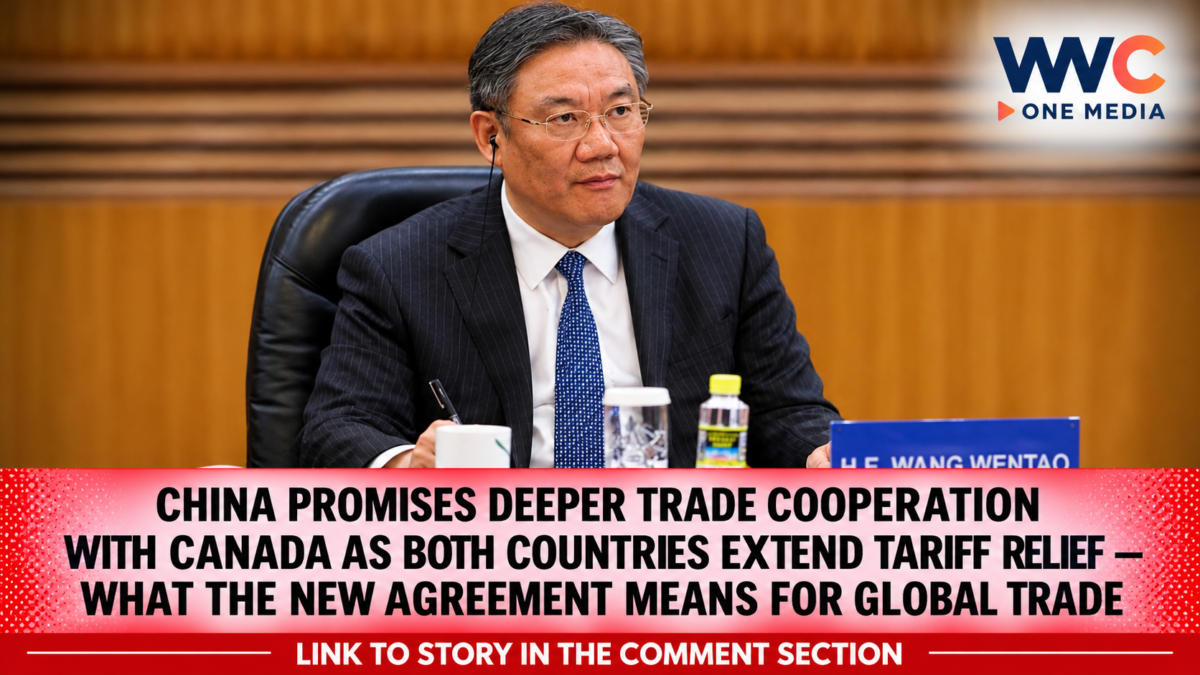
Chinese Commerce Minister Wang Wentao made the commitment during a meeting with Canadian International Trade Minister Maninder Sidhu in Beijing on November 3. China’s Ministry of Commerce described their discussions as candid and in-depth, covering bilateral economic relations, traditional industries, emerging sectors and outstanding trade concerns.
Wang said China was prepared to work with Canada to “shorten the list of problems and lengthen the list of cooperation”, according to the ministry’s November 4 statement.
The diplomatic message was accompanied by a significant development: Canada and China agreed to extend favourable market-access arrangements for Canadian canola meal, peas, lobsters and crab until the end of 2028.
The agreement offers Canadian exporters greater certainty and suggests that the two governments are trying to move beyond their recent trade disputes.
But the relationship is not fully repaired. Both countries still need to manage differences over industrial policy, market access and the treatment of imported products.
China and Canada Seek to Put Trade Disputes Behind Them
The November meeting took place as Canada pursues a broader effort to diversify its international trade partnerships.
For years, the relationship between Beijing and Ottawa has experienced significant tension, particularly over tariffs, agricultural products and electric vehicles.
Canada previously imposed a 100 per cent additional tariff on Chinese-made electric vehicles, alongside additional duties on Chinese steel and aluminium.
China responded with trade measures affecting Canadian agricultural and seafood exports, including canola products, peas, lobster and crab.
These disputes created uncertainty for businesses on both sides and raised concerns about the future of bilateral economic cooperation.
However, the situation began changing in January 2026, when Canadian Prime Minister Mark Carney visited China and met President Xi Jinping.
The visit produced an initial trade arrangement intended to address several of the outstanding economic disagreements.
The latest discussions between Wang and Sidhu build on that earlier agreement.
Rather than allowing the disputes to continue escalating, both governments appear to be using formal negotiations to restore commercial access and identify areas where their economies can cooperate.
New Agreement Extends Canadian Agricultural and Seafood Market Access Until 2028
One of the most important outcomes of the latest discussions is the extension of favourable market-access arrangements for selected Canadian exports.
Canada’s Global Affairs department announced on November 4 that the two countries had agreed to extend the relevant measures until December 31, 2028.
The products covered include:
- Canadian canola meal
- Canadian peas
- Canadian lobster
- Canadian crab
The measures were initially introduced under the preliminary joint arrangement announced during Carney’s January visit to Beijing.
The extension gives Canadian farmers, seafood harvesters, processors and exporters more predictable access to the Chinese market.
For businesses that depend on international buyers, predictable tariff treatment can be just as important as securing new customers.
Without certainty about future duties, companies may hesitate to sign long-term supply contracts, expand production or make additional investments.
The extension therefore provides an important degree of stability for Canadian agricultural and seafood industries.
Canada also agreed to extend certain remission measures covering Chinese steel and aluminium products that are not manufactured domestically.
This reciprocal component demonstrates that the arrangement involves trade concessions affecting both economies rather than a one-sided commitment.
Canola Remains One of the Biggest Issues in China-Canada Trade
Canola has been among the most politically and commercially sensitive products in the relationship.
Canada is a major global producer and exporter of canola, which is used in food products, animal feed and industrial applications.
China is an important destination for Canadian agricultural exports, making access to its market especially valuable for Canadian producers.
Under the January 2026 preliminary arrangement, China agreed to reduce the combined tariff on Canadian canola seed to approximately 14.9 per cent from nearly 85 per cent.
The arrangement also suspended certain additional measures affecting Canadian canola meal, peas and seafood products.
The latest extension is important because the favourable treatment for several of these products had originally been scheduled to expire at the end of 2026.
By extending the measures through 2028, both countries have created a longer period for businesses to plan shipments and commercial relationships.
However, the extension should not be interpreted as the permanent resolution of every agricultural trade dispute.
The two governments will still need to implement the arrangement and manage any future disagreements through their established consultation mechanisms.
Canada Also Opens the Door to Chinese Electric Vehicles
The January agreement was not limited to Canadian agricultural exports.
It also included a significant adjustment to Canada’s treatment of Chinese-made electric vehicles.
Under the arrangement, Canada agreed to allow an annual quota of 49,000 Chinese electric vehicles to enter the country under the 6.1 per cent most-favoured-nation tariff rate.
This replaced the additional 100 per cent tariff that Canada had imposed in 2024.
The quota is expected to increase gradually under the arrangement.
For Chinese automakers, the adjustment offers an opportunity to compete in a market that had previously become difficult to access because of the additional duties.
For Canadian consumers, greater access to Chinese vehicles could potentially increase competition and expand the range of available electric vehicles.
However, the arrangement has also generated political debate in Canada.
Critics have raised concerns about the impact of Chinese vehicle imports on domestic manufacturers and the country’s automotive workforce.
Supporters of a more open approach argue that competition can benefit consumers and accelerate the adoption of electric vehicles.
The issue illustrates the difficult balance Canada must maintain: strengthening trade with China while protecting domestic industries and maintaining its broader economic relationships.
Canada Wants to Increase Exports to China by 50 Per Cent by 2030
The improving trade relationship is part of Canada’s broader economic diversification strategy.
During his visit to China from November 3 to 6, Sidhu is working to advance Canadian trade and investment priorities.
The visit includes the first ministerial-level meeting of the China-Canada Joint Economic and Trade Commission, a formal mechanism designed to address trade concerns and develop economic cooperation.
Canada’s government has identified China as its second-largest single-country merchandise trading partner.
According to Global Affairs Canada, two-way merchandise trade reached approximately C$125.7 billion in 2025.
Canadian merchandise exports to China accounted for approximately C$35 billion, while imports from China reached around C$90.6 billion.
Canada also reported that its merchandise exports to China increased by 31.4 per cent during the first half of 2026, reaching approximately C$21.5 billion.
Sidhu said the government wants to build on the January arrangement and increase Canadian exports to China by 50 per cent by 2030.
The target reflects Ottawa’s intention to expand its commercial relationships beyond its traditional dependence on the United States.
For Canadian exporters, China represents a substantial market for agricultural products, seafood, energy and other goods.
But achieving the target will require more than diplomatic announcements. Businesses will need reliable market access, competitive products and predictable trade regulations.
China Wants Cooperation Beyond Agriculture and Seafood
Wang’s comments suggest that Beijing is also interested in expanding cooperation into industries that could shape the next phase of the relationship.
According to China’s Commerce Ministry, he identified several traditional sectors where the two countries could strengthen existing cooperation.
These include:
- Energy
- Agricultural products
- Aquatic and seafood products
- Consumer goods
He also called for greater cooperation in emerging industries, including:
- Advanced manufacturing
- Clean energy
- Smart agriculture
The proposed areas reflect the different economic strengths of the two countries.
Canada has substantial natural resources, agricultural production capabilities and expertise in energy and clean technology.
China has extensive manufacturing capacity, industrial supply chains and a large market for technology-related products.
Cooperation in these areas could create opportunities for businesses seeking investment, suppliers and new customers.
However, some sectors could also become sources of competition, particularly where governments have concerns about subsidies, national security or the impact of foreign imports on domestic industries.
The challenge will be finding arrangements that provide commercial benefits without creating new political disputes.
The Joint Economic and Trade Commission Takes on a Bigger Role
Another important aspect of the latest discussions is the strengthening of the China-Canada Joint Economic and Trade Commission.
The mechanism has historically provided a formal channel for the two governments to discuss economic and trade issues.
Under the January 2026 economic cooperation roadmap, both countries agreed to elevate the commission from a vice-ministerial-level mechanism to a ministerial-level platform.
The November meeting marked the first time it was held at that higher level.
This matters because trade disputes can become difficult to resolve when businesses and governments lack consistent channels for communication.
A ministerial-level mechanism gives senior officials a more direct platform to address problems, discuss market access and monitor the implementation of agreements.
It also creates an avenue for managing disagreements before they escalate into broader economic retaliation.
The commission is expected to remain an important part of the relationship as both countries work through outstanding trade concerns.
Canada Is Trying to Reduce Its Dependence on the United States
The renewed engagement with China also reflects Canada’s changing approach to international trade.
The United States remains Canada’s largest trading partner, but uncertainty surrounding American trade policy has encouraged Ottawa to explore additional markets.
Tariff disputes and political tensions have increased pressure on Canadian businesses that depend heavily on access to the American economy.
Carney’s government has therefore made economic diversification a central priority.
China offers a large consumer market and opportunities for Canadian agricultural, energy and industrial exporters.
However, expanding trade with Beijing does not mean Canada is abandoning its relationship with Washington.
Canada still has deeply integrated supply chains with the United States, particularly in manufacturing, automotive production and energy.
The government must therefore balance its efforts to diversify exports with the economic importance of its longstanding North American partnership.
The China agreement represents one part of that strategy, rather than a complete shift in Canada’s international alignment.
China Is Also Expanding Its Trade Partnerships Elsewhere
China’s renewed engagement with Canada comes as Beijing continues developing commercial relationships with other countries.
Its upgraded trade relationship with Switzerland is one example.
WWC ONE MEDIA previously examined the agreement in China-Switzerland Trade Deal Opens Chinese Market to 99.8% of Swiss Exports, which explored how Beijing is offering expanded market access to Swiss exporters while seeking stronger international economic partnerships.
Read more: https://wwconemedia.com/china-switzerland-trade-deal-opens-chinese-market-to-99-8-of-swiss-exports/
China is also managing trade tensions with other major economies.
Its tariff decisions involving American agricultural products have demonstrated how trade concessions can be used to address wider economic disputes.
WWC ONE MEDIA covered the issue in China Cuts Tariffs on U.S. Farm Goods — But Soybeans Are Left Out, examining why some agricultural products received more favourable treatment while soybeans remained excluded.
Read more: https://wwconemedia.com/china-cuts-tariffs-on-u-s-farm-goods-but-soybeans-are-left-out/
These developments show that Beijing’s trade strategy involves more than one bilateral relationship. It is also responding to shifting international demand, tariff disputes and efforts by governments to protect domestic industries.
The Global Trade Environment Remains Uncertain
The renewed China-Canada cooperation is taking place during a period of significant disruption to international commerce.
Governments are increasingly using tariffs, industrial subsidies and trade restrictions to protect strategic industries and influence supply chains.
This has created uncertainty for manufacturers, exporters and investors operating across borders.
WWC ONE MEDIA previously explored the wider problem in The WTO Says the Global Trade Order Is Facing Its Biggest Disruption in 80 Years — And the Worst-Case Cost Could Be Nearly 7% of World GDP.
The relationship between Washington and Beijing remains another important factor.
WWC ONE MEDIA also examined the fragile US-China trade arrangement in US-China Trade Truce Extended — But the Bigger Deal Is Still Out of Reach.
Read more: https://wwconemedia.com/us-china-trade-truce-extended-but-the-bigger-deal-is-still-out-of-reach/
For Canada, the situation creates both opportunities and risks.
A stronger relationship with China could provide additional customers for Canadian producers and exporters.
But a sudden deterioration in relations could once again expose businesses to tariffs, regulatory uncertainty and restrictions on market access.
What Happens Next for China and Canada?
The latest agreement represents progress, but its long-term significance will depend on whether both governments follow through.
The extension of favourable treatment for canola meal, peas, lobster and crab provides a clearer timeline for Canadian exporters.
The electric vehicle quota also creates a new commercial opportunity for Chinese manufacturers seeking access to Canada.
Meanwhile, the ministerial-level Joint Economic and Trade Commission gives both governments a more direct mechanism for addressing disagreements.
Sidhu’s visit to China continues through November 6, with further meetings and commercial engagement planned in Shanghai, including Canada’s participation as the Guest Country of Honour at the China International Import Expo.
The next major test will be whether the two countries can translate their diplomatic commitments into sustained trade growth and more predictable market conditions.
A Trade Reset — But Not Yet a Permanent Peace
China’s promise to expand cooperation with Canada is an important signal that both countries want to move away from the confrontational trade environment of recent years.
The extension of favourable market access through 2028 provides a tangible benefit for Canadian farmers, seafood producers and exporters.
For China, the arrangement supports its efforts to maintain international commercial relationships while expanding cooperation in manufacturing, clean energy and agriculture.
For Canada, it offers another opportunity to diversify trade and reduce the risks associated with relying too heavily on a single major market.
But major differences remain.
Electric vehicle competition, agricultural trade measures, industrial policy and the broader geopolitical relationship could still complicate future negotiations.
The two governments have made progress in reducing some of their trade problems.
The bigger question now is whether they can maintain that progress when the next major disagreement emerges.
For businesses on both sides, the real measure of success will not be another diplomatic promise — it will be whether the new trade arrangements remain stable, predictable and profitable through 2028 and beyond.