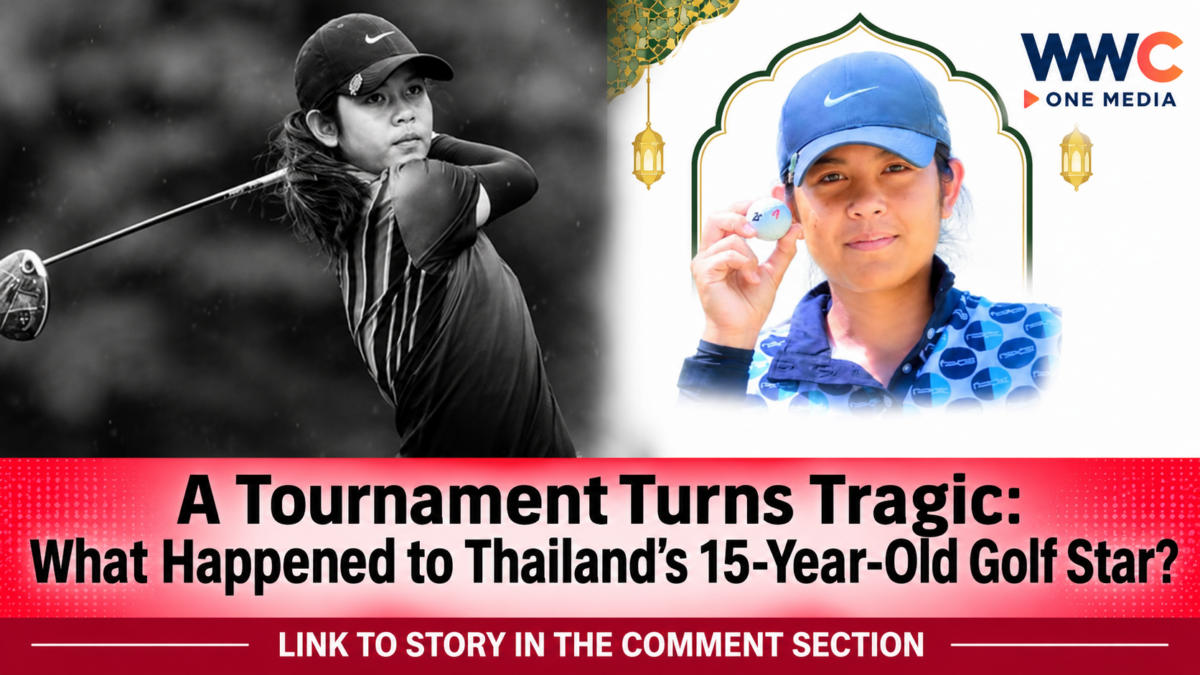
CHACHOENGSAO, THAILAND — November 5, 2026 — A promising 15-year-old Thai golfer has died after being struck by lightning during a junior golf tournament, leaving the country’s sporting community mourning her loss and raising serious questions about safety procedures during outdoor competitions.
Aeyavarin “Aeya” Pradubyart was competing in a youth golf tournament in Bang Nam Priao district, Chachoengsao province, on Sunday afternoon, November 1, when lightning struck near the 11th hole.
A 31-year-old female caddie, identified in Thai reports as Saithan, was also injured in the incident.
Aeya was reportedly found unconscious and without vital signs. Rescue workers performed cardiopulmonary resuscitation (CPR), eventually restoring her heartbeat before transporting her to Bang Nam Priao Hospital. She was later transferred to Buddhasothorn Hospital for further treatment.
Despite repeated medical efforts, the teenager died on November 2.
Her mother, Natcha Pradubyart, announced the heartbreaking news in a Facebook post, describing her daughter as exceptionally brave and recalling how she fought to survive until her father could return from neighbouring Myanmar to say goodbye.
The tragedy has since prompted the family to question why the tournament continued despite earlier signs of lightning activity and whether adequate emergency medical arrangements were available at the venue.
Aeya’s Father Rushed Home From Myanmar for One Final Goodbye
One of the most heartbreaking details of the incident emerged from the family’s account of Aeya’s final hours.
Her father had been working in Myanmar when the lightning strike occurred. As his daughter remained in critical condition, he travelled back to Thailand in the hope of seeing her.
According to her mother, Aeya’s heart had stopped for nearly an hour after the incident, but medical personnel managed to restore her heartbeat.
She reportedly underwent repeated resuscitation efforts and remained critically ill throughout the night.
Her father eventually reached the hospital and was able to say goodbye before she died on November 2.
In her emotional tribute, Natcha described her daughter as courageous and expressed the family’s pain at having to let her go.
She also used the tragedy to call on golf courses and tournament organisers to strengthen safety arrangements, saying she hoped no other family would experience a similar loss.
Family Questions Why the Golf Tournament Continued After Lightning Strikes
Beyond the devastating loss, the circumstances surrounding the tournament have raised concerns about how organisers responded to the approaching storm.
Aeya’s mother told Thai media that she noticed lightning activity near trees beside the golf course at around 3pm, approximately an hour before the fatal incident.
She alleged that lightning struck several times while the young competitors were still on the course.
According to her account, the golfers continued playing despite worsening weather conditions and the presence of thunder.
The competition was reportedly suspended only after another loud lightning strike and heavier rainfall.
Aeya’s grandmother, Aphorn Pradubyart, also questioned the decision to continue the tournament.
She said her granddaughter had already participated in two rounds and was playing near the 11th hole when the fatal strike occurred.
The family also alleged that there was no ambulance stationed at the golf course, raising concerns about the time required to transport Aeya to hospital.
These are serious allegations that require a proper investigation. They have not, however, been independently established as findings of wrongdoing by tournament officials.
The golf course and tournament organisers’ full account of the incident is important before responsibility can be determined.
A 31-Year-Old Caddie Was Also Injured
Aeya was not the only person affected by the lightning strike.
A 31-year-old female caddie accompanying the group was also injured and taken for medical treatment.
Thai media reports said she remained under close medical supervision at Bang Nam Priao Hospital following the incident.
The incident highlights how dangerous thunderstorms can become for everyone working or competing on an open golf course.
Golfers, caddies, coaches, tournament officials and spectators can all be exposed when severe weather approaches.
Unlike indoor sporting facilities, golf courses cover large outdoor areas, often with exposed fairways, trees and open spaces.
This makes having clear evacuation procedures and reliable weather monitoring especially important.
Aeya Was a Promising Junior Golfer With Tournament Victories
Aeya was not simply a young participant in a local competition. She had already established herself as a promising junior golfer in Thailand.
She was a registered member of the Thai Student Golf Union and had won several competitions.
One of her notable achievements came in March 2026, when she won the girls’ Class B category at the opening leg of the Junior Asian Tour after a playoff.
Her performances also earned her recognition as a provincial-level golfer representing Chon Buri.
Her grandmother said Aeya had been considered as a reserve player for the Chon Buri provincial golf team.
Her coach, who had worked with her for several years, also shared an emotional tribute, remembering their years of training together since she was a young child.
The coach described her as a dedicated student whose commitment and progress had made him proud.
For a young athlete who had spent years developing her game, the tragedy has left a painful void among her family, coaches and fellow golfers.
Tournament Organisers Announce Investigation and Postpone Competition
The incident has also prompted action from the tournament organisers.
Thai PBS World reported that the tournament committee issued a statement expressing condolences to Aeya’s family and those affected by the lightning strike.
Organisers said they were working with the golf course management to investigate the circumstances surrounding the incident.
As a precaution, the committee indefinitely postponed the third round, which had originally been scheduled for November 7.
The investigation is expected to be important in establishing the sequence of events, including when lightning was first detected, when play was suspended and how emergency assistance was arranged.
The findings could also help determine whether existing tournament safety procedures were followed and whether additional safeguards are needed for future competitions.
Why Lightning Safety Rules Matter in Golf
Aeya’s death has brought renewed attention to the dangers of thunderstorms during outdoor sports.
Golf courses are particularly exposed because players and caddies may be spread across several holes when weather conditions deteriorate.
The United States Golf Association (USGA) has established procedures for suspending play when dangerous conditions arise.
Its competition guidance distinguishes between ordinary suspensions and immediate suspensions for imminent danger, such as lightning. An immediate suspension is signalled so players can stop and seek safety without delay.
The R&A’s Rules of Golf also recognise that players may stop play when they reasonably believe lightning presents a danger. When a committee orders an immediate suspension, players are expected to stop playing and take shelter.
The US National Weather Service recommends that organisers of outdoor sporting events establish a lightning safety plan before competition begins.
Such plans should identify:
- Who is responsible for monitoring weather conditions.
- When officials must suspend competition.
- Where players, caddies and spectators should seek shelter.
- How players will be notified of an immediate suspension.
- When it is safe to resume play.
- What emergency procedures should be followed if someone is struck.
The National Weather Service recommends waiting at least 30 minutes after the last thunder before resuming outdoor activities.
The US Centers for Disease Control and Prevention also advises people to seek a substantial enclosed shelter whenever they hear thunder or see lightning.
These guidelines provide important safety context, although they do not establish which specific procedures applied to the Thai tournament.
Lightning Strikes Can Be Fatal Even When Someone Survives the Initial Impact
Lightning injuries can cause cardiac arrest, burns, neurological damage and other serious complications.
A person struck by lightning may initially have no detectable heartbeat or breathing, making immediate emergency response critical.
The CDC advises calling emergency services, assessing the victim and providing CPR or using an automated external defibrillator (AED) when appropriate.
Importantly, a person struck by lightning does not carry an electrical charge and can be safely touched by rescuers.
The response to a lightning emergency must also protect rescuers and others from the possibility of another strike.
Aeya’s case demonstrates how quickly a seemingly ordinary sporting event can become a life-threatening emergency when severe weather develops.
A Tragedy That Could Change How Youth Sports Handle Severe Weather
The death of a 15-year-old athlete has consequences beyond one tournament.
Youth competitions require particular attention to safety because children and teenagers may depend on adults and event officials to make decisions about dangerous conditions.
Parents, coaches and organisers all have roles in protecting young athletes, but clear authority to stop play and reliable emergency arrangements are essential.
The questions raised by Aeya’s family are therefore important: How early was the lightning risk recognised? Were players given clear instructions? Was safe shelter available? And was emergency medical assistance sufficiently prepared?
Those questions should be answered through a transparent investigation rather than speculation.
WWC One Media has also been following developments in international golf, including its coverage of the major professional golf tournaments taking place across Mexico, Japan and Abu Dhabi.
While professional and junior golf operate under different conditions, both depend on organisers providing safe environments for athletes and everyone working around the course.
The wider sporting community can also follow regional developments through WWC One Media’s Asia-Pacific sports news coverage.
The Bottom Line: Aeya’s Final Fight Has Left a Difficult Question for Golf Organisers
Aeyavarin “Aeya” Pradubyart had already achieved what many young athletes spend years working towards. She had won competitions, represented her province and earned recognition as one of Thailand’s promising junior golfers.
Her death after a lightning strike during a tournament has now turned a sporting tragedy into a wider discussion about weather monitoring, emergency response and the responsibility of organisers to protect competitors.
Her family is seeking answers about why play allegedly continued despite earlier lightning activity and whether the golf course had adequate emergency medical arrangements.
The tournament committee has announced an investigation and postponed the next round, but the findings will be crucial in establishing exactly what happened.
Aeya’s achievements should be remembered alongside the urgent safety questions raised by her death.
If lightning had already been detected near the course, were the warning signs acted on quickly enough — and what must change to prevent another young athlete from suffering the same fate?