
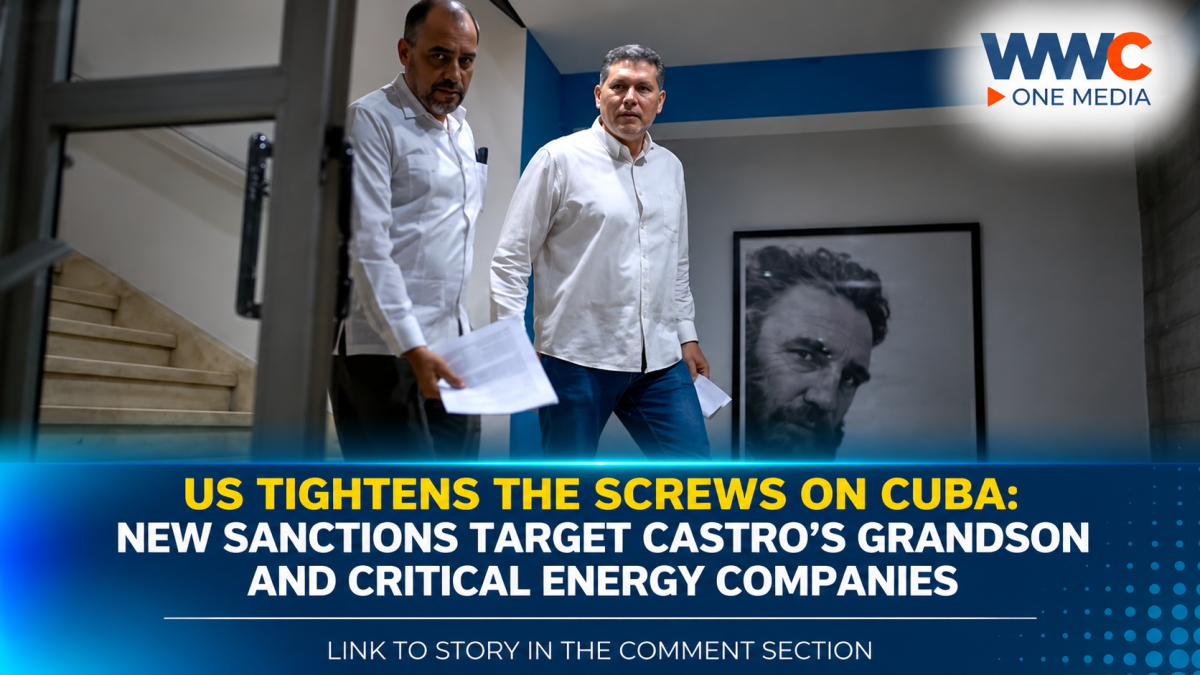
WASHINGTON/HAVANA — The United States has imposed another round of sanctions on Cuba, targeting a member of the Castro family, a state-owned Cuban bank and four companies linked to the island’s energy and mining sectors as Havana struggles with blackouts, fuel shortages and a deepening economic crisis.
The latest measures, announced by the U.S. Treasury Department’s Office of Foreign Assets Control (OFAC) on September 3, 2026, represent another escalation in Washington’s pressure campaign against Cuba’s Communist government.
Among those newly sanctioned is Fidel Ernesto Castro, the 31-year-old grandson of former Cuban president Raúl Castro and son of the late Cuban revolutionary official Alejandro Castro Espín. OFAC also added Banco Exterior de Cuba, along with four state-owned companies involved in petroleum supplies, fuel distribution and nickel-related operations.
The move comes as Cuba faces what may be its most serious economic and energy crisis in years.
Who was targeted?
According to OFAC, the September 3 designations include:
- Fidel Ernesto Castro Calis
- Banco Exterior de Cuba
- Comercial CUPET S.A.
- Empresa de Servicios Comandante René Ramos Latour (Nicarotec)
- Empresa Importadora de Abastecimiento para el Petróleo (Abapet)
- Empresa Importadora y Abastecedora del Níquel (Cexni)
OFAC said the individuals and companies were designated under Executive Order 14404, issued in May 2026, which authorizes sanctions against people and entities connected to specified sectors of Cuba’s economy, as well as alleged repression, corruption and support for the Cuban government.
The inclusion of Abapet is particularly significant because the company imports machinery and equipment used in Cuba’s petroleum sector and power infrastructure.
Cuba’s power crisis is getting worse
The sanctions arrive at a particularly difficult moment for ordinary Cubans.
Cuba has been experiencing increasingly severe electricity shortages, with prolonged blackouts affecting households and businesses. Fuel shortages have made it harder for the country’s aging power system to operate reliably.
The Associated Press reported that daily outages in some parts of Cuba have stretched beyond 24 hours, leaving residents without reliable electricity and, in some cases, water.
For Cubans already struggling with shortages of food, fuel and basic necessities, another disruption to the supply of power-grid equipment could make the situation even more difficult.
Sanctions expert Brett Erickson told AP that Washington appeared to be tightening pressure on smaller Cuban state companies, potentially making it harder and more expensive for Havana to obtain replacement parts and maintain critical infrastructure.
Washington says the pressure is aimed at Cuba’s ruling elite
U.S. Secretary of State Marco Rubio defended the sanctions, accusing senior Cuban officials and members of the Castro network of benefiting from corruption and sanctions evasion while ordinary Cubans suffer.
Rubio said the Trump administration remains committed to seeing Cuba become free.
The U.S. government has increasingly framed its Cuba policy around weakening the economic resources available to the Communist government while attempting to pressure the leadership toward political change.
But Havana strongly rejects that argument.
Cuba accuses Washington of collective punishment
Cuban officials have blamed U.S. sanctions and the long-running American embargo for worsening the island’s economic and humanitarian conditions.
Cuban Foreign Minister Bruno Rodríguez condemned the latest measures, arguing that deliberately increasing economic pressure on the country amounts to collective punishment and risks worsening conditions for ordinary citizens.
Cuban officials have also highlighted their own economic reforms, arguing that Havana is trying to attract foreign investment and modernize parts of its economy despite the pressure from Washington.
Cuba is actually opening parts of its economy
One of the most striking developments is that the sanctions came almost simultaneously with a major announcement from Havana about economic reform.
Cuba has introduced new regulations designed to make it easier for foreign investors to operate on the island, including changes affecting tourism, real estate, employment and financial transactions.
Reuters reported that the new package represents the most extensive transformation of Cuba’s socialist economy since the 1959 revolution, building on a broader package of reforms announced earlier this year.
Among the changes are measures allowing private travel agencies and freelance tour guides, simplifying certain procedures for foreign investors and easing some restrictions on foreign bank accounts and business operations.
That creates a remarkable contradiction:
Havana is trying to open its economy while Washington is simultaneously tightening the financial screws.
Tourism is already taking a major hit
The economic pressure is also showing up in Cuba’s tourism industry.
According to AP, Cuba received only about 419,000 international visitors from January through July 2026, representing a 62% decline from the same period in 2025.
The sector has been hit by fuel shortages, airline disruptions and broader financial difficulties.
Several international hotel operators have reduced or suspended operations, while some airlines have stopped flights because of the island’s fuel shortages, according to AP.
The collapse in tourism is particularly damaging because tourism has traditionally been one of Cuba’s most important sources of foreign currency.
The US pressure campaign is not new
The September 3 sanctions are part of a much broader escalation under President Donald Trump.
OFAC’s Cuba sanctions program includes restrictions based on multiple U.S. laws and executive orders. In January 2026, the administration declared a national emergency related to Cuba, followed by additional measures targeting people and sectors Washington considers connected to the Cuban government.
In August, Trump also extended for another year the U.S. authorities underpinning major elements of the Cuba sanctions regime, continuing them through September 14, 2027.
The September 3 action therefore represents another step in an expanding campaign rather than an isolated sanctions announcement.
What happens next?
The central question is whether increased economic pressure will force meaningful political or economic concessions from Havana — or instead deepen the hardship already being experienced by ordinary Cubans.
Washington appears determined to keep tightening restrictions.
Cuba, meanwhile, is attempting to attract foreign capital and introduce market-oriented reforms while maintaining its existing political system.
And for millions of Cubans facing electricity shortages and rising economic pressure, the consequences are immediate.
The bigger question is no longer simply whether Washington will tighten sanctions — it is how much pressure Cuba’s already-strained economy can absorb before the crisis reaches another level.
WWC ONE MEDIA J.M.D

Leave a Reply