
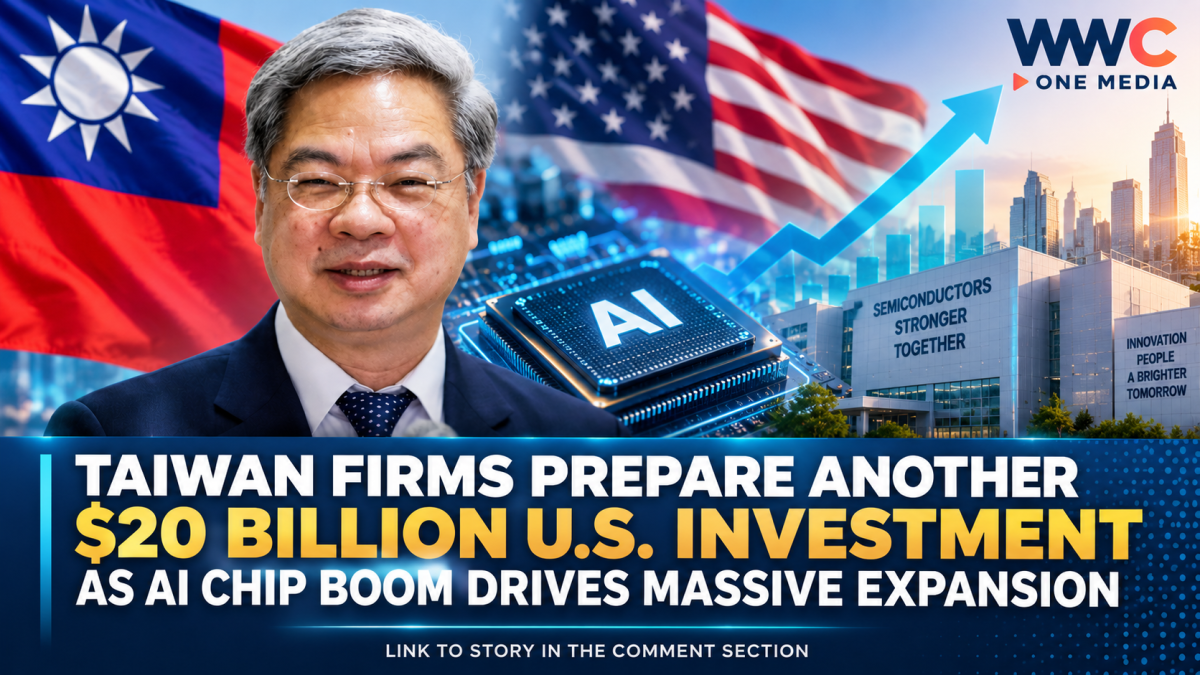
TAIPEI — Taiwanese companies are preparing an additional US$20 billion in investment in the United States, with much of the money expected to flow into semiconductor supply chains and artificial-intelligence server businesses as demand for AI computing continues to surge.
Taiwan’s Ministry of Economic Affairs said the planned investment represents the latest expansion of Taiwanese companies’ U.S. manufacturing footprint and comes on top of roughly US$35 billion in previously identified investment plans from 20 companies.
The latest figure was disclosed by Economy Minister Kung Ming-hsin as Taiwan and the United States move toward deeper cooperation in semiconductors, artificial intelligence and other strategic industries.
The announcement comes at a critical moment for the global chip industry. Semiconductor manufacturers and AI hardware companies are racing to add capacity as demand for advanced processors, servers, networking equipment and data-center infrastructure accelerates.
AI Boom Pushes Taiwan’s Chipmakers Toward the U.S.
According to Taiwan’s Ministry of Economic Affairs, the additional US$20 billion is expected to be concentrated largely in semiconductor-related supply chains and AI server manufacturing.
Kung said Taiwan remains a major production base, but the extraordinary increase in global demand means companies must expand capacity both domestically and overseas.
The timing is significant. At SEMICON Taiwan this week, industry officials highlighted the enormous growth expected in the semiconductor market. SEMI, the international semiconductor industry association, has raised its forecast for global semiconductor revenue to approximately US$1 trillion in 2026, with the market potentially reaching US$2 trillion by 2030, according to Taiwan’s economy ministry.
That growth is being fueled heavily by AI infrastructure, which requires enormous quantities of advanced chips, high-bandwidth memory, networking equipment, advanced packaging and specialized server components.
U.S. Investment Could Grow Even Larger
The US$20 billion figure announced by Taiwan’s economy ministry is also important because it intersects with comments from U.S. Commerce Secretary Howard Lutnick.
Lutnick said Wednesday that Taiwan was expected to announce another US$20 billion to US$30 billion in U.S. investment as part of broader bilateral arrangements involving semiconductors, AI and energy.
Taiwan’s government subsequently clarified that the investment Lutnick referred to is the same additional US$20 billion that its economic ministry had identified.
That distinction matters: the Taiwanese government has publicly identified an additional US$20 billion, while Lutnick referred to a potential range of US$20 billion to US$30 billion.
Reuters separately reported that Taiwan’s latest investment plans are being driven by strong AI demand and efforts by Washington to expand semiconductor manufacturing inside the United States.
TSMC Already Has a Massive U.S. Commitment
The new investment plans should not be confused with Taiwan Semiconductor Manufacturing Co.’s separate U.S. expansion.
TSMC announced an additional US$100 billion investment in Arizona in July, bringing its total planned U.S. investment to approximately US$265 billion.
The U.S. government said the expanded TSMC program is expected to include additional advanced semiconductor fabrication facilities and advanced packaging operations.
The U.S. National Institute of Standards and Technology said the expanded TSMC plan would bring the company’s planned U.S. footprint to 12 leading-edge semiconductor and packaging facilities.
Reuters likewise reported that TSMC’s Arizona commitment had risen to US$265 billion following the additional US$100 billion announcement.
This means Taiwan’s semiconductor expansion in the United States is no longer centered on a single company. The latest US$20 billion announcement points toward a broader build-out involving suppliers, AI-server manufacturers and other parts of the technology ecosystem.
Why Washington Wants More Taiwanese Production
The United States has been pushing aggressively to increase domestic semiconductor production and reduce vulnerabilities in critical technology supply chains.
Washington’s strategy includes incentives under the CHIPS Act, while U.S. officials have repeatedly emphasized the importance of bringing more semiconductor manufacturing and related supply-chain activity onto American soil.
At SEMICON Taiwan, U.S. Commerce Department semiconductor investment official Bill Frauenhofer welcomed Taiwan’s additional investment plans, describing them as evidence of continued cooperation on a secure and resilient semiconductor and electronics supply chain.
The broader U.S.-Taiwan relationship has also been strengthened by major private-sector investment.
Raymond Greene, director of the American Institute in Taiwan, said recently that cooperation between the two sides extends across the semiconductor value chain, including research, chip design, materials, equipment, manufacturing, advanced packaging, logistics and cybersecurity.
Semiconductor Tariffs Add Pressure
The investment push is unfolding as Washington prepares a new approach to semiconductor tariffs.
Lutnick has indicated that the Trump administration is considering targeted tariffs linked to where semiconductor companies manufacture their products.
That creates an additional incentive for Taiwanese companies to establish production capacity in the United States.
Taiwan’s economy minister said companies investing in the U.S. could receive duty-free import quotas equivalent to 2.5 times their U.S. production capacity under the investment framework signed between Taiwan and the United States earlier this year.
However, the precise scope and implementation of future semiconductor tariffs remain important questions for Taiwanese manufacturers.
A Controversial 40% Claim Remains Unconfirmed
Lutnick has also claimed that Taiwan would bring 40% of its semiconductor production to the United States.
That statement has generated considerable attention, but it should not be presented as an established Taiwanese government commitment.
TaiwanPlus reported that Taiwan’s government had not confirmed Lutnick’s 40% production claim at the time of its report. Taiwan’s Economy Minister Kung instead emphasized that Taiwan would remain the industry’s main production base while U.S. capacity would expand alongside growing global demand.
That distinction is crucial. Taiwan has confirmed additional U.S. investment plans, but the 40% production figure remains a claim from the U.S. commerce secretary rather than a publicly confirmed Taiwanese commitment.
Taiwan Wants Its Suppliers to Follow
The investment wave could extend well beyond Taiwan’s largest technology companies.
Taiwan’s Ministry of Economic Affairs said it is working with the Taiwan Electrical and Electronic Manufacturers’ Association to explore overseas technology parks that could help suppliers and small and medium-sized enterprises establish operations alongside larger Taiwanese companies.
The goal is to create a more complete Taiwanese technology ecosystem in the United States rather than simply relocating individual factories.
Taiwan News reported that the government’s latest assessment brought the total value of identified Taiwanese U.S. investment to approximately NT$1.75 trillion, or about US$55 billion at recent exchange rates, including previously announced commitments.
The Bigger Picture: AI Is Rewriting the Global Chip Map
The latest investment announcement illustrates how the AI boom is reshaping semiconductor geography.
For decades, Taiwan has been at the center of global advanced chip manufacturing. Its companies have built highly specialized networks covering semiconductor fabrication, packaging, testing, electronics manufacturing, servers and components.
But the explosive growth of AI is forcing that ecosystem to expand closer to major customers and markets.
The United States, meanwhile, wants more of the strategic semiconductor supply chain physically located on American soil.
The result is a potentially historic shift: Taiwan is not abandoning its semiconductor base at home, but its technology companies are increasingly building a second major production ecosystem in the United States.
With another US$20 billion in Taiwanese investment now in the pipeline — alongside TSMC’s US$265 billion commitment — the economic footprint of Taiwan’s technology industry in America could become substantially larger in the years ahead.
And as AI demand continues to climb, the race for chips, servers, advanced packaging and semiconductor capacity is likely to become one of the defining investment stories of the global economy.
WWC ONE MEDIA J.M.D




Leave a Reply