
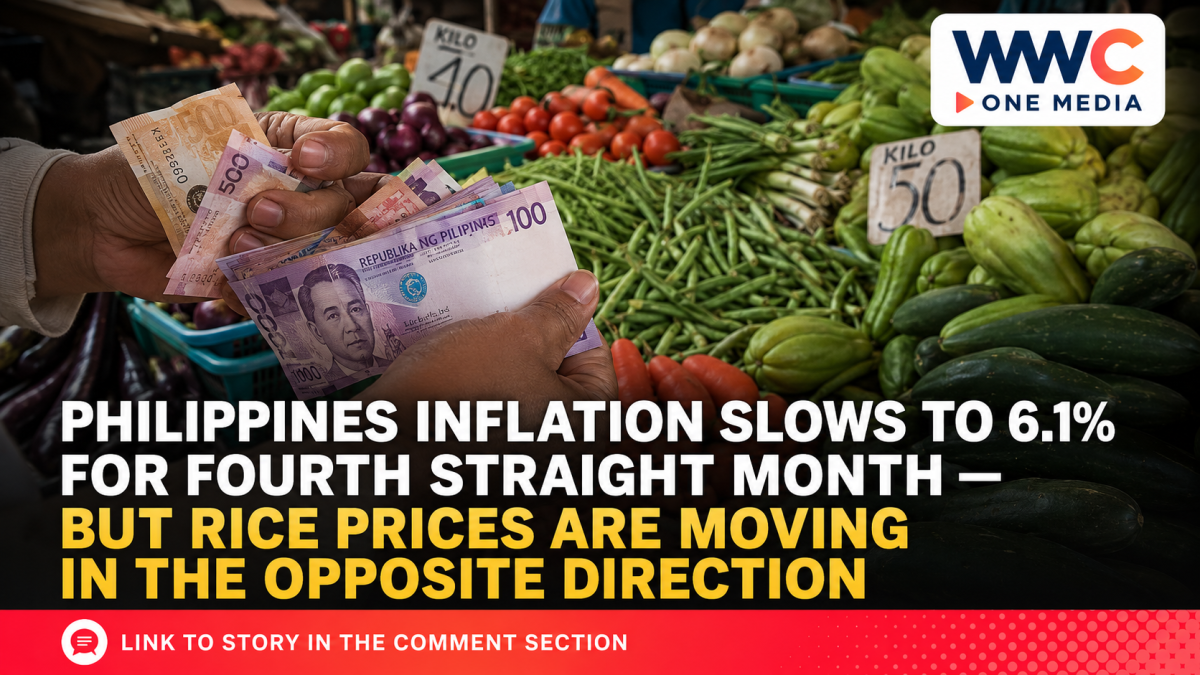
MANILA, Philippines — Philippine inflation eased for a fourth consecutive month in August, offering another sign that the surge in consumer prices earlier this year may be losing some momentum.
But behind the improving headline number, several pressure points remain: rice inflation accelerated to 19.4%, transport inflation climbed to 13.5%, and inflation experienced by the country’s bottom 30% income households remained much higher at 8.2%.
The Philippine Statistics Authority said Friday that headline inflation slowed to 6.1% in August 2026, down slightly from 6.2% in July. The reading was also the lowest in five months after inflation surged to 7.2% in April.
The improvement, however, was marginal—just 0.1 percentage point from the previous month.
And inflation remains far above where it was one year earlier.
In August 2025, inflation stood at just 1.5%. The average inflation rate for January through August 2026 has now reached 5.2%, exceeding the Bangko Sentral ng Pilipinas’ 2% to 4% target range.
Inflation has fallen for four straight months
The direction is clearly improving from the peak recorded earlier this year.
PSA figures show headline inflation moving from:
7.2% in April → 6.8% in May → 6.4% in June → 6.2% in July → 6.1% in August.
National Statistician Dennis Mapa acknowledged that while the August reading remains high, the sustained slowdown over the past four months represents an improvement.
But an important distinction often gets lost in inflation headlines.
A decline in inflation from 6.2% to 6.1% does not mean prices generally fell.
It means prices, on average, continued rising compared with a year earlier—but at a slightly slower rate.
Food helped pull inflation down
The biggest reason August inflation eased was a slowdown in food and non-alcoholic beverage prices.
Inflation for that broad category dropped to 4.6% from 5.2% in July, according to the PSA.
Housing, water, electricity, gas and other fuels also eased to 7.9% from 8.2%.
Together, food and utilities were major forces pulling the national inflation rate lower.
The PSA said food and non-alcoholic beverages still accounted for 28.8% of overall inflation, equivalent to around 1.8 percentage points. Housing and utilities contributed another 26.6%, while transport accounted for 20.1%.
Vegetable prices reversed sharply
One of the biggest changes came from vegetables.
Prices for vegetables, tubers, plantains, cooking bananas and pulses recorded a 3.4% year-on-year decline in August, reversing an 8.4% increase in July.
Fish and seafood inflation also eased to 6.6% from 7.8%, while corn inflation moderated to 18.2% from 21.9%.
Those movements helped bring overall food inflation down.
But one staple moved dramatically in the other direction.
Rice inflation jumps to 19.4%
Rice inflation accelerated to 19.4% in August from 17.1% in July.
That means rice prices were nearly one-fifth higher, on average, compared with the same month a year earlier under the PSA’s CPI measurement.
Other food categories also experienced faster increases.
Inflation for fruits and nuts rose to 5.8% from 5.0%, while flour, bread, pasta and other cereal products accelerated to 4.3% from 4.0%.
The rice figure is especially important because staple grains carry substantial weight in household budgets, particularly among lower-income families.
And that leads to perhaps the most important number hidden beneath the national 6.1% headline.
Poorer households are experiencing 8.2% inflation
For households belonging to the bottom 30% income group, inflation did not fall at all.
It remained at 8.2% in August, unchanged from July.
Their average inflation rate for the first eight months of 2026 reached 6.2%.
Food and non-alcoholic beverages alone accounted for 52.5% of the inflation experienced by these households.
Housing, water, electricity, gas and fuel contributed another 18.9%, while transport accounted for 12%.
The contrast is striking:
National inflation: 6.1%
Bottom 30% households: 8.2%
It shows why the official slowdown may not yet feel like significant relief for many Filipino families.
Rice is even worse for low-income households
The numbers become even more striking when rice is isolated.
For the bottom 30% of income households, rice inflation accelerated to 22.5% in August from 19.3% in July, according to PSA data.
Food inflation for these households remained elevated as well.
The broader food and non-alcoholic beverages category registered 8.0% inflation, while housing and utilities rose at a 10.3% annual rate.
Transport inflation for the lowest-income households accelerated to 15.3% from 14.2%.
In other words, the expenses consuming the greatest share of poorer families’ budgets continue to rise substantially faster than the national headline figure.
Transport inflation accelerates to 13.5%
Transportation was another major source of pressure nationally.
Transport inflation jumped to 13.5% in August from 11.9% in July, even while the overall inflation rate fell.
The BSP said higher global crude oil prices pushed up domestic pump prices, helping drive faster transport inflation during the month.
That matters beyond motorists.
Higher transportation and fuel costs can eventually feed into the prices of agricultural products, manufactured goods and other commodities because businesses must pay more to move products around the country.
Core inflation also eases—but remains above 4%
There was another mildly encouraging indicator.
Core inflation, which excludes selected volatile food and energy items, slowed to 4.1% from 4.2% in July.
It was nevertheless substantially higher than the 2.7% core inflation rate recorded in August 2025.
Core inflation is closely watched because it can provide clues about whether price pressures are spreading more broadly through the economy rather than being driven only by temporary swings in food or fuel.
BSP already raised interest rates again
The latest inflation report comes just over a week after the Bangko Sentral ng Pilipinas tightened monetary policy again.
On August 27, the Monetary Board raised its target reverse repurchase rate by 25 basis points to 5%—the third consecutive policy meeting in which rates were increased.
The overnight deposit and lending rates were also raised to 4.5% and 5.5%, respectively.
The central bank cited persistent inflation risks, including volatile oil prices, possible agricultural disruptions from severe El Niño conditions, and potential wage adjustments.
Higher interest rates are intended partly to restrain demand and prevent inflation expectations from becoming entrenched, although they can also raise borrowing costs for households and businesses.
BSP sees inflation averaging 6.1% this year
Interestingly, August’s monthly inflation reading of 6.1% is identical to the BSP’s latest forecast for average inflation for the entire year.
The central bank recently lowered its 2026 average inflation forecast to 6.1% from 6.4%, partly because inflation in June and July came in lower than previously expected and oil prices had moderated from earlier levels.
That is an improvement in the outlook.
But 6.1% would still leave full-year inflation considerably above the BSP’s 2% to 4% target band.
The central bank also expects inflation to remain above the target ceiling in 2027 before gradually moving closer to its longer-term objective.
Metro Manila versus the rest of the Philippines
Inflation also differed sharply by location.
In the National Capital Region, inflation slowed to 4.1% from 4.4% in July.
Outside Metro Manila, however, inflation remained considerably higher at 6.6%, although that was slightly below July’s 6.7%.
Housing and utility costs were the main reason inflation declined in Metro Manila, with that category slowing to 6.8% from 7.9%.
But transport inflation in NCR accelerated to 10% from 8.6%.
So is inflation really getting better?
Statistically, yes.
The country’s headline inflation rate has now fallen for four consecutive months, food inflation is moderating in several categories, vegetable prices have declined year-on-year, and core inflation is moving lower.
But for consumers, the picture is considerably less comfortable.
Inflation remains more than four times the 1.5% rate recorded a year earlier. Rice prices are rising sharply. Transport inflation is accelerating. And families in the bottom 30% of the income distribution are experiencing inflation of 8.2%—more than two percentage points above the national rate.
That makes August’s report a story of two realities.
The inflation curve is finally pointing downward.
But for millions of households paying for rice, transportation, electricity and other everyday necessities, the cost-of-living squeeze is far from over.
WWC ONE MEDA J.M.D




Leave a Reply