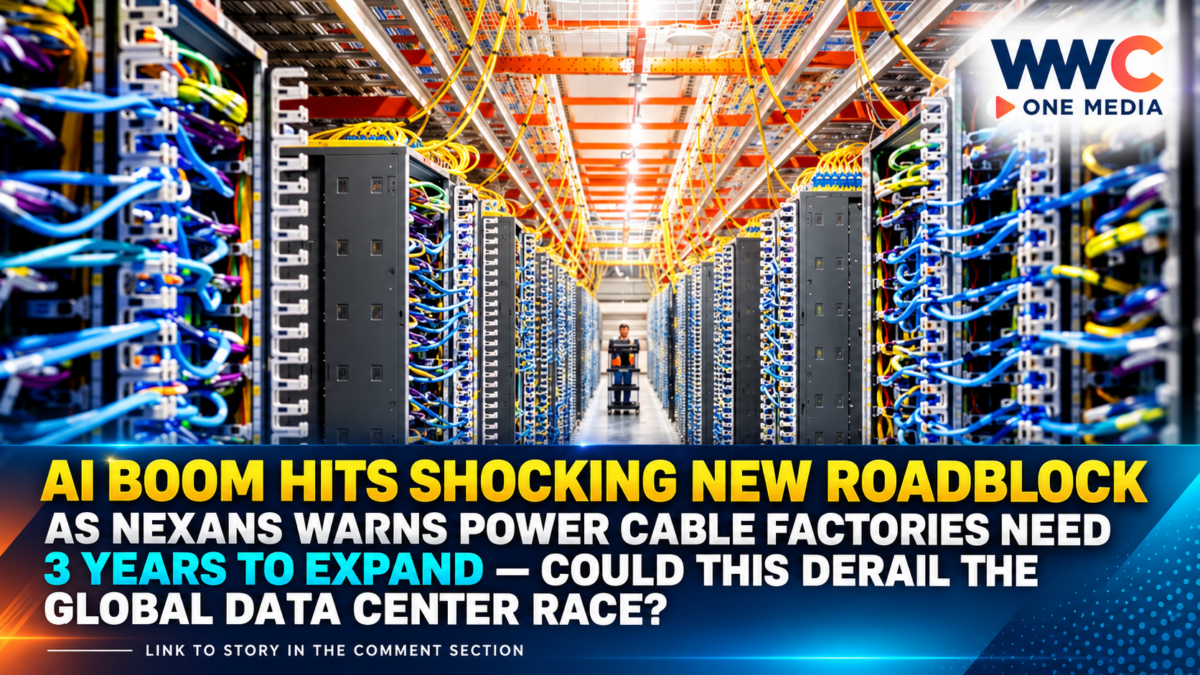
The global artificial intelligence boom is confronting an unexpected infrastructure challenge: the power cables needed to bring massive AI data centers online cannot be manufactured fast enough to keep up with surging demand.
French cable manufacturer Nexans has warned that limited production capacity is emerging as a major obstacle to the rapid construction of AI facilities, exposing a growing mismatch between technology companies’ ambitious expansion plans and the industrial infrastructure required to support them.
Speaking to Reuters on October 22, Nexans Chief Financial Officer Vincent Piquet explained that the global cable manufacturing industry is operating under tight capacity constraints. Expanding production of certain specialized power cables requires significant investment and time, making it difficult for manufacturers to respond quickly to rising orders.
Most significantly, installing a new production line for cross-linked polyethylene (XLPE) cables can take approximately three years.
That manufacturing timeline raises a critical question for the technology industry: Can companies build their next generation of AI supercomputing facilities as quickly as they promise if essential electrical infrastructure takes years to produce?
AI’s Hidden Infrastructure Problem Goes Beyond Microchips
Much of the global conversation surrounding artificial intelligence has focused on advanced semiconductors, graphics processing units, computing power and the multibillion-dollar investments being made by technology companies.
But even the most powerful AI processors cannot operate without dependable electricity.
Data centers require extensive networks of electrical cables to connect substations, transformers, switching equipment and internal power distribution systems.
Larger AI facilities generally require more medium-voltage cabling because their electrical demands are substantially greater than those of smaller facilities.
Nexans says demand for low- and medium-voltage cables is increasing faster than manufacturers can expand capacity.
The bottleneck is especially difficult because cable factories cannot immediately increase output simply by adding more workers or extending operating hours. Specialized manufacturing equipment must be ordered, installed and commissioned before major additional capacity becomes available.
This is turning power distribution infrastructure into another potential limiting factor in the global AI race.
Oracle Project Highlights Growing Pressure on Electricity Supply
The risks are already visible in major data center development projects.
According to Reuters, Oracle issued a force majeure notice in September 2026 to a unit of investment firm Blue Owl involved in developing a large data center in New Mexico.
The notice cited potential difficulties securing adequate electrical power for the facility.
The development illustrates how access to electricity can complicate even heavily financed technology infrastructure projects.
Importantly, the Oracle case concerns power availability; Reuters did not establish that a shortage of Nexans cables specifically caused the problem.
Nevertheless, the incident underscores the broader vulnerability of AI expansion plans to electricity infrastructure constraints.
For developers, delays in securing reliable power can affect construction schedules, equipment deployment and the timing of future computing capacity.
France’s Enedis Moves Toward Contracts Lasting Up to Seven Years
As concerns about the availability of essential electrical components intensify, major infrastructure operators are changing how they secure supplies.
French electricity distribution network operator Enedis has shifted from annual cable procurement arrangements toward contracts lasting six or seven years, according to Nexans’ finance chief.
The longer agreements are intended to provide greater certainty over future deliveries.
For manufacturers, such contracts can improve production planning and visibility into demand.
For customers, they can reduce the risk of being left without essential electrical components when global orders increase.
However, long-term procurement arrangements may also make access to manufacturing capacity more competitive, particularly for developers entering the market without established supplier relationships.
The trend suggests that securing electrical infrastructure could become as strategically important as obtaining land, financing and advanced AI chips.
Reuters Reports Wider Equipment Shortages Across the United States
The cable supply warning follows broader concerns about electrical equipment shortages.
In a separate July 9, 2026 report, Reuters documented how rising demand from AI data centers was adding pressure to supplies of critical grid components, including transformers.
Some high-voltage transformers, which previously required approximately a year for delivery, now face lead times extending into multiple years.
Utilities and data center developers have consequently been placing orders earlier in an effort to secure equipment and avoid missing construction deadlines.
Industry analysts have identified equipment availability as a major concern because developers are racing to bring new computing capacity online before competitors.
This means the AI infrastructure challenge extends beyond cable manufacturing to the broader electrical supply chain.
Europe and the United States Face Different Obstacles
Although both regions are experiencing increased demand for AI infrastructure, their challenges are not identical.
Piquet said some European countries, particularly in northern Europe, benefit from comparatively strong electrical networks and face fewer grid connection difficulties than the United States.
However, European projects can encounter lengthy permitting and regulatory procedures that delay development.
The United States, meanwhile, continues to attract substantial private-sector investment in AI infrastructure, creating intense competition for electricity, grid connections and specialized components.
Piquet expects European data center expansion to be less pronounced than in the US, partly because of differences in the scale and availability of private investment.
These regional differences could influence where future AI facilities are built and how rapidly projects proceed from announcement to operation.
CNA
+1
Nexans Warns That Grid Connections Are Only Part of the Problem
In an October 8 industry analysis, Nexans emphasized that obtaining approval to connect a data center to the electricity grid does not guarantee that the facility can immediately receive power.
The company explained that projects must still obtain, install and commission transformers, switchgear, protection systems and cabling.
Even if lengthy grid connection queues were reduced, manufacturers would still need to supply the physical equipment necessary to energize facilities.
Nexans’ analysis also highlighted potential pressures from copper markets and trade restrictions, although it identified transformers and switchgear as more significant sources of prolonged delays than cables in many projects.
The distinction is important: the emerging cable capacity challenge adds to existing bottlenecks rather than replacing them.
Could Cable Manufacturers Become Unexpected Winners of the AI Revolution?
Despite the difficulties facing data center developers, the surge in electrical infrastructure demand presents commercial opportunities for manufacturers.
Nexans could benefit from stronger order demand, longer procurement contracts and increased flexibility in allocating its limited production capacity.
Piquet indicated that the company could be more selective about how it distributes available manufacturing output.
However, higher demand does not automatically guarantee increased profits. Actual financial benefits depend on production costs, contract terms, capital spending and the company’s ability to fulfill orders.
Meanwhile, developers risk facing construction delays if electricity infrastructure cannot be delivered according to schedule.
The situation highlights an increasingly important reality: artificial intelligence investment is creating opportunities not only for semiconductor manufacturers and cloud providers, but also for companies supplying the physical infrastructure that makes high-performance computing possible.
What Happens Next?
Nexans does not expect AI-related demand to weaken significantly in the near term.
But the industry’s ability to translate growing investment into functioning data centers will increasingly depend on factors beyond software breakthroughs and semiconductor availability.
Electrical equipment production, factory expansion, grid construction, procurement strategies and regulatory approvals will all play an important role.
For investors, technology companies and governments, the emerging lesson is that building the infrastructure for the AI revolution may prove considerably harder than financing it.
The biggest obstacle to the next wave of artificial intelligence might not be the availability of advanced processors.
It could be the industrial supply chain responsible for delivering the electricity those processors need.