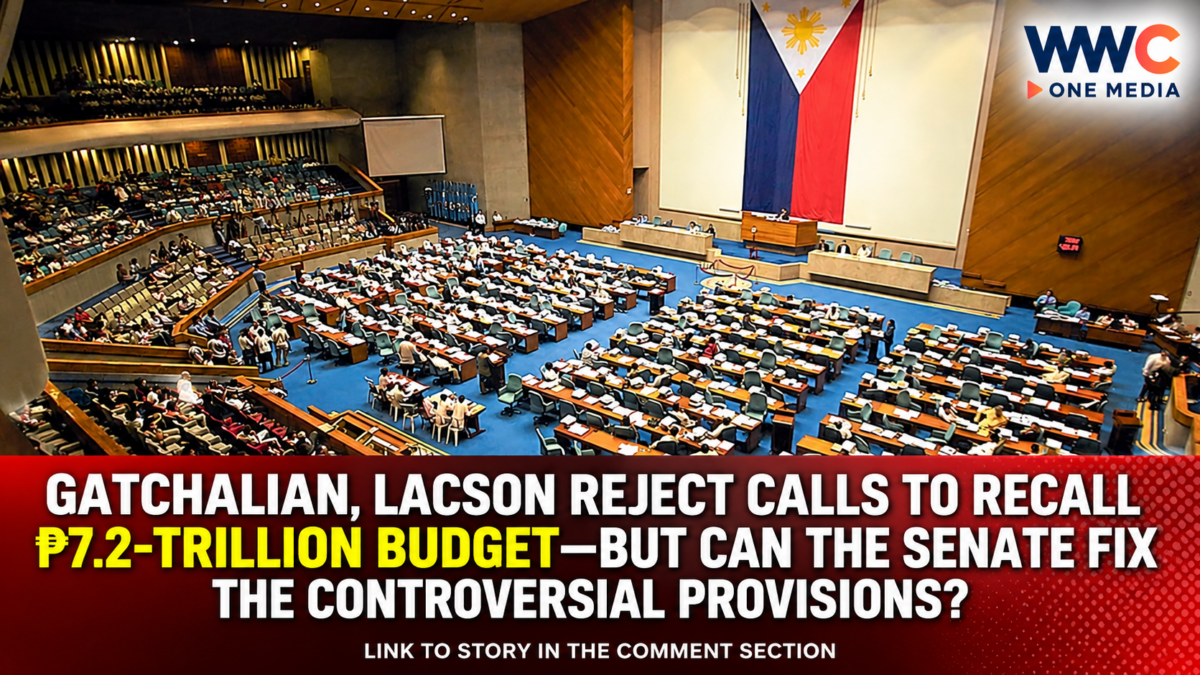
MANILA, Philippines — Calls to recall the House of Representatives’ version of the proposed ₱7.2-trillion national budget for 2027 are facing resistance from Senate leaders, as lawmakers prepare to scrutinize disputed spending adjustments and ensure the proposed spending plan complies with the Constitution.
Senate President Sherwin Gatchalian and Sen. Panfilo “Ping” Lacson have opposed the need to recall the House-approved budget bill, according to the Philippine Daily Inquirer. The debate comes as Congress confronts questions about provisions governing unprogrammed appropriations following a Supreme Court ruling that struck down certain provisions in previous national budgets.
The controversy puts the spotlight on a critical question: Can lawmakers correct the disputed provisions through Senate deliberations without sending the House bill back for reconsideration?
Why some lawmakers want the House to recall the budget
The Makabayan bloc has urged the House to recall its version of the proposed 2027 General Appropriations Bill, arguing that it still contains provisions that raise constitutional and transparency concerns.
House Deputy Minority Leader Antonio Tinio cited questionable conditions for releasing public funds, unitemized lump-sum allocations and changes involving unprogrammed appropriations. He also questioned the treatment of infrastructure funding and the transparency of amendments made during the budget process.
The bloc has called for clearer disclosure of budget changes, including the projects added or removed and the lawmakers responsible for the amendments.
These objections follow a Supreme Court ruling concerning unprogrammed appropriations in the 2024 and 2025 national budgets. The ruling has prompted renewed scrutiny of how Congress authorizes standby funds and how the executive branch releases them.
Supreme Court ruling puts unprogrammed funds under scrutiny
Unprogrammed appropriations are budget allocations that generally depend on specified funding conditions before they can be released. They are not equivalent to ordinary programmed expenditures that are planned to be financed under the government’s regular revenue program.
During Senate discussions on the proposed 2027 budget, Gatchalian sought clarification from the Department of Budget and Management (DBM) about how the court’s decision would affect the release of these funds.
Budget Secretary Kim Robert C. de Leon said the administration’s proposed 2027 National Expenditure Program had already removed the Strengthening Assistance for Government Infrastructure and Social Programs (SAGIP) provision and reduced the number of items covered by unprogrammed appropriations.
However, questions remain over whether certain revenue-related conditions for releasing standby funds can continue to be used or must be revised to comply with the ruling.
The DBM has committed to working with Congress and coordinating with the Office of the Solicitor General to refine the relevant provisions and strengthen safeguards against constitutional problems.
In its October 22 statement, the department also said it was prepared to provide more detailed information on foreign-assisted projects and the basis for their proposed allocations.
Lacson warns Senate review could change billions in allocations
Lacson has separately warned that the Senate will closely examine changes made by the House to the proposed 2027 budget, particularly reductions affecting foreign-assisted projects and adjustments to infrastructure spending.
In an October 15 report, the Philippine News Agency quoted Lacson as saying the Senate could restore hundreds of billions of pesos in cuts and realignments after reviewing the House version.
The Philippine Star subsequently reported that the House version included substantial changes to several spending items. These included reported reductions in funding for foreign-assisted projects, calamity response and selected health programs, alongside an increase in medical assistance for financially disadvantaged patients.
Lacson has emphasized the need to protect the government’s commitments under foreign financing agreements. Failure to fund agreed projects could expose the country to additional costs, including commitment fees, depending on the terms of the agreements.
He has also raised concerns about infrastructure allocations, including flood control spending, amid continuing public scrutiny of alleged irregularities in government projects.
The Senate’s review could therefore lead to changes in the House-approved measure, although the final allocations will depend on the legislative deliberations and the resulting budget legislation.
Will the Senate be able to fix the disputed provisions?
The DBM has expressed confidence that the executive branch and Congress can work together to produce a constitutionally compliant budget.
Gatchalian has likewise emphasized the need to follow the Supreme Court’s ruling, while lawmakers have sought technical guidance on how to revise provisions governing unprogrammed appropriations.
The disagreement over recalling the House bill reflects two competing approaches: returning the measure for corrections before the Senate proceeds, or allowing the Senate and the subsequent bicameral conference process to address disputed provisions.
The issue is particularly important because the proposed 2027 budget is intended to fund government operations and public services throughout the coming year. Any prolonged delay could complicate the approval process, although a reenacted budget is not inevitable.
The DBM said earlier this month that it had not seen indications that the country would have to operate under a reenacted budget in 2027.
What happens next?
The Senate’s examination of the House-approved budget will be crucial in determining whether questioned allocations and fund-release provisions will be revised.
For taxpayers, the central issue extends beyond whether the House bill should be recalled. It is whether the final budget will clearly identify where public money will go, establish lawful conditions for releasing funds and provide sufficient safeguards against misuse.
As deliberations continue, lawmakers will face pressure to balance timely budget approval with constitutional compliance, transparency and accountability.
The bottom line: Rejecting calls to recall the bill does not automatically settle the controversy. The decisive test will be whether Congress can address the disputed provisions and produce a final 2027 national budget that withstands legal scrutiny and earns public confidence.