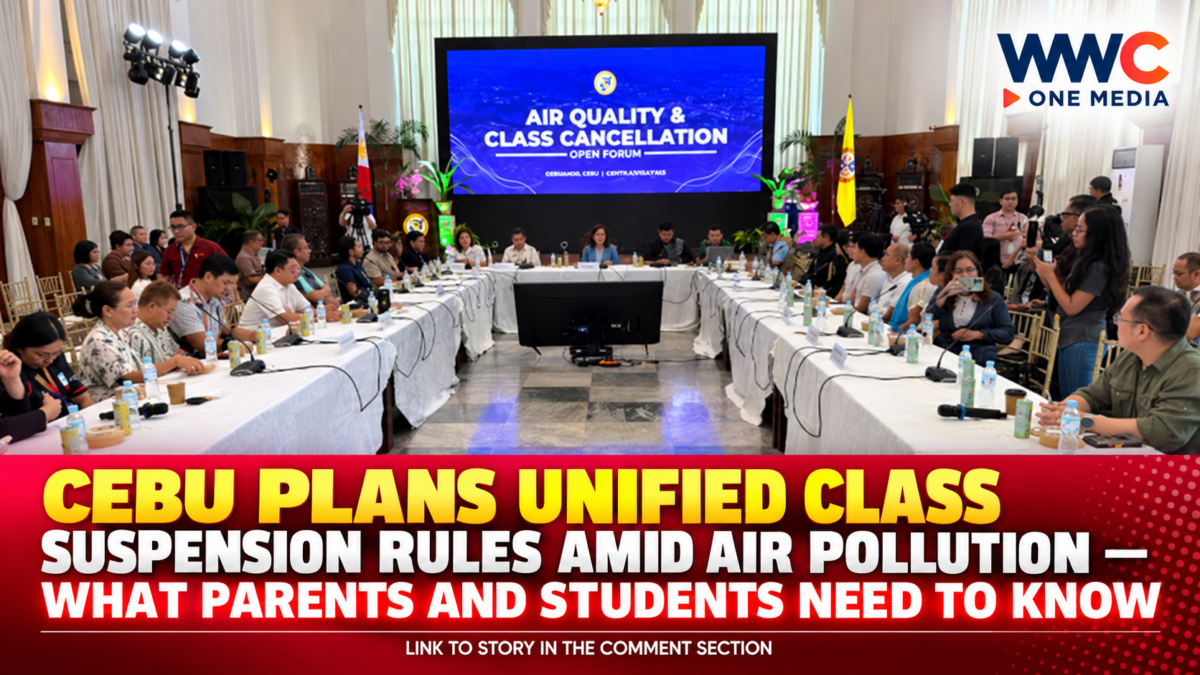
CEBU, Philippines — Cebu officials are working to establish clearer, more consistent guidelines for suspending classes when air pollution reaches unhealthy levels, following recent haze episodes that exposed differences in how schools and local governments assess air quality.
The proposed framework aims to help local officials make better-informed decisions, protect students from potentially harmful pollution and reduce confusion among parents, teachers and school administrators.
According to reports by Cebu Daily News, The Freeman and SunStar Cebu, the discussions center on a key problem: the Department of Education (DepEd) and the Department of Environment and Natural Resources–Environmental Management Bureau (DENR-EMB) use different measurements when assessing air quality and determining when protective action may be necessary.
Cebu Gov. Pamela Baricuatro has pushed for a coordinated approach involving local government units, education officials, environmental regulators, health experts and public and private schools.
Why Cebu wants one set of guidelines
One major source of confusion is the difference between the Air Quality Index (AQI) published by environmental authorities and the PM2.5 concentration used in education-related guidance.
AQI translates air pollution measurements into categories that are easier for the public to understand. PM2.5, meanwhile, measures fine particulate matter small enough to penetrate deep into the lungs.
Because the two systems express air pollution differently, school administrators and local officials need a clear way to interpret readings and determine when classes should continue, shift to alternative learning arrangements or be suspended.
The proposed guidelines are intended to establish a more consistent basis for decisions across Cebu’s cities and municipalities.
However, the final framework has not yet been confirmed as a provincewide policy. Local chief executives will continue to exercise their authority over localized class suspensions under applicable national rules.
Recent pollution readings highlight the challenge
Air quality concerns intensified in Metro Cebu in October 2026.
The DENR-EMB recorded an AQI of 107 on October 17, a level classified as unhealthy for sensitive groups. Environmental officials attributed the deterioration primarily to local emissions, including motor vehicles and industrial activities, combined with weather conditions that limited the dispersal of pollutants.
The readings subsequently improved, illustrating why officials want decisions to be based on current, reliable information rather than assumptions that air quality is the same across the region.
Monitoring data can also vary by location. Officials have raised concerns that the concentration of monitoring stations in Central Cebu leaves gaps in information about air quality in northern and southern parts of the province.
These differences matter because pollution levels can change with wind direction, nearby emission sources and local weather conditions.
Children face particular health risks
Health experts have emphasized the need to protect children, whose developing respiratory systems make them particularly vulnerable to air pollution.
PM2.5 particles can travel deep into the lungs, potentially worsening asthma and other respiratory conditions. Exposure to polluted air can also affect people with existing lung or cardiovascular problems.
During discussions on the proposed guidelines, pediatric specialists called for protective measures to be considered at lower pollution levels, rather than waiting until conditions become severely unhealthy.
Authorities are also examining how schools should handle outdoor activities when pollution levels rise, even if face-to-face classes are allowed to continue.
The goal is to make decisions that account for students’ exposure not only inside classrooms but also during their daily commute and other outdoor activities.
Could classes continue with protective measures?
Cebu City has discussed a separate approach under which schools could continue operating during certain very unhealthy AQI readings if protective measures, including face masks, are implemented.
Under the arrangement reported by The Freeman, AQI readings between 151 and 200 would allow private schools to continue classes with protective precautions, while readings above 200 would prompt schools to consider suspension, subject to the mayor’s authority to intervene.
These provisions should not be confused with a finalized, uniform rule for the entire province. The provincewide guidelines remain under development, and the final thresholds and procedures are subject to official confirmation.
Officials have also discussed providing masks for public school students to help reduce exposure when travel or other outdoor activities cannot be avoided.
Schools prepare for learning disruptions
Beyond deciding when to suspend classes, education officials are also working to prevent students from falling behind academically.
DepEd Cebu has directed public schools to prepare learning materials in advance under Project HELPS, or Helping Every Learner Progress and Succeed.
The initiative is designed to give students activity sheets and other materials they can use at home when face-to-face instruction is interrupted.
Schools are being encouraged to prepare and distribute these resources ahead of time so learning can continue during emergencies.
The effort reflects a broader challenge for education officials: protecting students’ health while minimizing repeated disruptions to their schooling.
What happens next?
Cebu officials are consolidating recommendations from government agencies, school representatives and medical experts into a common position paper. Reports indicate that the target for finalizing this document is October 26, 2026.
The proposed guidelines are expected to address pollution thresholds, protective measures, localized decision-making and the need for timely announcements to families.
The framework will also need to account for differences in air quality across communities and the limitations of existing monitoring stations.
Until the guidelines are formally adopted and announced, parents and students should continue to follow advisories from their respective local governments, schools and relevant education authorities.
Will Cebu’s proposed unified rules finally bring clarity to class suspensions during pollution episodes? The answer will depend on the final guidelines, the quality of monitoring data and how consistently local officials apply the policy.